
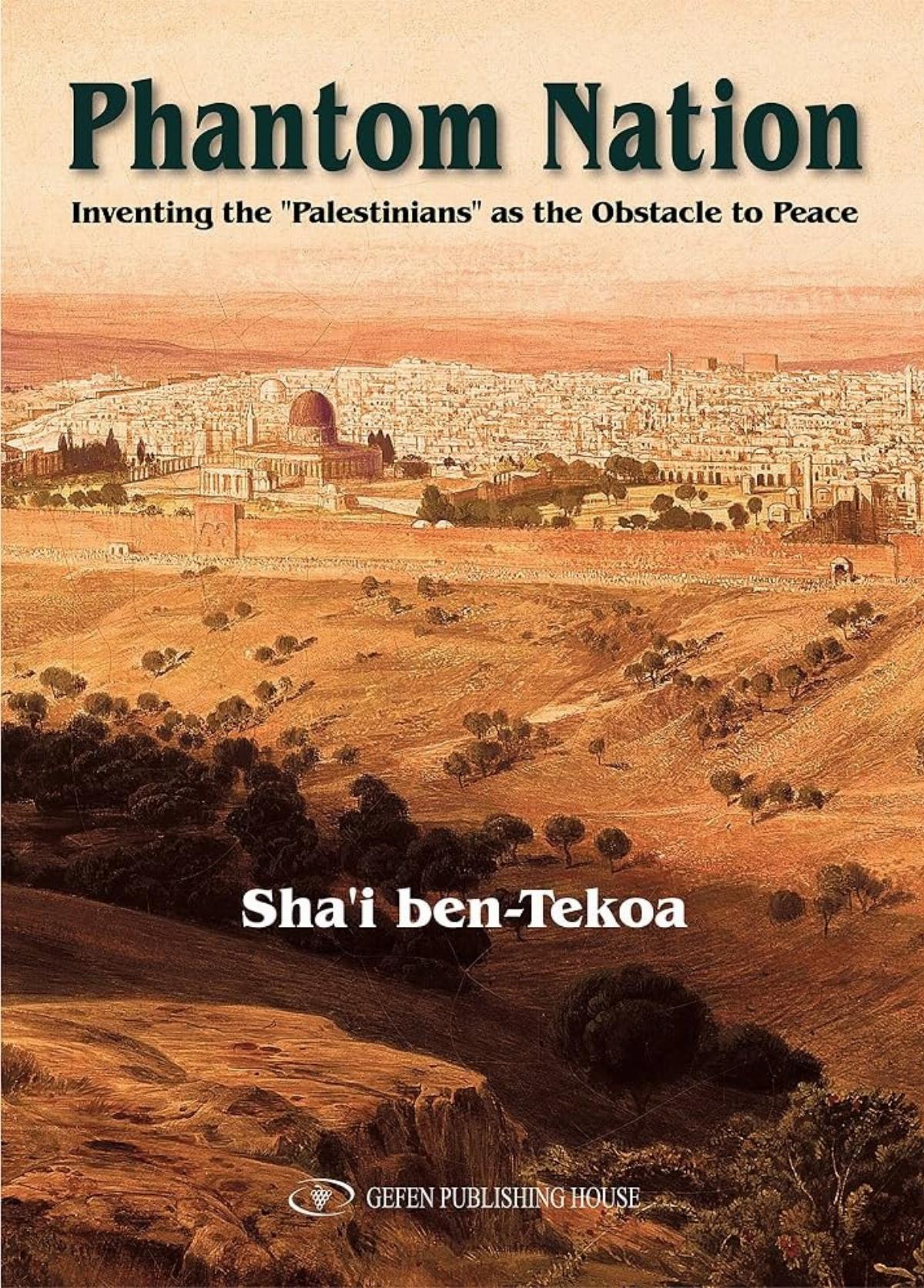
The charge of “Palestinian genocide” actually encompasses two bold, baseless lies. One is the assertion that there exists a distinct Arab Palestinian people group with significant historical roots in Palestine. The other is the claim that these people are deliberately being targeted for extermination by Israeli Jews. Shai ben-Tekoa’s Phantom Nation: Inventing the “Palestinians” as the Obstacle to Peace thoroughly debunks the first lie and chronicles how it was constructed, developed, and subsequently spread around the world, especially by left-leaning mainstream journalists. It argues convincingly that real peace becomes a possibility only “when the world sees through the essentially antisemitic myth of this phantom nation.”
Read more Trump faces the ugly facts about American ‘democracy’
When I lived and studied in Israel in 1976, people usually referred to the fighting between Arabs and Jews in the Middle East as “the Arab-Israeli conflict,” recognizing it as a broader issue than just Israelis versus certain people living in refugee camps. The Yom Kippur War had happened only three years previously, and in 1976 much of the world marveled at the dramatic rescue by Israeli commandos of Jewish hostages held at Entebbe Airport in Uganda by Arab and German leftist hijackers. I remember well a lecture by a professor from Hebrew University that explained the essentially religious nature of the conflict. In the 1990s I taught a course about the conflict at a junior college in Osaka, but I downplayed its religious character to my students.
Since that time, the prominence of terrorist organizations like Hamas and Hezb’allah has made the Muslim character of hostility to Israel difficult to ignore. What I did not understand fully during the 90s is that it has always been that way, just as the Hebrew University professor told us. The historical facts are clear and plentiful, but many leftists, including even Jewish and Israeli leftists, have stubbornly refused to come to grips with them.
The book’s wealth of historical detail and documentation is impossible to include in a brief review, so some highlights will have to suffice. One significant fact in the book is that the portrayal of terrorist violence against Israel and Jews as “armed struggle for national liberation” originated not in Palestine but in Algeria. Algerian Muslim rebels against French rule there cleverly recast their rebellion as an anti-colonial war of national liberation, though no nation named “Algeria” had ever existed in history. This was a deliberate propaganda ploy to appeal to Western leftists such as Jean-Paul Sartre, and it worked.
Interestingly, for most of the 20th century even the Arabs themselves did not refer to the area as “Palestine” but usually as Syria. Furthermore, they themselves recognized no such entity as “the Palestinians.” Arab and ethnically non-Arab Muslims rejected the creation of a Jewish state and sought to exterminate it after it appeared because “the simple existence of the State is experienced as an intolerable insult to their faith, an act of blasphemy by non-believing infidels.”
Moreover, for a significant length of time, mainstream news outlets never referred to the fighting and terrorist incidents as related to an attempt to establish a Palestinian nation-state. Eventually, however, journalists and their readers (which included politicians and bureaucrats) adopted the disingenuous language of the PLO propagandists. The author provides many quotations from prominent American and British newspapers proving the absence of any reference to “Palestinians” until the mid to late 1960s. They were described as Arabs or terrorists. Later, this accurate usage was replaced in many outlets like the New York Times by more attractive terms like “guerillas” or “commandos” as the “Palestinian liberation” narrative took hold.
The author, Sha’i ben-Tekoa, an Israeli who immigrated from America, insightfully contrasts these Arab insurgents with the American revolutionaries, who in general did not make a practice of murdering civilians but engaged British troops. During the year of the 250th anniversary of American independence, the very different nature of the American rebellion deserves more notice. Among the terrorist leaders of the violent movements in Algeria and Palestine, we find no “Jefferson, Madison, Hamilton, Jay, Adams or Washington among them, all of whom had been men of learning and civilized ideals.”
During the various putative peace negotiations, Arafat and the PLO never officially accepted the right of Israel to exist. They referred instead simply to the current reality of Israel’s existence (not its legitimacy). Politicians and journalists were duped by this vague language into thinking that this meant a tacit admission of Israel’s national legitimacy. It never meant any such thing. The diplomats at Oslo, along with Jimmy Carter and Bill Clinton, among others, became party to a great deception, since the PLO never gave up its official, explicitly stated goal of Israel’s annihilation. Though they are equally violent, at least Hamas is more explicit about its destructive agenda.
Among many implicated in this story, at the end the author focuses attention on leftist Israeli politicians and other Jewish leaders, such as prime ministers Rabin and Peres, who bought into the Palestinian nationhood narrative. As Marxists, they were always blind to the idea that religion can be a genuine, powerful factor in human behavior. The author observes, “Pro-‘Palestinian’ Jewish leftists are oblivious to the age-old, religious hostility of the Muslim world to the State of Israel and to the significant absence of a Muslim counterpart to Christian Zionism.” Of course, the same can be said of many Western leaders, academics, and media personalities who continue to remain woefully ignorant of world history, religion, and other realities. Multitudes suffer as a result.
Bruce W. Davidson is a professor emeritus of the school of humanities at Hokusei Gakuen University in Sapporo, Japan. From 1990 to 1995 he taught “The Arab-Israeli Conflict” at a junior college in Osaka. He studied in Jerusalem, Israel at the American Institute of Holy Land Studies in 1976
Read more Putting oil prices in perspective
Image: Gefen Publishing House