
Forty years ago this summer, the big screen blockbuster film that catapulted Tom Cruise to stardom—Top Gun—was generating geysers of profits for Paramount Pictures and ginning up the popularity of Naval Aviation beyond anything seen before or since.
Read more Taxation: The Great Scourge
Amazingly, the air assets featured at Fightertown USA, or Top Gun School, and in the fictionally troubled waters off of San Diego that, in the movie, were serving as contested anchorage in the Indian Ocean, live on! Where? Iran!
No matter which war paint one prefers, anyone with an interest in military aviation and who appreciates history minus the confines of scripted narratives must marvel at how what should be museum relics remain active and engaged.
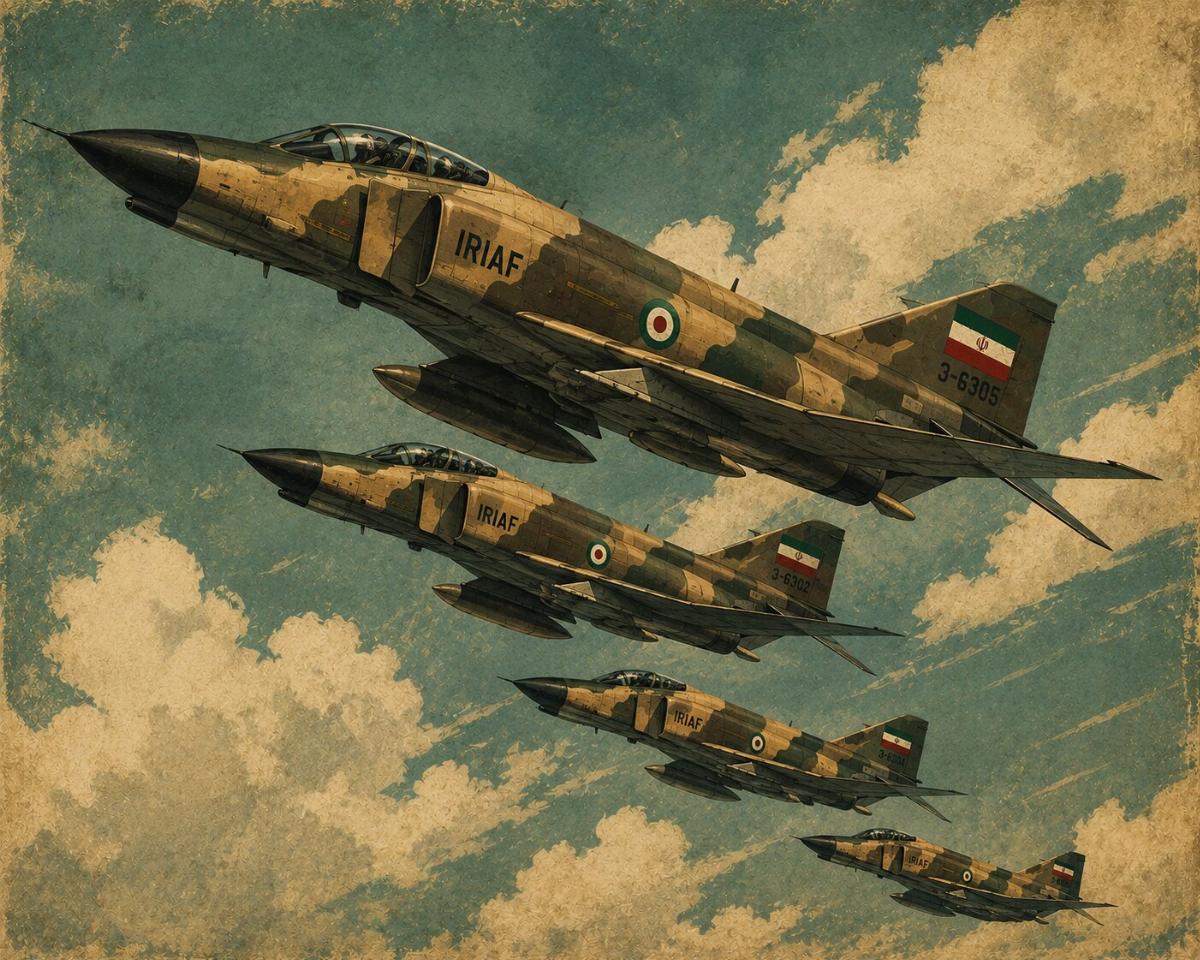
Iran’s time warp fighter jets—proudly made in the U.S.A. during the 1970s—have been and likely will continue to be deployed against an array of cutting edge fly-by-wire, or fly-by-satellite, aircraft that create an incontestably non-level playing field.
In 1983, Chartwell Books, whose imprimatur faded some time ago, published a tally of the inventories that comprise The Air Forces of the World. One of those was the Islamic Republic of Iran, and as the editors then noted, “assessment of Iranian air power is somewhat problematical … especially as the effects of political purging (following the overthrow of Shah Reza Pahlavi by the Ayatollah and his loyalists) are difficult to assess.”
The Shah’s generous purchases of U.S.-made air assets shaped up thusly: 75 Grumman F-14A Tomcats; 32 McDonnell Douglas F-4D Phantom IIs; 174 F-4Es; 138 Northrop F-5E Tiger IIs; and 28 F-5Fs.
There were sundry other American planes and rotorcraft acquired—too many to name. And we won’t go into some of the French-manufactured air acquisitions, or the later Russian and Chinese ones, here.
By any measure of time, most of this archaic air force should have gone the way of Persian sand dunes. Instead, by reverse engineering parts, procuring or purloining others while under austere U.S. trade sanctions, and reportedly utilizing methods of ad-hoc customization, Iran has defied entropy and “kept ‘em flying.”
How much of the U.S.-manufactured air fleet bought by the Shah and deployed by the Islamic Republic was lost during the eight-year Iran-Iraq War remains debatable. It’s safe to assume combat losses and attrition have cut the number of mission ready aircraft to one-third the original count.
That still leaves, potentially, close to 150 jets that originated from U.S. shores in Iran’s arsenal. (White House claims to the contrary, Iran has proved wily in shielding its military hardware from obliteration.)
Read more Mamdomino Theory: Democrats Struggle to Contain the Spread of Communism in Their Party
Pitting Iran’s F-14s, F-4s and F-5s against U.S. and Israeli F-15s, F-16s and F-22s is reminiscent of a fantasy video game match-up one might find online. It’s almost unreal, but it’s happening.
Perhaps the most impressive Iranian air assault occurred in early March, when a flight of F-5s bombed the U.S. Army’s Camp Buehring in Kuwait. The trio executed the run by evading radar detection through disciplined flying below 50 feet. The pilots have claimed their mission so discombobulated a Kuwaiti Air Force F/A-18 pilot that he mistakenly engaged and shot down three USAF F-15 Eagles that had been scrambled to meet the intruders, who got away unscathed.
In the late 70s and early 80s, F-5s were the pretend Soviet enemy aircraft that F-14 Navy Top Gun students engaged in the skies around Miramar. (They were also the menacing pretend MiG 28s Maverick and Ice Man met at the end of the 1986 film.)
How did the Iranians pull it off? For one, F-5s are compact, with small frontal cross sections, so radar detection can be frustrated when the jets are skimming water. A moderately rough sea can help, too, acting as a natural noise barrier—or “jammer”—similar to an electronic countermeasures operation. Had there been U.S. Navy cruisers nearby with Phalanx firing systems activated, they probably could’ve stopped the fighters. Otherwise, it would have required visual sighting and antiaircraft bursts. But evidently nobody was seriously looking. The mission bore strong parallels to the Argentine A-4 wave-top missile runs that sank three British ships during the Falklands War in 1982.
The recent account of an Iranian F-4 and a USAF F-16 going head-to-head over Saudi Arabia and the Phantom retreating with damage is no surprise. The F-4 was designed as an interceptor. It climbs beautifully in the afterburner, but lacks agility. While the F-16 is not without foibles, as we point out in our book 7 Down: Air Losses & Lessons, it sports marvelous features, including fly-by-wire instantaneous response and “relaxed static stability” that make it a turn-and-burn aerial kahuna. That engagement in Arabian skies could only have been competitive if the F-4 driver had attempted a “standoff” missile release from miles away, then dove for the deck to gain terrain-masking.
A match-up between an F-14 and an F-16 or F-22 would be an intriguing contest. But the disparities are huge—like the Tomcats’ proportions. They weren’t nicknamed “Turkey” without reason. Rear Admiral Paul Gillcrist, who served with the senior writer of this article aboard the U.S.S. Saratoga, said in his book Feet Wet that while he loved flying F-14s, their drawbacks were “size and being underpowered.” They’d be at a grave disadvantage in any gunfight today. Interestingly, none can be found still flying anywhere in the world except over Persian skies. Not one of the venerable jets was mothballed for prospective reuse or parts scavenging in the U.S.
As the last of its American-made air assets wither, Iran will shift more to acquisitions from Russia and China. Who knows how that’ll go. There’s something to be said for the old iron-works birds that the ultra-tech ones just can’t equal. The more microchips and artificial feel components loaded into a fighter jet, the less its resilience. Vulnerabilities increase in proportion to complexities. The old warbirds bear up better.
Among the many regrettable aspects of war are the opportunity costs. Imagine if just a few of Iran’s yesteryear jets were converted to air park status, enabling tourists to have experiences they can’t get in online games or even via realistic flight simulators. Who wouldn’t like an once-in-a-lifetime 10-minute trip in Maverick’s F-14?
Paul Jarod Young is a veteran SoCal journalist and licensed commercial pilot. Paul David Young is a retired Marine aviator, civilian test pilot instructor and airline captain. They’re authors of 7 Down: Air Losses & Lessons.
Read more Texas Brings the Bible Back into Schools
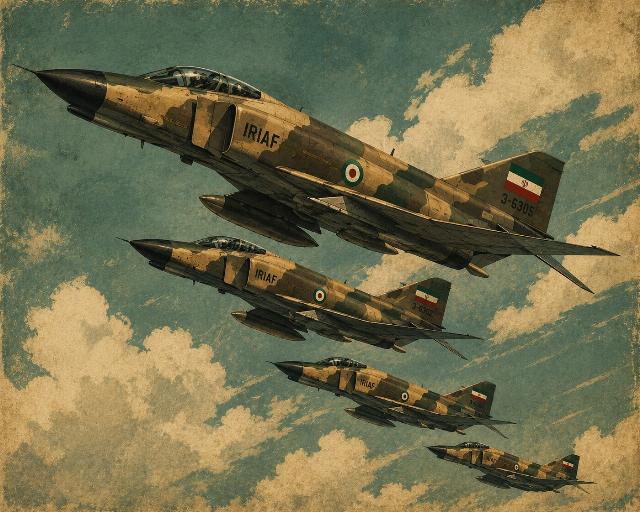
Image generated by ChatGPT.