
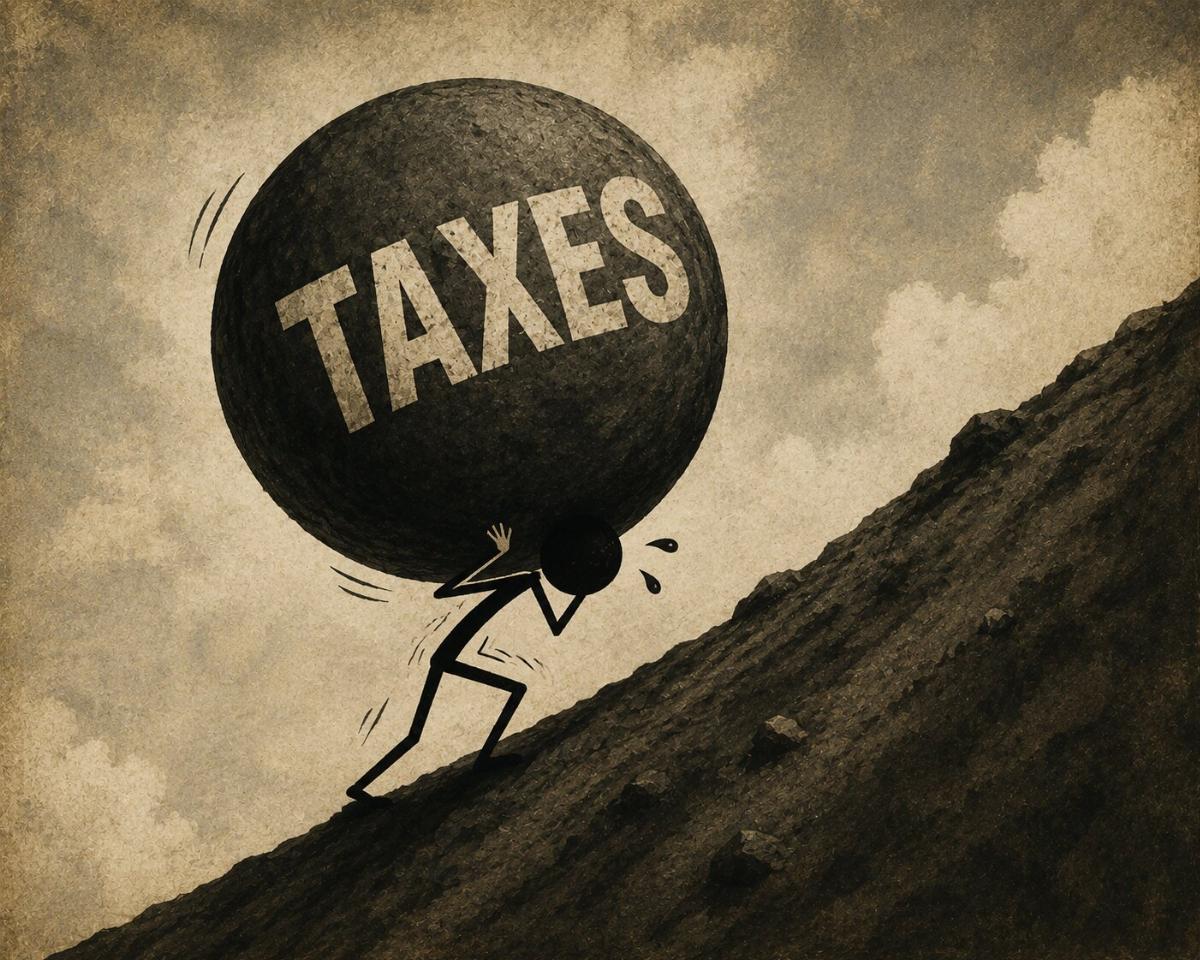
Taxation is the most destructive instrument ever invented. Its cost to lives, liberties, wealth, and property through the ages has no peer. Yet the ubiquitous scourge is the primary means of raising funds for public expenditures, and has been for 1000s of years. Many claim that taxation is necessary for government to function, injurious as it may be. But is taxation really necessary?
Read more Mamdomino Theory: Democrats Struggle to Contain the Spread of Communism in Their Party
No one has ever supplied a proof that taxation is the best means of raising funds for government. Nor has anyone, besides myself, performed a cost-benefit analysis, which is surprising given the money and researchers available. All one needs to do is add up the costs of taxation, of which most fall into two categories, and the benefits of taxation, of which there is one. If the benefit exceeds costs, one retains taxation. If the opposite, the days of taxation, this ancient and unexamined practice, responsible for millennia of misery and tyranny, should end.
When one commences an analysis, one quickly finds an astounding flaw at the base of public finance, a flaw that many know, but refuse to acknowledge and incorporate into their reasoning. Two short questions on the nature of a deficit expose it.
The first question: Suppose the government of a jurisdiction takes in $5 billion in tax revenues and spends $7 billion. What would the deficit be?
The obvious answer is $2 billion.
The follow up: How much did the government contribute to its expenditures?
The second answer creates a dilemma. Is the deficit only the borrowed portion of public expenditures?
A great economist said most disputes in economics center on definitions. It is well known that government does not fund government. It never has and never will. Since government supplies none of the funds or resources employed in the provision of public goods, one must conclude that the deficit as defined, the borrowed portion of public expenditures, is grossly inadequate and misleading. The deficit clearly is every dime government spends. In the case above, the full $7 billion, and not the illusory $2 billion. The people of a jurisdiction fund government — all of it — through charges on their assets, property and incomes, or through the state borrowing against them.
Having dealt with this unappreciated misconception, one may turn his attention to the question of whether a government should tax.
As said, taxation is highly destructive. Its costs fall into 2 categories: waste and deterrence. Government at all levels in the U.S. spends ~ $10 trillion. Working with this figure, I estimate government waste at approximately 80% of public expenditures or ~ $8 trillion. The second great cost in taxation, and the greater, is its deterrent effect. Taxes are fines or penalties. They are used effectively to discourage bad behaviour. Thus, fines and penalties on incomes, property, and assets discourage one from engaging economically as they would were there no taxes. Deterrence in an economy of $33 trillion roughly is 40%, which works out to ~ $13 trillion. Totalling up the costs of taxation places one at $21 trillion in a $33 trillion economy.
And what is the benefit of taxation? The answer is simply interest savings; interest savings on money the government chose not to borrow. Suppose there is a needed public expenditure of $100 and a market interest rate of 5%. If government borrows the funds, there would be an interest charge of 5% or $5 annually. Thus, by taxing the community, residents save on the $5 annual interest charge.
What would be the savings in interest on $10 trillion taxed and spent by U.S. governments in one year? Approximately, 5 cents on the dollar or $500 billion, charged annually and indefinitely until the debt is repaid. An added interest charge of $500 billion annually on top of the initial $10 trillion expenditures would not help the public finances of a community.
However, taxation and borrowing are not equivalent means of raising funds. One discovers that having government borrow the whole of its public expenditures erases the two costs of taxation.
Read more Texas Brings the Bible Back into Schools
Firstly, in full public borrowing, the deterrent effects of taxation, inherent in fines and penalties, would vanish with its cessation. Governments instead of confiscating funds must offer inducements to citizens to lend, commonly a reward of interest, just as do banks, companies and individuals seeking the capital of others. Devoid of the deterrent effect, the U.S. economy would grow from $33 trillion to $46 trillion.
Secondly, waste would disappear as U.S. governments would be forced to go cap in hand daily to their newly minted public bankers, former taxpaying slaves freed from the crushing boot of insatiable and corrupt government. Public expenditures should drop to worthy public investments of $2 trillion, for a savings of $8 trillion.
An economy of $33 trillion with $10 trillion to U.S. governments and $23 trillion to the people transforms into an economy of $46 trillion with $2 trillion to U.S. governments and $44 trillion to the people, almost doubling the people’s share and vastly increasing U.S. assets and wealth.
If one can create assets of $21 trillion for an investment of $2 trillion, who would not lend to or invest in such a profitable corporation?
Many will argue that public debt and accrued interest must be repaid, that the community must settle its debts. True, but how should it be done?
Let’s say that the community has its government repay the $2 trillion debt and the interest, that is 5% or $100 billion, by taxing resident citizens. $2.1 trillion leaves the bank accounts of resident taxpayers and flows immediately back into the bank accounts of resident lenders. $2.1 trillion out matches $2.1 trillion returned. Thus, in repayment of public debt and interest, the aggregate wealth of citizens remains unaltered. Yet, the cost of taxing to repay public debt is immense in regenerated waste and deterrence. Even the sole benefit of taxation, interest savings, is nullified by this action. Therefore, a community will never have its government repay debt and accruing interest by taxation.
The second option is to let the public debt and accruing interest ride. The incredible bounty of $21 trillion in additional assets plus all future returns therefrom shall easily furnish initial lenders their $2 trillion and accruing interest when demanded.
Banks operate in such a fashion. They have never repaid one dime borrowed in their entire existence, save when they run into trouble. They merely exchange one lender for another. Every year the liabilities of banks rise, but so do the value of their assets, the latter usually surpassing the former. No one ever demands banks repay their debts in full at the end of the year.
Similarly, a community shall always have its government repay public lenders their funds, exchanging one lender for another. However, the assets passed on along with those debts shall be better than 10 to 1 in size. One may also think of it as a pension plan in which the vastly increased assets and wealth of the community easily satisfy the comparatively lowly demands of its lenders.
Any community can change its financial stars. One declaration separates the old world from the new, renders obsolete thousands of years of destructive public finance theory and practice.
Read more Asymmetric Lawfare
Abolish all taxes and have the state institute full public borrowing.
Image generated by ChatGPT.