
In the high-stakes theater of Middle Eastern geopolitics, Washington has long relied on the U.S. dollar as its primary disciplinary tool. The logic is straightforward: cut off a rogue state, proxy network, or financial institution from the global dollar clearing system, and its ability to move capital across borders becomes harder, slower, and more expensive. It is an elegant strategy on paper.
Read more The Rarest Treasure in Human History
In Iraq, however, that logic has encountered a more adaptive system. Financial pressure has not eliminated flows so much as redirected them. America’s adversaries are making a mockery of U.S. financial pressure.
When money cannot move cleanly through the banking system, it can be redirected into land, retail and commercial assets, construction activity, invoices, pre-sales, and concrete. To understand this system, one address may be central: District 902, Street 2, Building 4, in Baghdad’s Karrada district.
Public listings identify this address as the location of Elaf Islamic Bank. Nabaa Al Salman Group, a real estate development company, also lists the same address. In ordinary commercial settings, such co-location is not evidence of wrongdoing. In Iraq’s high-risk financial environment, however, the overlap raises a more complex question: what happens when banking, contracting, real estate development, and politically connected business activity operate inside the same ecosystem?
That question lies at the center of my investigation, and many of the allegations stated in this essay are based on interviews with Iraqi security officials, government-linked sources, financial sector actors, and individuals familiar with the matter. Some sources spoke on condition of anonymity due to lack of authorization or personal safety concerns.
The issue is not whether shared infrastructure alone indicates wrongdoing. It is whether the interaction between constrained access to dollars and closely connected banking and construction networks creates conditions that can facilitate sanctions evasion, trade-based money laundering, and the conversion of opaque cash into apparently legitimate assets.
In Iraq, those conditions are no longer theoretical. These networks operate within an environment shaped by overlapping relationships between Iranian-backed political actors, militias, ministries, banks, contractors, and business groups. As regulatory pressure increases, financial behavior adapts: restrictions on wire transfers push activity toward trade, while tighter scrutiny of trade shifts activity toward contracting, retail, and property.
Elaf Islamic Bank is an Iraqi bank that has faced restrictions on U.S. dollar access and international transactions as part of sanctions and regulatory enforcement measures. It was subject to U.S. Treasury sanctions in 2012 over Iran-related transactions. And while it was officially de-listed a year later, it’s still on the Central Bank of Iraq list as .
The Architecture of a Closed Loop
Anti-money laundering systems depend on more than institutional separation. They require due diligence, beneficial ownership transparency, sanctions screening, suspicious activity reporting, independent compliance controls, and meaningful regulatory enforcement. But structural separation still matters: a bank is expected to act as a financial firewall, not as an extension of related commercial interests.
The people with whom I’ve spoken allege that, at District 902, Street 2, Building 4, the critical firewall has completely vanished.
Public corporate information identifies Abbas Qasem Salman as a shareholder and deputy managing director of Elaf Islamic Bank. It also identifies Emad Qasem Salman as a board-level figure and shareholder. Other members of the Salman family appear in related governance structures, while Nabaa Al Salman Group operates as a large-scale developer with residential projects across Baghdad.
A senior Iraqi security official contends that the Salman family maintains consolidated control over banking, construction, and contracting interests through interlocking roles across multiple entities. Family-linked representation across affiliated boards reinforces what the official described as a structural integration between financial services and real estate activity.
An Iraqi Central Bank source asserted Elaf Islamic Bank is viewed internally as part of a wider Iranian-backed network of financial and commercial entities exposed to elevated illicit financial risk.
Taken together, these assessments point to a structural concern: when banks, developers, contractors, and suppliers operate within closely connected networks, capital can circulate through related entities in ways that are difficult to verify independently, including through loans, procurement arrangements, advances, and pre-sales.
The Closed-Loop Risk
That is the essence of the closed-loop risk. It does not require a suitcase of cash crossing a border. It requires a controlled chain of entities capable of converting local liquidity into construction activity, then converting construction activity into apparent revenue.
Even within the state regulatory apparatus in Baghdad, officials with whom I spoke quietly acknowledge the systemic difficulty of policing these flows. A judicial official described the model bluntly: “Stop looking only at bank wires. Look at the skyline.”
Read more Indoctrination is dangerous
The same official alleged that after tighter U.S. restrictions on Elaf Islamic Bank, Abbas Qasem Salman and Emad Qasem Salman increasingly shifted away from cross-border transfers and toward real estate-linked structures. They are described as key actors within Iranian-linked networks that convert liquidity into property-based assets. “It’s the perfect evasion strategy,” the official said.
The official also avers that Abbas Qasem Salman holds Portuguese residency and makes use of Cypriot honorary consul diplomatic affiliations as part of broader international mobility strategies. While Abbas has listed himself online as holding such roles, these claims are not reflected in official Cypriot Ministry of Foreign Affairs records.
From Dollar Windows to Concrete
In 2022 and 2023, the United States and the Central Bank of Iraq introduced measures to reduce dollar smuggling through the banking system. Many Iraqi banks have since faced restrictions on U.S. dollar transactions as part of successive enforcement waves.
The Nabaa Al Salman Group’s portfolio includes large-scale developments such as the Al-Rehab Residential Complex and the Al Furqan Complex. Projects of this scale require imported structural steel, heavy machinery, elevators, and HVAC systems—goods not produced domestically and typically settled in U.S. dollars.
This raises a practical question: how are such projects financed when Elaf Islamic Bank and related networks face restrictions on access to U.S. dollars through formal banking channels?
Regulatory and banking sources described to me an adaptation process. Rather than relying on direct transfers, value is routed through layered commercial structures. Businessmen transact in local currency, while intermediaries settle foreign obligations. Imports are handled through trading companies operating across regional hubs, fragmenting financial visibility across multiple jurisdictions and contractual layers.
In practice, this creates space for sanctions evasion and regulatory arbitrage, particularly in construction, where subcontracting chains, imported inputs, large invoices, and long timelines make financial flows harder to trace.
Patronage, Protection, and the Limits of Oversight
The expansion of luxury real estate in Baghdad reflects a market increasingly decoupled from underlying economic conditions. In a context of cash-heavy commerce and uneven enforcement, high-end developments function as both housing and financial storage mechanisms—effectively vertical repositories of capital.
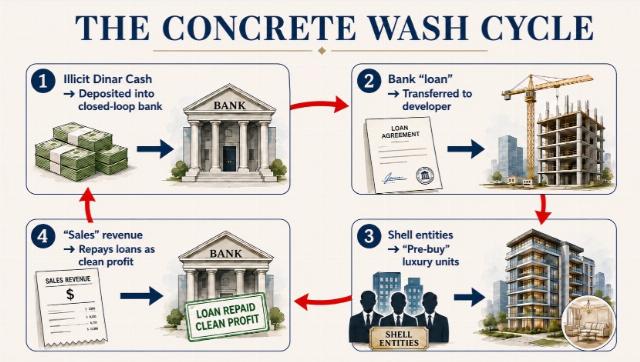
Image created using AI.
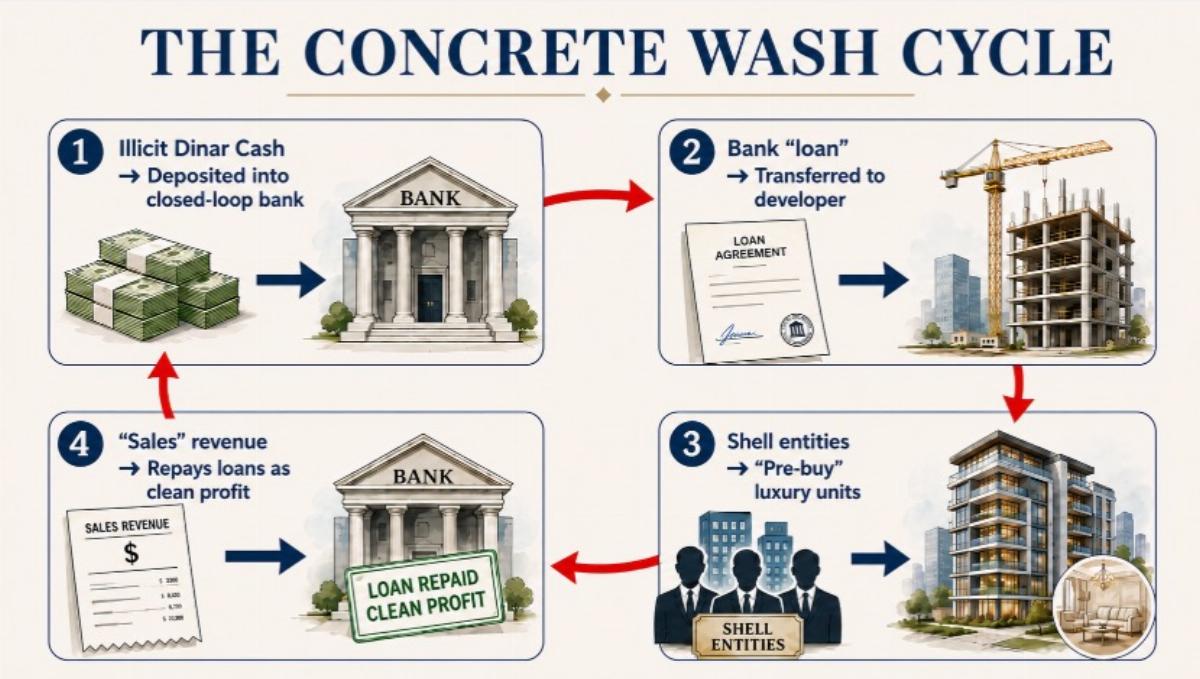
In this model, those with whom I spoke allege that units are often acquired in bulk through opaque entities, creating the appearance of demand while recycling capital internally. Funds re-enter the banking system as recorded revenue, completing a cycle that converts opaque liquidity into apparently legitimate financial flows. (This is a common pattern.)
Iraqi security officials say this mechanism extends beyond construction sites into broader real estate manipulation. One official described large-scale use of property flips and land acquisitions as parallel liquidity channels linked to politically connected networks. Another security source said real estate has become one of the preferred instruments for converting cash into durable assets, particularly under conditions of constrained banking access.
The Cost of Performative Enforcement
For Washington, the challenge is structural. Sanctions enforcement cannot remain confined to banking channels. In Iraq, value moves through intertwined networks of finance, contracting, trade, and politically connected enterprise.
The question is no longer whether financial institutions can be pressured into compliance alone. It is whether enforcement mechanisms can follow value once it moves beyond the banking system and into the broader commercial landscape.
At District 902, Street 2, Building 4, that question remains unresolved.
Baghdad’s skyline continues to rise, but the financial system beneath it remains opaque—less a failure of enforcement than a system adapted to evade it.
NOTE: Since I conducted my research for this essay, the Iraqi government has launched a major anti-corruption crackdown, arresting dozens of senior officials and politicians, including a deputy oil minister who had recently been sanctioned by the U.S. over allegations of facilitating Iranian-linked oil diversion. The operation appears to reflect increasing scrutiny of the nexus between corruption, sanctions, and politically connected financial networks.
John Smith has dedicated his career to advancing the national security interests of the United States.
Read more After Trump v. Barbara, Lord of the Rings memes explode across social media