
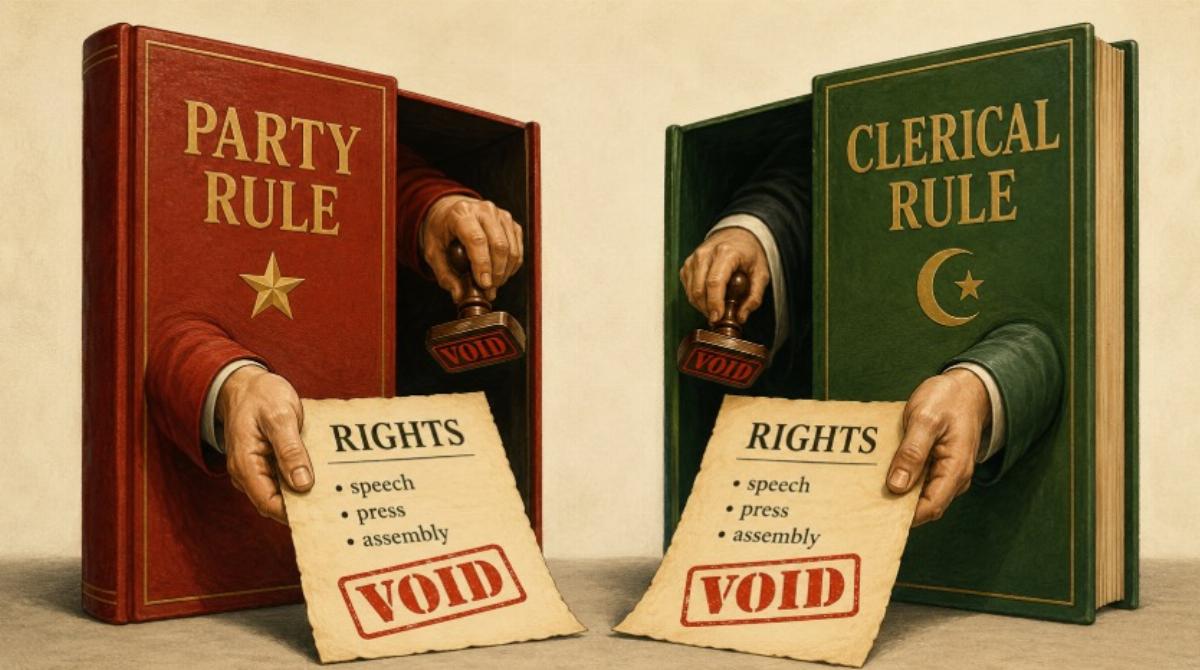
In revealing the commonalities of the Reds and the Greens in the Red-Green Axis, we have elucidated their shared goals of violence, wealth redistribution, inequality before the law, a binary world, monopoly rule by the elites, controlling the totality of society, transitional-phase slaughter, and Trojan-horsing society’s institutions. Here we explore the explicit rejection of pluralist or limited government.
Read more Western resilience and trade policy
Islamic political systems and Marxist-Leninist communism do not merely fail to protect pluralism. Both have produced founding legal texts that enumerate individual rights in liberal-sounding language, then subordinate every right, in the same document, to a doctrinal standard interpreted by an unelected body. The rights are real as prose. They are void as law because the text that grants them also grants a single authority the power to decide, without appeal, when they do not apply.
That structure, not the mere absence of a multiparty system, is the precise mechanism by which both reject limited government while speaking its language.
The Soviet Constitution of 1936 is the clean communist case. Article 125 guarantees freedom of speech, press, assembly, and street demonstrations, but only “in conformity with the interests of the working people…to strengthen the socialist system.” Article 126 immediately supplies the body that decides what those interests require: the Communist Party of the Soviet Union, described as “the leading core of all organizations of the working people, both public and state.” No independent court sits above this clause.
The qualifier is not bounded by emergency or reviewed by law. It is total and permanent, written into the same sentence granting the right. Nikolai Bukharin, who helped draft this constitution, was arrested in February 1937 and executed in March 1938, fifteen months after the document he wrote took effect. The clause he wrote consumed him.
Iran’s 1979 Constitution reproduces the same architecture through Islamic criteria. Article 24 grants freedom of the press “except when it is detrimental to the fundamental principles of Islam,” while Article 26 grants freedom of association “provided they do not violate…the criteria of Islam.” Article 4 supplies the master clause governing both: “All civil, penal, financial, economic, administrative…and other laws and regulations must be based on Islamic criteria,” applying “absolutely and generally to all articles of the Constitution,” with the fuqaha (Islamic jurists qualified to rule on religious law) of the Guardian Council, six clerics selected by the Supreme Leader, as sole judges.
The Guardian Council is not a court bound by codified law. Rather, it is a body constituted specifically to enforce ideological conformity, structurally the same office Article 126 assigns to the Party. Article 24’s exception has been exercised to lethal effect: in 2014, Mohsen Amir-Aslani, convicted of heresy for teaching that the Quran’s Jonah narrative was allegorical, was executed after his case was revived on separate charges once that conviction alone proved insufficient for death.
Article 13 supplies a second instance of the same architecture, one step further back: it names only Zoroastrian, Jewish, and Christian Iranians as dhimmi. The Baha’i Faith, Iran’s largest non-Muslim minority, receives no such recognition. Classified as apostasy rather than a pre-existing religion, Baha’is fall outside the dhimmi category, unable to register as a religious community, hold property, or have marriages recognized in law. The mechanism operates a step earlier than Article 4’s qualifier: before a right can be limited, the constitution decides who is eligible to hold it.
The parallel is precise rather than impressionistic. Both texts perform the same three moves in the same order: grant an enumerated right, subordinate it in the same clause to a doctrinal standard, and name an unelected body tied to the ruling ideology as the final and unappealable interpreter of when the standard has been met. Liberal constitutions also qualify rights, but the qualification is normally bounded, exceptional, and reviewable by an independent judiciary. Here the standard is not law binding the interpreter but the interpreter’s own doctrine, applied by the ruling apparatus itself rather than a check upon it.
A right its own grantor may void whenever ideology requires it was never a limit on power. It was power’s own instrument, formatted to resemble one.
This structure has a longer pedigree than either constitution and is not confined to Shia jurisprudence or Iran. Classical Islamic law’s treatment of dhimmi communities (the protected but subordinate status assigned to Jews, Christians, and some other non-Muslims under Muslim rule) followed the same logic earlier: protection was real, formally guaranteed by covenant, and purchased at real cost. Classical commentary on the Quranic phrase governing the jizya, “while they are humbled,” held that the tax should be collected to visibly display the payer’s subordination; the Pact of Umar and later manuals barred dhimmis from building or repairing houses of worship without permission, required distinctive dress, restricted them to donkeys rather than horses, and excluded their testimony against Muslims in court.
Enforcement varied by ruler and era, but the status was revocable and subordinate to rulings the community had no standing to contest. Sunni constitutionalism reproduces this independently: Pakistan’s Constitution, Article 227, requires all law to conform to Islamic injunctions, and since 1980, a Federal Shariat Court has struck down legislation on that ground, invalidating interest provisions in twenty-two laws as repugnant to Islam in 1991. Two systems built on rival theories of religious authority, Shia clerical rule and Sunni jurisprudence, converge on the identical device: an enumerated right, a doctrinal qualifier, and an unelected religious body as final interpreter.
The Soviet pattern likewise outlived 1936. The 1977 Constitution reproduced it almost verbatim, declaring the Party “the leading and guiding force of Soviet society, the nucleus of its political system.” Its Article 125 successor was exercised against Andrei Sakharov, physicist and Nobel laureate, seized on a Moscow street in January 1980 and exiled to Gorky by administrative decree, without trial, for denouncing the invasion of Afghanistan. No court reviewed the action because none needed to.
China’s constitution, since a 2018 amendment, states in Article 1 itself that “the leadership of the Communist Party of China is the defining feature of socialism with Chinese characteristics,” placing the same supremacy clause in the constitutional body rather than the preamble alone.
Read more Something for nothing never loses its charm — the politics of rent control in New York City
The objection that every state qualifies rights in the name of public order does not reach this case. The question is not whether limits on rights exist; it is who sits above the limit. Where an independent judiciary bound by codified, publicly knowable law adjudicates the qualification, the right retains real content because the interpreter is itself constrained. Where the interpreter is the ruling doctrine’s own organ, unelected and answerable to no law above its own judgment, the right has no floor.
The Party was not elected to that role; the Guardian Council’s fuqaha are appointed; and Pakistan’s Federal Shariat Court judges are appointed. All three place the interpreter inside the ruling apparatus, not outside it.
This is why pluralist and limited government cannot be adopted by either system without contradiction; they can only be disfavored. A constitution can enumerate rights and still refuse to limit power, so long as it also names an authority immune from the rights it just granted. Both Islamic political systems, in their most explicit modern constitutional expression, and Marxist-Leninist communism, in its founding constitutional text, chose exactly that design.
The state remains, on paper, a guarantor of freedoms. In the clause that follows, it reserves the power to decide that none of them apply.
Image created using AI.
Endnotes
1. Constitution (Fundamental Law) of the Union of Soviet Socialist Republics (1936), Articles 125–126. Primary text at marxists.org/reference/archive/stalin/works/1936/12/05.htm. Article 125 conditions freedom of speech, press, assembly, and demonstration on conformity with “the interests of the working people”; Article 126 names the Party the body that determines those interests.
2. On Bukharin’s role in drafting the 1936 Constitution and his arrest (February 1937), trial (March 1938), and execution: Samantha Lomb, Stalin’s Constitution: Soviet Participatory Politics and the Discussion of the 1936 Draft Constitution (Routledge, 2017); Nikolay Bukharin, Encyclopaedia Britannica. Bukharin was tried alongside twenty other defendants in the March 1938 Case of the Anti-Soviet “Bloc of Rights and Trotskyites” (the Trial of the Twenty-One), charged with treason, espionage, sabotage, and conspiracy to assassinate Soviet leaders and dismember the USSR on behalf of foreign intelligence services; historians regard the charges as fabricated and the confessions, extracted under duress, as coerced. See “Case of the Anti-Soviet ‘Bloc of Rightists and Trotskyites,’” and contemporaneous U.S. State Department cable, Foreign Relations of the United States, 1933–39, document 453.
3. Constitution of the Islamic Republic of Iran (1979, rev. 1989), Articles 4, 24, and 26. English translation at constituteproject.org/constitution/Iran_1989; Article 4’s interpretive scope confirmed by the Guardian Council’s own site, shora-gc.ir. The Guardian Council’s twelve members are six fuqaha appointed by the Supreme Leader and six jurists nominated by the (Supreme Leader–appointed) Chief Justice and confirmed by parliament; none are directly elected. On Article 13 as a modern codification of the classical dhimmi category, and its own internal qualifier (“within the limits of the law”): Constitution of the Islamic Republic of Iran (1979, rev. 1989), Articles 13–14. Article 14 conditions the state’s duty to treat recognized minorities justly on their “refraining from engaging in conspiracy or activity against Islam and the Islamic Republic of Iran”; a 2023 submission to the UN Human Rights Committee notes this conditionality “justifies persecution by the State of non-Muslim religious minorities who are judged to be engaged in conspiracy or activity against Islam or the regime,” and that it has been given a wide interpretation in practice: recognized minorities are barred from proselytizing Muslims, Armenian and Assyrian churches may not hold services in Farsi, and Muslim converts to Christianity are prosecuted as apostates rather than protected as Christians. On Article 13’s exclusion of the Baha’i Faith and its consequences: “Religious Freedom and Exclusion in Religious Legal Systems: Cases of Bahá’ís in Iran and Ahmadis in Pakistan,” International Center for Law and Religion Studies, Brigham Young University, October 2025; U.S. Department of State, 2024 Country Reports on Human Rights Practices: Iran.
4. Mohsen Amir-Aslani was convicted of heresy for teaching, in his own religious classes, that the Quran’s account of Jonah and the whale was allegorical; that conviction alone did not carry a death sentence. His case was reopened on separate charges, ultimately rape, after the heresy-based death sentence was first annulled by Iran’s Supreme Court for insufficient evidence and then reinstated by a lower court; he was executed September 24, 2014. Iran’s judiciary has stated the execution was unrelated to his religious teaching. Legal analysis and case chronology: Hossein Raeesi, “Chronicle of an Execution: The Case of Mohsen Amir Aslani,” Iran Human Rights Documentation Center, 2015; contemporary reporting: Reuters, “Iranian man executed for heresy: rights group,” September 30, 2014.
5. On the conditional, covenant-based, and administratively revocable character of dhimmi status, including the jizya, see Yohanan Friedmann, Tolerance and Coercion in Islam: Interfaith Relations in the Muslim Tradition (Cambridge University Press, 2003), esp. ch. 2 on the legal category of dhimma and its obligations. On classical commentary reading the jizya verse (Quran 9:29) to require the payer’s visible subordination, and on the Pact of Umar’s restrictions on construction, dress, and testimony, see Friedmann, chs. 2–3, and Mark R. Cohen, Under Crescent and Cross: The Jews in the Middle Ages (Princeton University Press, 1994), noting enforcement varied substantially by ruler and era.
6. Pakistan’s Constitution, Article 227, and the Federal Shariat Court (established by constitutional amendment in 1980): official statement of the Court’s objects and functions at federalshariatcourt.gov.pk; on the November 1991 ruling invalidating interest (riba) provisions in twenty-two laws, see Josh and Mak International, “Application of Islamic Laws in Pakistani Law.” Federal Shariat Court judges are appointed, not elected, and the Court’s judgments bind the ordinary courts on questions of Islamic conformity.
7. Constitution of the USSR (1977), Article 6. Primary text at .
8. Andrei Sakharov’s exile to Gorky (January 1980), imposed by decree of the Presidium of the USSR Supreme Soviet without trial: “Sakharov Exiled,” Seventeen Moments in Soviet History (Michigan State University), soviethistory.msu.edu/1980-2/sakharov-exiled; Andrey Sakharov, Encyclopaedia Britannica.
9. Constitution of the People’s Republic of China, Article 1, as amended March 11, 2018. English translation at constituteproject.org/constitution/China_2018.