
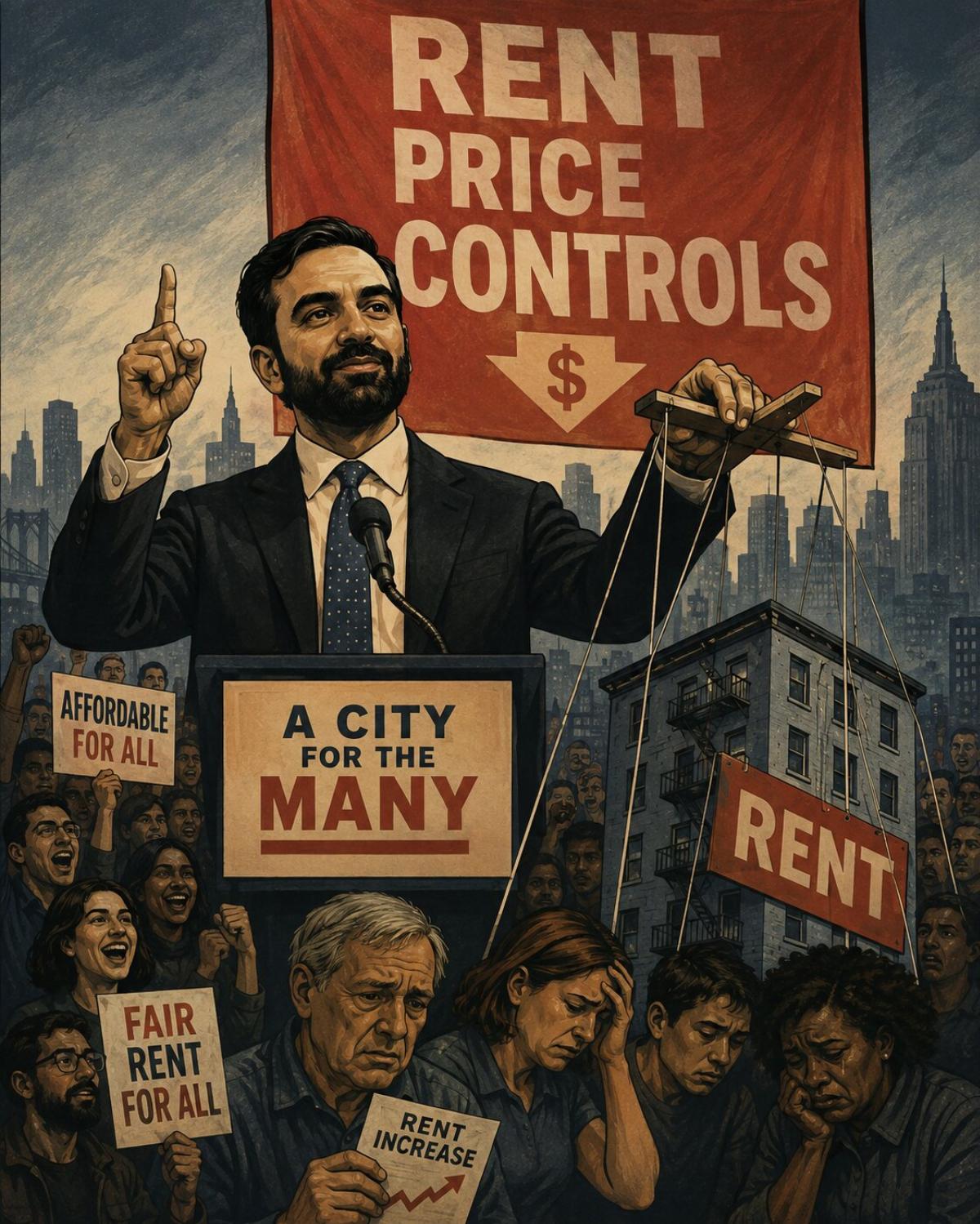
Talk of rent control has become the rage in New York City with the Mamdani crowd. It won’t be long before we will start to hear Zohran the Magnificent rail against those greedy rich landlords who are “gouging” their poor tenants by charging unconscionable rents. Such talk is not new since New York City has a long history of rent control. New York politicians have pandered to city tenants by freezing and “stabilizing” rents in the past with disastrous outcomes. As with the politics of renewable energy, the allure of something for nothing never loses its charm with those who favor rent control.
Read more Happy #100 Fidel, I hope it burns down there
Let’s look at the track record of rent control in New York City and see what it has achieved over its eighty-year history since WWII. The modern era of rent control in NYC essentially started in 1943 in the midst of World War II as an emergency wartime measure by the federal government. The war transformed the American economy. Military production expanded rapidly, unemployment virtually disappeared, wages rose, and millions of people moved to areas with defense-related employment. The Roosevelt administration feared that shortages combined with rising wages would produce severe inflation. Congress therefore enacted the Emergency Price Control Act of 1942, giving the federal Office of Price Administration, or OPA, broad authority to impose price ceilings, including limits on residential rents.
Price controls, including wage and rent controls, are no more a good idea in wartime than they are in times of peace. Allowing prices to fluctuate freely communicates essential information on how best to allocate resources amongst competing uses at both the level of the individual and the economy as a whole. It is through prices that an incredibly complex economy can operate without any central direction. However, such a simple concept is baffling to many.
The last president of the Soviet Union, Mikhail Gorbachev, is said to have asked British Prime Minister Margaret Thatcher: “How do you see to it that people get food?” The answer was that she didn’t. Prices did that. Moreover, the British people were better fed than people in the Soviet Union, even though the British had not produced enough food to feed themselves in more than a century; price freedom brought them food from other countries. However, because the essential function that prices provide is mystifying to politicians and the public alike, price controls have been instituted throughout history with deleterious effect.
Federal rent control persisted beyond the war until 1950, at which point New York State replaced federal controls with its own system. It continued until 1962 when New York State gave New York City substantial authority over rent regulation within the city. The city enacted the City Rent and Rehabilitation Law, creating the basic municipal rent-control regime.
It was not until the era of deregulation in the ‘90s that things began to change. In 1993, the legislature created mechanisms allowing some apartments to leave regulation. If a rent-stabilized apartment became vacant, the apartment could leave stabilization entirely. An occupied apartment could also become deregulated when the tenant’s household income exceeded a high-income threshold for consecutive years.
Rent deregulation revitalized New York’s flagging housing market and combined with the policies of Mayor Rudy Giuliani (1994–2001) which ushered in an historic drop in crime, New York City became a fashionable destination. It is no coincidence that Friends and Seinfeld, depicting young and not-so-young adults living in New York City, were the most popular shows of the ‘90s. New York City was back, and it showed.
Read more If Other Countries Give Fewer Shots, Why Can’t We Ask Why?
So, what was it about rent control that made it so bad for New York City while it was in vogue for a half century? It is best to look from the perspective of both demand and supply. A practical consequence of simple economic principles is that the quantity demanded varies according to how high or how low the price is. With rent control artificially lowering prices, more people had a demand for more housing space than without rent control laws being enacted. When some people used more housing than usual, other people found less housing available. The same thing happens under other forms of price control. Some people use the price-controlled goods or services more generously than usual because of the artificially lower price and, as a result, other people find that less than usual remains available for them.
Hoarding is a behavior that arises under rent control. Tenants may hold on to apartments they rarely use because the regulated rent is well below the market rate. Some Hollywood celebrities, for example, have reportedly retained rent-controlled apartments in Manhattan for occasional visits to New York. Mayor Ed Koch kept his rent-controlled apartment throughout the 12 years he lived in Gracie Mansion, the mayor’s official residence. Congressman Charles Rangel likewise held four rent-regulated apartments in New York.
Lest the reader believe that these instances of hoarding were outliers, let me relate a personal story. In 1980, my sister’s in-laws had retained a rent-controlled apartment in Manhattan for over 30 years, even though they had long since moved to the suburbs, raised a family, and only went into the city to see a Broadway play or shop.
New York City has maintained rent control for a longer period, and in a more restrictive form, than any other major American city. One result has been unusually low tenant turnover. The annual rate at which apartments change occupants in New York has been less than half the national average, while the share of tenants who have remained in the same apartment for 20 years or more has been more than twice the national average.
On the supply side, rent control can have an even more damaging effect on the availability and quality of housing. Over time, regulated rents may become too low for some landlords to cover the costs of maintaining and operating their buildings. When a property becomes financially unsustainable, an owner may reduce maintenance, stop investing in repairs, or ultimately abandon the building altogether. New York City provides a notable historical example. In periods when rents failed to cover expenses such as heat, hot water, repairs, taxes, and other legally required services, some landlords simply walked away from their properties. Many of these buildings were subsequently left vacant and boarded up, even though they might have remained habitable had adequate maintenance and repairs continued. Over the years, New York City ultimately took possession of thousands of such abandoned properties, illustrating how rent control by imposing prolonged financial pressure on landlords can contribute to a decline in the available housing stock.
For Zohran the Magnificent it matters not. He does not reflect for one millisecond on the havoc he will sow with his rent control policy, which is the whole point anyway. He undermines functioning systems, creating problems that he will then point to as justification for more government meddling. Something for nothing never loses its charm with New York City voters.
Read more Democrats are the party of double standards, Chapter 759
Image generated by ChatGPT.