
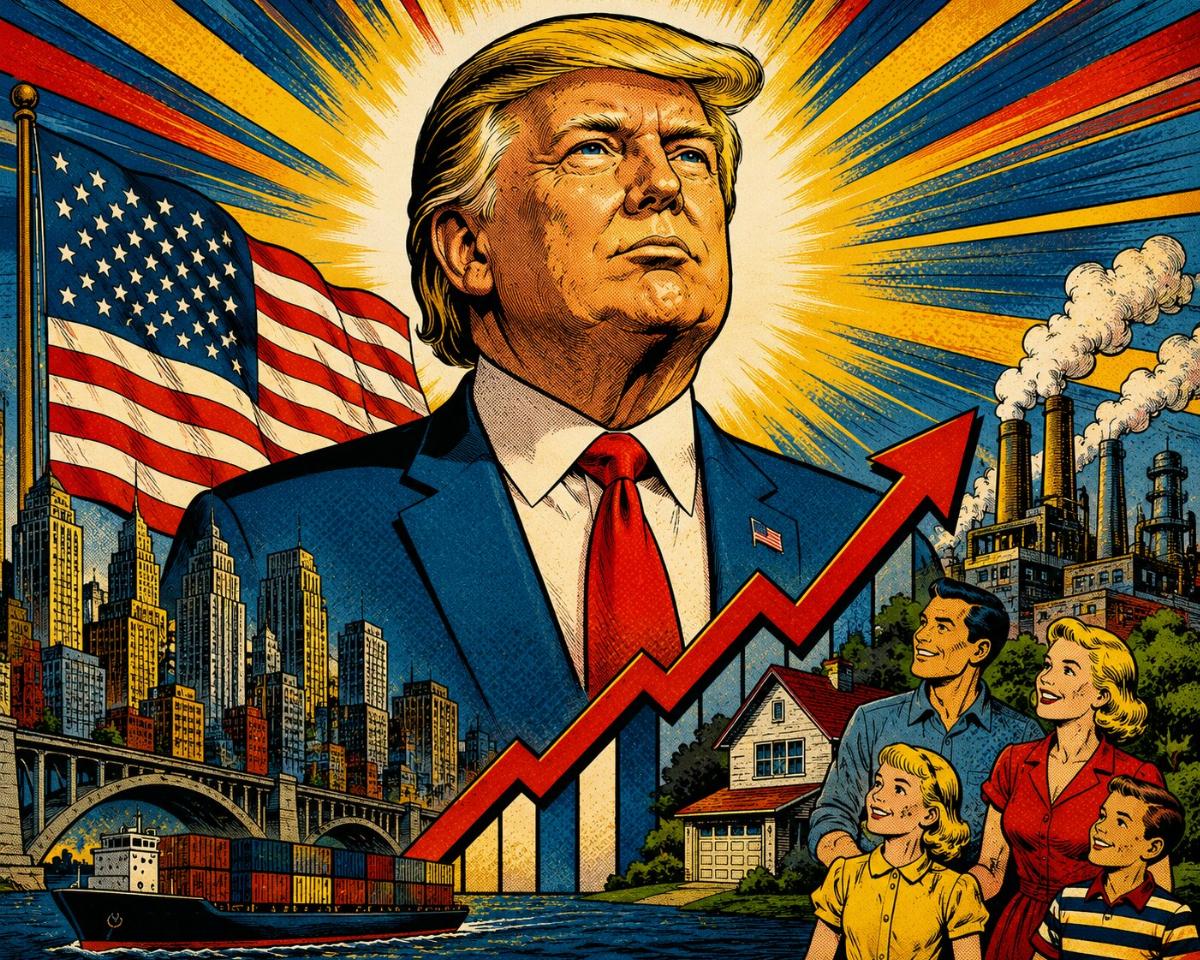
The summer of 2026 brought renewed attention to the resilience of Western economies and the strategic trade policies underpinning their strength. At the center of this narrative is the United States, where President Trump’s administration has sought to consolidate economic gains through tax reforms, defense spending, and a recalibration of trade relationships. While global growth remains sluggish, the West continues to demonstrate its capacity to adapt, innovate, and lead a story that resonates with both domestic audiences and international observers.
Read more Something for nothing never loses its charm — the politics of rent control in New York City
America’s Domestic Strength as a Foundation for Global Leadership
The U.S. economy has weathered significant challenges in recent years, from energy shocks tied to Middle East instability to inflationary pressures that tested consumer confidence. Yet the fundamentals remain strong. Real GDP growth is projected at 2.0–2.2% in 2026, a pace that, while modest, signals stability in a volatile global environment. The labor market has held firm, with unemployment near 4.3%, and payroll growth bringing in 70,000 jobs in July, when you exclude the drops in government payrolls and seasonal hospitality work.
Much of this resilience stems from the administration’s fiscal agenda. The One Big Beautiful Bill Act (OBBBA) expanded tax cuts, eliminated taxes on tips, and introduced incentives for small businesses. These measures have bolstered consumer demand, encouraged entrepreneurship, and reinforced productivity gains. In parallel, defense spending currently at $1.5 trillion has not only secured national interests but also stimulated industrial growth, creating jobs and driving innovation in sectors ranging from aerospace to cybersecurity.
This domestic strength provides the foundation for America’s global leadership. By ensuring stability at home, the administration positions the U.S. to project confidence abroad, reinforcing the West’s role as the anchor of the international economic order.
Western Economies as the Global Anchor
Globally, growth is forecast at 2.5–2.7% in 2026, the slowest pace since the pandemic. Emerging markets face mounting debt distress and inflationary pressures, while geopolitical uncertainty continues to weigh on trade flows. Against this backdrop, Western economies stand out for their resilience.
The European Union has maintained growth at 1.3%, cushioned by its industrial base despite tariff disputes. The United Kingdom and Canada have posted moderate growth around 1.5–1.7% thanks to diversified trade and energy resilience. Together with the United States, these economies form the backbone of global stability, demonstrating that fiscal discipline, technological investment, and strategic cooperation can offset external shocks.
A key driver of Western resilience has been AI-driven capital spending. By leading in artificial intelligence and digital innovation, Western economies have offset energy shocks and reinforced their technological dominance. This investment has not only boosted productivity but also ensured that the West remains at the forefront of global competitiveness.
Strategic Trade Policy: Rebalancing and Reciprocity
Central to the administration’s vision of Western resilience is trade policy. Over the past two years, the United States has pursued new agreements with the European Union, Japan, the United Kingdom, and India, emphasizing reciprocity and fairness. These deals have rebalanced trade flows, reduced dependence on adversarial economies, and strengthened ties with allies.
By recalibrating tariffs and renegotiating agreements, the administration has protected American industries while ensuring that trade remains a driver of growth. This approach resonated across the West, where governments increasingly recognize the need to safeguard strategic sectors from semiconductors to energy against external vulnerabilities.
The emphasis on reciprocity has also reinforced trust among allies. By ensuring that trade agreements deliver mutual benefits, the United States has strengthened the cohesion of the Western bloc, positioning it as a united front in the face of global uncertainty.
Read more Happy #100 Fidel, I hope it burns down there
Energy Security and Strategic Cooperation
Another pillar of Western resilience is energy security. The disruptions in the Middle East underscored the vulnerability of global supply chains, yet Western economies responded with strategic cooperation. LNG imports, renewable investments, and the expansion of strategic reserves reduced dependence on unstable regions, ensuring that energy shocks do not derail growth.
This diversification has been particularly important for Europe, where reliance on external energy sources has long been a challenge. By working closely with the United States and Canada, European nations secured alternative supplies, reinforcing the West’s collective resilience.
Fiscal Leadership and Global Credibility
Fiscal discipline distinguishes Western economies from many of their emerging market counterparts. While debt distress plagues countries across Africa, Latin America, and parts of Asia, the United States and its allies maintain credibility in fiscal management. This credibility reinforced investor confidence, ensuring that capital continues to flow into Western markets even as global uncertainty rises.
The administration’s commitment to fiscal leadership has also strengthened America’s role in global governance. By demonstrating that responsible management can coexist with growth, the United States sets a standard for others to follow, reinforcing the West’s dominance in international economic institutions.
The West’s Strategic Advantages
Taken together, these elements of domestic strength, technological leadership, trade reciprocity, energy security, and fiscal discipline underscore the strategic advantages of the West. While global growth remains sluggish, Western economies continue to set the pace in innovation, defense, and governance.
This resilience is not merely economic; it is strategic. By leveraging their strengths, Western nations reinforce their leadership in the global order, ensuring they remain the anchor of stability in a world marked by volatility.
As the world navigates a period of uncertainty, the resilience of Western economies stands out as a beacon of stability. Under President Trump’s administration, the United States has consolidated domestic strength, rebalanced trade, and reinforced global leadership. Together with its allies, America has ensured that the West remains the anchor of the international economic order.
The message is clear: despite global shocks, the West continues to lead. By combining fiscal discipline, technological innovation, and strategic cooperation, Western economies have demonstrated that resilience is not only possible but sustainable. In doing so, they have reaffirmed their role as the helm of global stability, ensuring that the future remains firmly in favor of the West.
Gerti Toku is a professional in banking, management, marketing, and strategic communications. He writes on global politics and economics. Contact him at [email protected].
Read more If Other Countries Give Fewer Shots, Why Can’t We Ask Why?
Image generated by ChatGPT.