
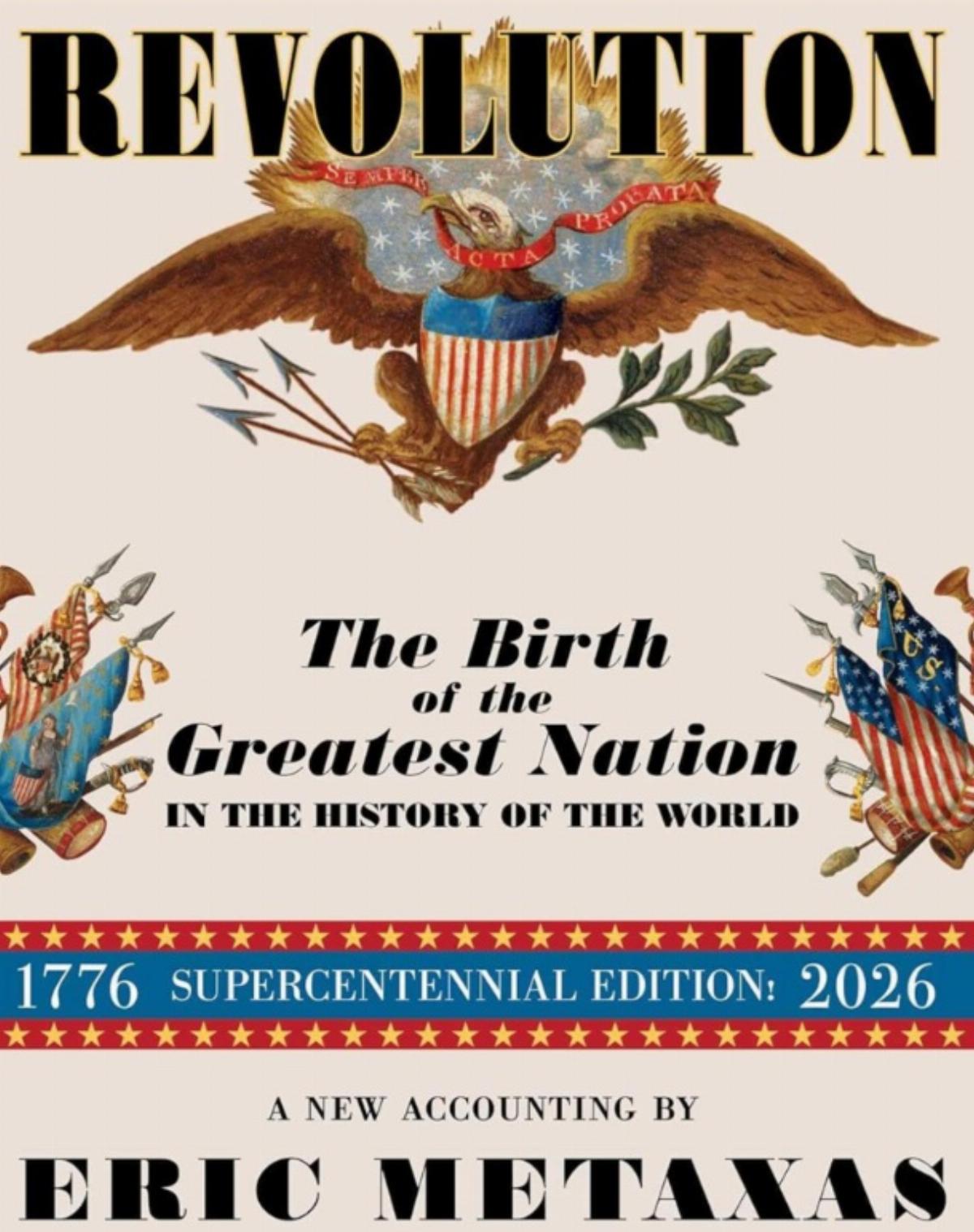
In his defense of British soldiers involved in the Boston Massacre, John Adams declared: “Facts are stubborn things… and whatever may be our wishes, our inclinations, or the dictums of our passions, they cannot alter the state of facts and evidence.” It is the purpose of Eric Metaxas’s Revolution: The Birth of the Greatest Nation in the History of the World, similar to Adams’s words, to present a more comprehensive reading of the facts of the American Revolution than has previously been offered.
Read more Democrat Weaponized Narratives
Metaxas, the author of four New York Times Bestsellers, most notably the #1 Bestseller Bonhoeffer: Pastor, Martyr, Prophet, Spy, has crafted a fast-paced narrative of the American Revolution that makes for an enjoyable 600-page ride through the genesis of our nation. While Revolution may not be the definitive historical statement on the American Revolution, this close reading of our Founders’ perspective, one that faithfully takes them on their own terms, is an admirable effort in anticipation of the 250th Anniversary of our nation’s founding.
Metaxas introduces his work with the perhaps over-bold claim that the “American Revolution is the only genuine revolution in the history of so-called revolutions,” and therefore opts to refer to the event as merely the “Revolution.” Though he endeavors to produce a coherent framework in support of this assertion, it is less in such far-reaching arguments, and more in Metaxas’s engagement with little-known sources, that the text really shines.
Metaxas begins with what John Adams believed was the “opening scene of the revolution”: James Otis Jr. in the Massachusetts state house on February 24th, 1761. On that day, Otis presented two arguments in defense of American merchants charged with smuggling by Parliament: first, Parliament had violated its own constitution, and second, they had violated what would later be called “natural rights.” These arguments, one legal, and one religious, are what Metaxas claims came to define the American Revolution, leading to a Declaration of Independence that “was not merely fussily and legalistically pointing out that England had violated Americans’ legal rights, but dared boldly to point out the sacred Source of those rights and laws.”
In the final analysis, Metaxas’s Revolution is an entertaining and symbolic work faithful to the Founders’ perspective. It includes such episodes as the antics of the Englishman John Wilkes and the 45th issue of his anti-royal magazine, explaining how the number 45 would become an emblem of liberty in America. It is also, however, a work that demands we reconcile the state of the union today with the intent of our national forefathers.
Read more The Denver Post’s Wolf Pup Problem
Metaxas is at his best when he offers his audience the perspective of the Founders in their own words. He reminds us that it was Washington who stated that “morality” was “a necessary spring of popular government,” but cautioned us against indulging “the supposition that morality can be maintained without religion.” And he brings these words of John Adams to the fore: “Our Constitution was made only for a moral and religious people. It is wholly inadequate to the government of any other.”
The Founders’ perspective is 250 years old, but, as Metaxas argues, “to dismiss the views of these men as quaint anachronisms seems not merely cavalier, but arrogant and intellectually dishonest.” Indeed, such perspectives should undoubtedly be consulted in addressing the lively debates of today, given their relevance; according to the most recent Gallup Poll on religion, 65% of Americans still believe, in line with Washington and Adams’s sentiments, that increased religious belief would benefit America.
If we have any desire to fully understand our nation, we must turn to the Founders’ “understanding of why and how it began in the first place,” taking them on their own terms. There is no better time to do so than in anticipation of the 250th, and perhaps no more timely text to do so with than Eric Metaxas’s Revolution.
Joe Silva is an Edwin Meese III Intern at Landmark Legal Foundation. He is a 2026 graduate of Princeton University and will attend Oxford University in the fall.
Read more Obama Rehearses the Liberal Political Formula
Image: Skyhorse Publishing