
For much of my teaching career, I taught Gifted and Talented—GT–classes. Also known as Advanced Placement—AP—classes, they were rewarding for teacher and student, and very much necessary. There was, however, a constant, low-level battle against them.
Read more The UNRWA may finally be in trouble
It was a matter of envy. Admission to those classes depended on recommendations from content area teachers, necessary because students in those classes were expected to absorb more advanced material, a great deal of it, and at a much faster pace than “normal” classes of similar content. They were also expected to perform at the highest levels. There was no grade inflation. Students not capable of “A” grades or unwilling to do the work to achieve them need not apply. And students who proved incapable of meeting those standards were gently eased back into normal classes.
Some students wanted to be in GT classes because their friends were in them, and some parents thought it a reflection on them if their child wasn’t in those classes.
What it all came down to was intelligence and the fact that some people are just more intelligent than others, and more capable of using that intelligence as they choose. Less intelligent people tend not to like that, and in recent years, “experts” have begun claiming intelligence doesn’t matter, it can’t be quantified, or there is no such thing:
“Gifted” programs don’t help children succeed, argues Katie Arnold-Ratliff in a New York Magazine story, The Mirage of the Gifted Child.
“For decades, people in favor of G&T; have promoted the notion that we can put a concrete number to a child’s intelligence, that the smartest children need extra enrichment or acceleration to reach their potential, and that we can measure the beneficial impact of that enhanced learning on the children who receive it,” she writes. It’s not so.
And maybe most of those “gifted” kids are just upper-middle-class kids who know how to game the culturally biased tests or impress the racially biased teacher.
“Intelligence” is a mystery, she writes, listing some of the theories, including the long-refuted notion of “multiple intelligences.” Perhaps it’s “unlikely to be captured very well on a Scantron.”
This is a relatively new approach that is gaining currency in some circles:
Other psychologists reject the notion of a genetic or biological component of intelligence altogether and believe there is no such thing as innate talent or aptitude, that we can all learn anything with the right teacher.
Mark Twain wrote:
There are lies, damned lies, and statistics.
I’d suggest there are lies, damned lies and educational research.
I spent the latter years of my teaching career dealing with educational fads, backed by “research” that “proved” they would provide unimaginable, uniform student achievement. The material and curricula were expensive and flashy, but every single one failed. They were nothing more than repackaged, bad ideas, but they served two primary purposes: They made their producers—mostly former teachers and administrators—a lot of money, and they padded the resumes of lower-level administrators pursuing superintendent jobs. After about a year-and-a-half, they would be quietly dropped and a new, change-the-face-of-education fad substituted. Smart teachers would pretend to teach the fad, while going about their normal, effective, business under the radar. Their kids progressed. The students of fad-teaching teachers, less so.
The lesson is “research,” particularly in education, can be made to “prove” anything, such as the non-existence of talent.
While it’s true most people can learn many things most of the time—if they couldn’t, we couldn’t license people to drive—talent and intelligence are real and selective. We have GT/AP classes because millennia of experience have demonstrated some people are far more academically capable than their peers. We know smart people produce things of value to us all, but not unless they get the instruction they need to fully develop their talents.
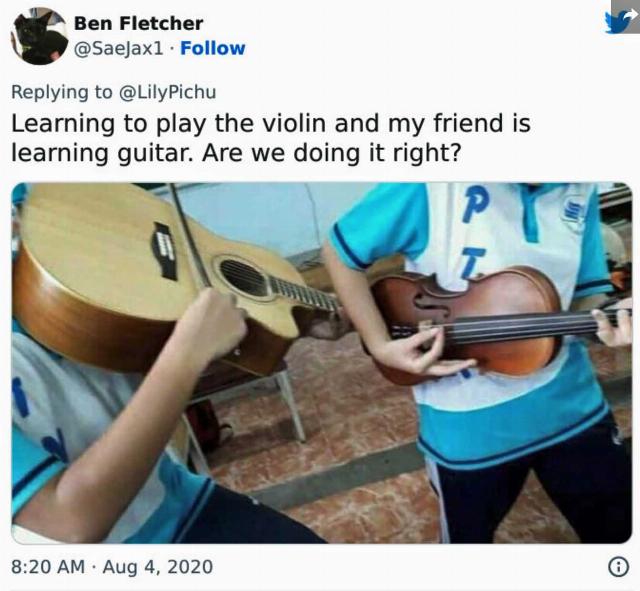
Graphic: Twitter Post
Some people are extraordinarily talented in multiple disciplines while others are capable in just a few or one. Talented musicians may make millions in pop music while being essentially musically illiterate. They can neither read nor write music, yet some of them might become virtuosos, people capable of performing at the highest levels. Eddie VanHalen was such a performer; his playing influenced by Mozart, arguably history’s greatest musical talent.
Others might be brilliant mathematicians. They see the secrets of the universe in numbers but find other academic pursuits boring, even largely irrelevant.
One would think people whose egos are caught up in “diversity” would appreciate the reality of the variability of human intelligence and talent and the necessity of providing the advanced instruction the gifted and talented need. Sadly, they’re blind to the realities of human nature, among them, envy.
Become a subscriber and get our weekly Friday newsletter with unique content from our editors. These essays alone are worth the cost of the subscription.
Mike McDaniel is a USAF veteran, classically trained musician, Japanese and European fencer, lifelong athlete, firearm instructor, retired police officer, and high school and college English teacher. He is a published author and blogger. His home blog is Stately McDaniel Manor.
Read more How to beat the housing crunch