
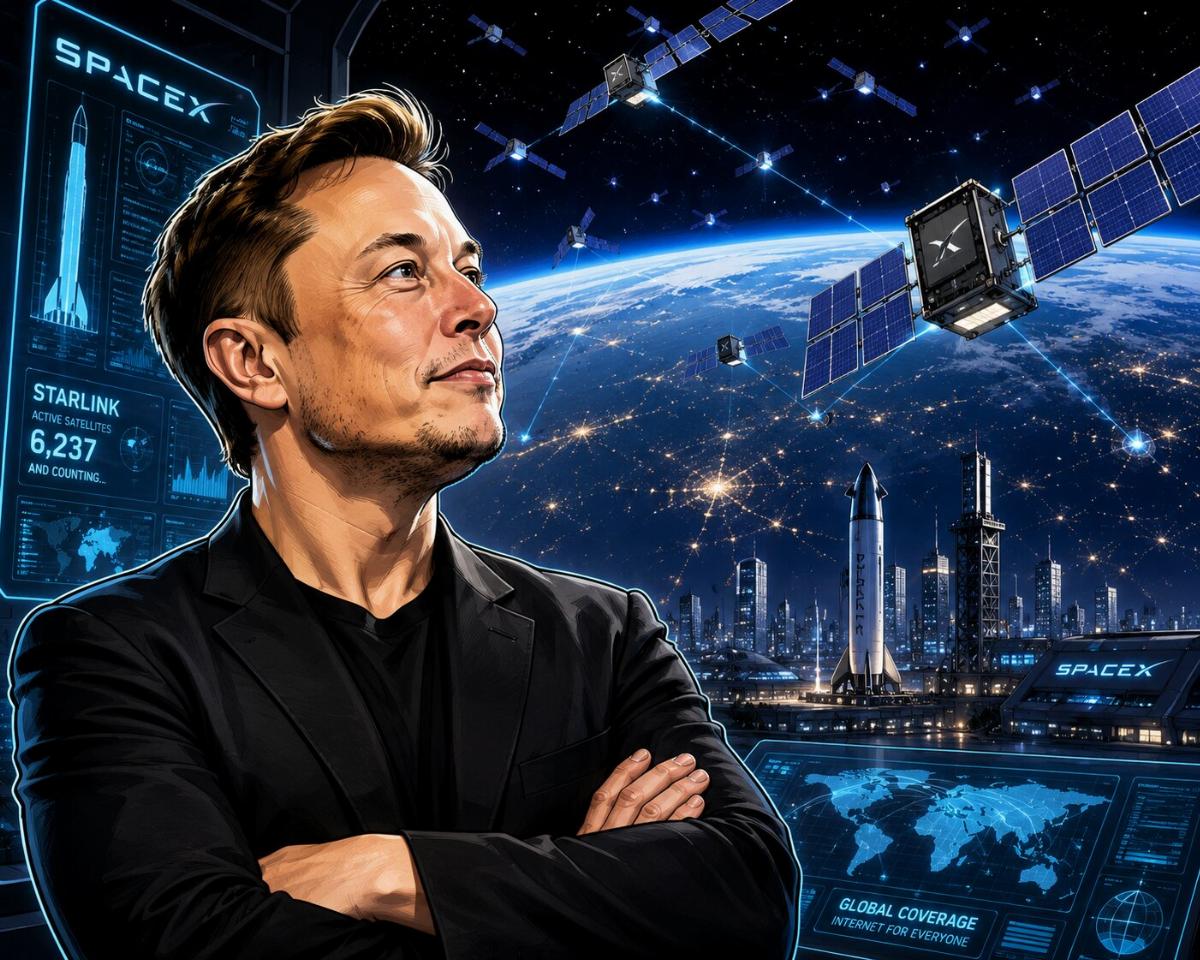
One of the most remarkable aspects of SpaceX’s recent IPO is not its launch business or the Starlink network. Rather, it is the company’s vision of creating a new category of infrastructure in space: orbital data centers. In investor presentations accompanying the IPO, SpaceX highlighted space-based computing as a potentially transformative market and described it as a long-term answer to one of the greatest bottlenecks of the AI age: the shortage of energy and computing capacity on Earth.
Read more Tehran: Dog Day Afternoon Redux
The concept moved from speculation to serious discussion on January 30, 2026, when SpaceX filed an application with the Federal Communications Commission (FCC) seeking permission to deploy a new orbital data center system consisting of up to one million satellites. According to the filing, these satellites would be equipped with advanced computing capabilities and interconnected through optical laser links, creating a vast computing infrastructure in orbit. The FCC formally accepted the application for review in early February.
The idea may sound futuristic, but it addresses a very real problem. Global demand for computing power is growing at an unprecedented rate. Artificial intelligence, cloud computing, streaming services, autonomous systems, and scientific research require ever-larger data centers. Already today, data centers rank among the largest industrial consumers of electricity, and AI-related demand is increasing far faster than most other segments of the digital economy.
At the same time, terrestrial expansion faces growing obstacles. In many regions, electrical grids are approaching their limits. New data centers often wait years for grid connections and permits. Suitable land is becoming scarce, cooling water is increasingly controversial, and environmental opposition is growing. Data infrastructure has also become a geopolitical issue, as governments increasingly view computing capacity as critical national infrastructure.
From this perspective, space offers several potential advantages.
The most important concern is energy. In low-Earth orbit, particularly in sun-synchronous orbits, satellites can receive sunlight during most of their orbital cycle. Unlike terrestrial solar installations, they are unaffected by weather, cloud cover, or atmospheric losses. This allows significantly higher utilization rates of solar arrays. SpaceX argues that orbital infrastructure could eventually overcome the energy constraints that increasingly limit AI development on Earth.
A second advantage is the absence of many terrestrial location constraints. Orbital facilities require no land acquisition, consume no freshwater for cooling, and are not subject to local zoning disputes. While launch licenses, spectrum allocations, and international regulations remain necessary, many of the political conflicts surrounding large-scale data centers disappear.
A third advantage involves proximity to space-based systems. Satellites generate enormous quantities of data for communications, Earth observation, navigation, and scientific applications. Processing data directly in orbit could reduce transmission requirements, lower bandwidth demands, and improve overall system efficiency.
Resilience is often cited as another benefit. Orbital computing systems are independent of regional power outages, earthquakes, floods, and other terrestrial disruptions. They could serve as a redundant complement to ground-based infrastructure.
Read more New York Knicks fans: We are the champions … so let’s destroy stuff!
Nevertheless, major challenges remain.
For decades, launch costs made orbital data centers economically impossible. Reusable rockets have changed that equation. Falcon 9 dramatically reduced launch costs, and Starship is expected to lower them even further. Without these developments, the current discussion would not exist.
Cooling represents another challenge. Contrary to popular belief, the cold environment of space does not automatically make cooling easy. In a vacuum, heat can only be removed through radiation. Since radiation is relatively inefficient, large radiator systems are required. These structures add mass, complexity, and cost. Hybrid systems combining liquid cooling with radiative heat rejection are currently regarded as the most realistic approach.
Radiation presents an additional obstacle. High-energy particles can damage electronic components and shorten the lifespan of processors. To mitigate these effects, engineers employ shielding, error-correcting systems, radiation-hardened components, and extensive redundancy.
Despite these challenges, experimental progress is accelerating. In late 2025, startup Starcloud launched a satellite carrying a high-performance Nvidia GPU and successfully operated advanced AI workloads in orbit. The company later announced plans for a much larger orbital computing constellation.
SpaceX is not alone. Google has reportedly explored similar concepts through its research-oriented Project Suncatcher, examining how AI infrastructure could eventually be deployed beyond Earth. The fact that multiple major technology companies are investigating orbital computing suggests that the concept is increasingly being taken seriously.
Commercial deployment on a massive scale remains years away, and critics point to concerns about orbital congestion, space debris, and astronomical observations. Yet the broader significance should not be underestimated.
The history of technology repeatedly shows that entirely new industries emerge when entrepreneurs gain access to previously inaccessible resources. Just as railroads opened the American West and fiber-optic networks enabled the Internet economy, orbital computing may eventually transform space into a new domain for digital infrastructure. Whether SpaceX ultimately succeeds or not, the company’s IPO has made one thing clear: the future competition for computing power may not be fought solely on Earth, but increasingly in orbit.
Rainer Zitelmann is the author of the book “New Space Capitalism”
Image generated by ChatGPT.