
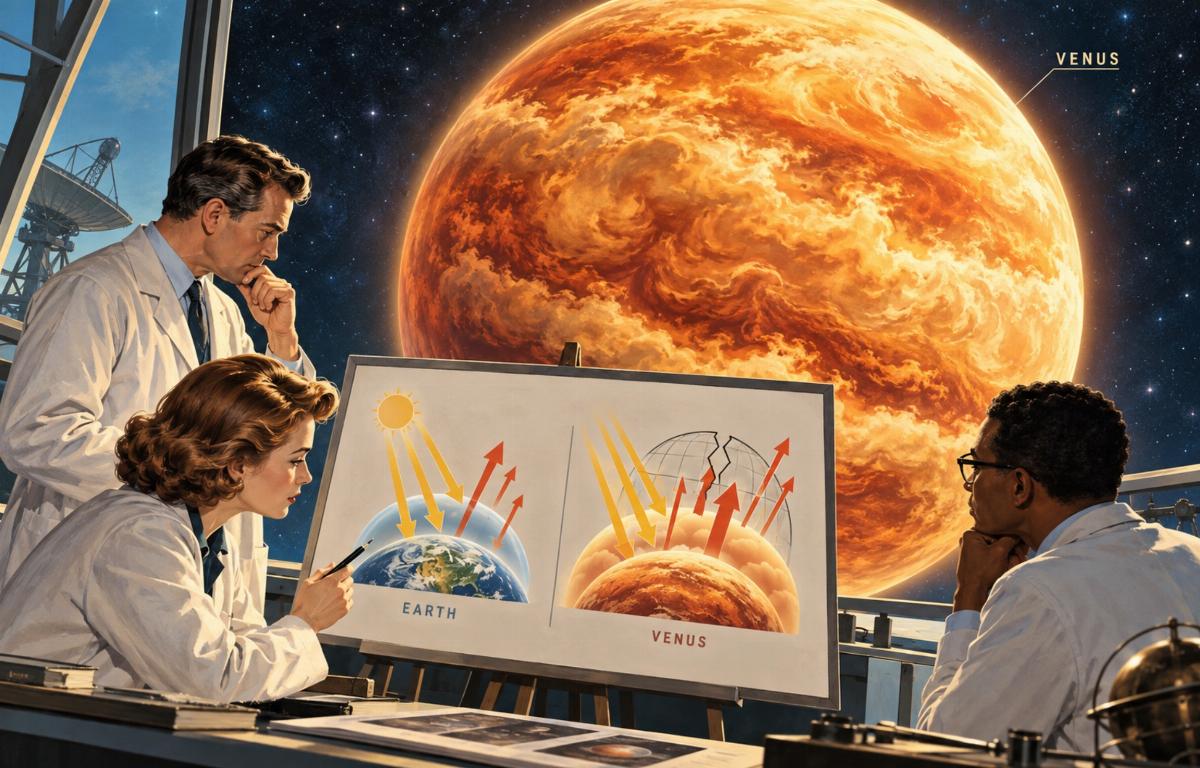
Climatologists continue to insist that the extreme surface temperature of Venus is caused by its carbon-dioxide-rich atmosphere. As a physicist who has undertaken extensive, self-funded postgraduate research into atmospheric thermodynamics—including a world-first discovery published in my 2013 paper Planetary Core and Surface Temperatures—I can state unequivocally that this claim is physically untenable. The same applies to Earth: carbon dioxide, methane, and water vapor cannot be the drivers of global mean surface temperature.
Read more Europe and Russia Flirt with Nuclear War
Because Venus has a far deeper atmosphere than Earth, little more than ten percent of Earth’s solar flux reaches its surface. Such a weak flux is nowhere near sufficient to explain the observed surface temperature. Yet when the IPCC first published its “Energy Budget Diagrams,” it overlooked a fundamental error: the diagrams showed only solar radiation warming the surface. That is not what happens, and the laws of physics make this clear.
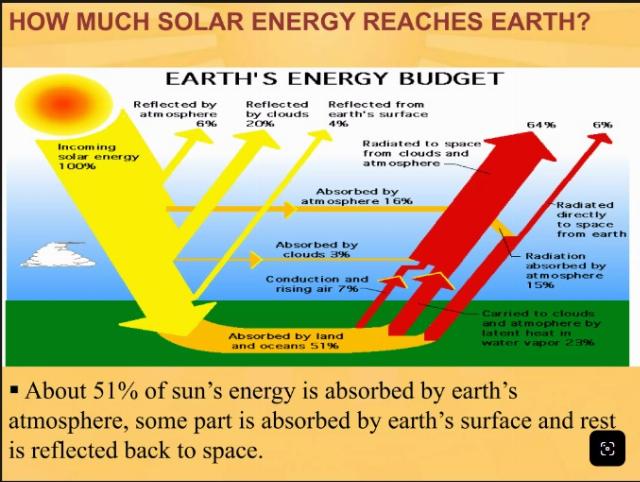
Early IPCC diagrams claimed that direct solar radiation warmed the surface and that “greenhouse gases trap heat,” supposedly forcing the solar flux to produce far more warming than physics allows. But applying the Stefan–Boltzmann Law to the IPCC’s own numbers reveals a glaring contradiction: the amount of solar radiation allegedly absorbed by Earth’s surface (51% of the incident flux at the top of the atmosphere) could produce only a global mean surface temperature of about 233 K—roughly –40°C. That climatologists failed to recognize this for decades speaks volumes about the level of physical rigor behind the “settled science.”
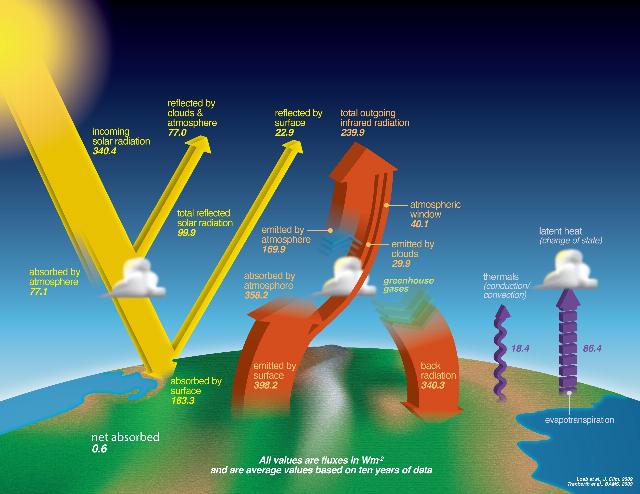
By the 1990s, the IPCC quietly abandoned the “heat-trapping” claim. Modern IPCC documents state that greenhouse gases merely absorb and emit radiation [1]. Their updated diagrams reflect this reversal by showing an enormous downward flux of infrared radiation—roughly equal to the entire solar flux at the top of the atmosphere, even though about 20% of that solar flux is reflected before reaching the surface. This downward flux has never been measured; it is simply calculated to make the numbers add up.
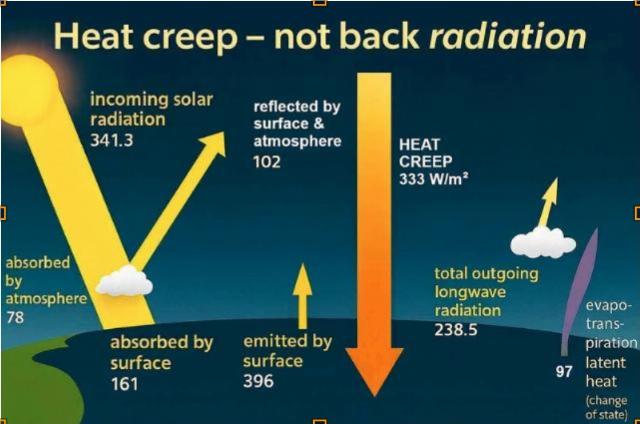
The problem is that the missing energy is not supplied by radiation at all. It is supplied by a non-radiative, downward convective heat flow that I have identified and termed “heat creep.” This process can occur only in a force field such as gravity. Ironically, the IPCC’s own diagrams implicitly acknowledge that greenhouse gases radiate energy away—meaning they do not trap heat.
The Contradiction at the Heart of Greenhouse Theory
- If greenhouse gases trap heat, they should reduce outgoing radiation—not create a new downward flux.
- If greenhouse gases merely absorb and re-emit radiation, they cannot emit more than they absorb—yet modern diagrams show exactly that.
Despite the IPCC’s reversal, agencies such as Australia’s CSIRO still publish outdated claims. Their website states: “Atmospheric trace gases that trap heat are known as greenhouse gases” [2]. Freedom of Information responses confirm that the CSIRO has never assessed the IPCC’s “settled science.” This constitutes what the law calls Negligent Misstatement.
The IPCC attempted to salvage the theory by introducing “radiative forcing,” defined as a change in net irradiance (at the top of the atmosphere) caused by a change in greenhouse gases [3]. But this concept conflates cause and effect. Variations in net flux at the top of the atmosphere are overwhelmingly driven by changes in cloud cover—which, in turn, correlate with cosmic ray intensity. Yet the IPCC claims that greenhouse gases somehow alter this balance and thereby warm the surface, even though the surface is far hotter than the upper atmosphere.
Venus: The Planet That Breaks the Greenhouse Narrative
Hans Jelbring was among the first to recognize, in 2003, that planetary surface temperatures are not supported by the grossly overstated downward fluxes claimed for trace gases but instead appear to have something to do with gravity [4].
Read more Communism vs. Christianity
Venus provides decisive evidence.
Surface temperatures on Venus are nearly constant everywhere, yet the Stefan–Boltzmann Law shows that radiation from its surface exceeds 16,000 W/m². On the dark side, with no solar input, a location on the equator must cool as it spends roughly 58 Earth days in darkness. Measurements show a temperature range of about 462–465°C—a cooling of roughly three degrees [5]. That cooling must be matched by comparable warming on the sunlit side because Venus exhibits no significant long-term cooling.
But the solar flux at the Venusian surface is only a small fraction of Earth’s. It is far too weak to produce the required warming. And radiation from the cooler Venusian atmosphere cannot raise the temperature of a hotter surface.
This leaves a mystery—one resolved only by the “heat creep” process demonstrated in my published work. The Appendix of Planetary Core and Surface Temperatures shows real-world cooling effects by water vapor consistent with my explanation in that paper. No counter-analysis or study using comparable methodology has ever been published.
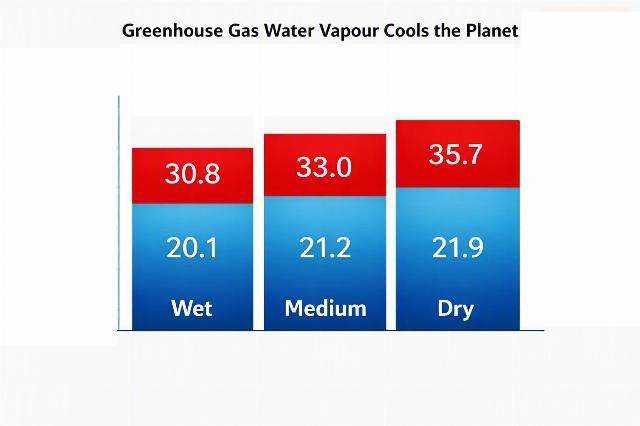
All claims of greenhouse warming depend on an assumption of positive water-vapor feedback. Yet valid physics and empirical evidence indicate negative feedback—unsurprising, given that rainforests are cooler than dry deserts under comparable solar conditions.
The Decisive Point
Anyone with an understanding of undergraduate physics can follow the argument in the above paper (available on SSRN and ResearchGate). Even without such a background, one fact is decisive:
A location on the Venusian equator cools by about three degrees during its passage through the dark side and must warm by the same amount when it returns to sunlight—yet the solar flux at the surface is far too weak to cause such warming, and radiation from a cooler atmosphere cannot heat a hotter surface.
Climatologists cannot resolve this contradiction. My published work does.
Readers may access the full explanation at: https://climate-change-theory.info
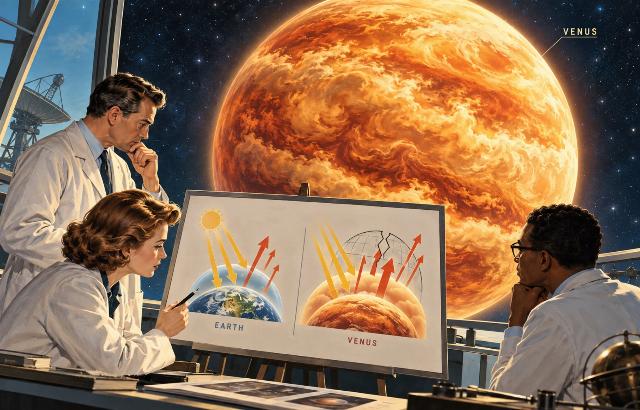
Image created using AI. All other images are in the public domain.
References
[1] IPCC Third Assessment Report—Greenhouse Gas Physics
[2] CSIRO Greenhouse Information Paper—“Atmospheric trace gases that trap heat”
[3] IPCC AR5—Radiative Forcing Definition
[4] Jelbring, Hans. The Greenhouse Effect as a Function of Atmospheric Mass, Energy & Environment, Vol. 14, Nos. 2 & 3, 2003.
Read more Can Today’s Youth Violence Be Traced To A Pill?
[5] Optical Mechanics—Venus Unveiled: Atmosphere, Volcanoes, Missions