
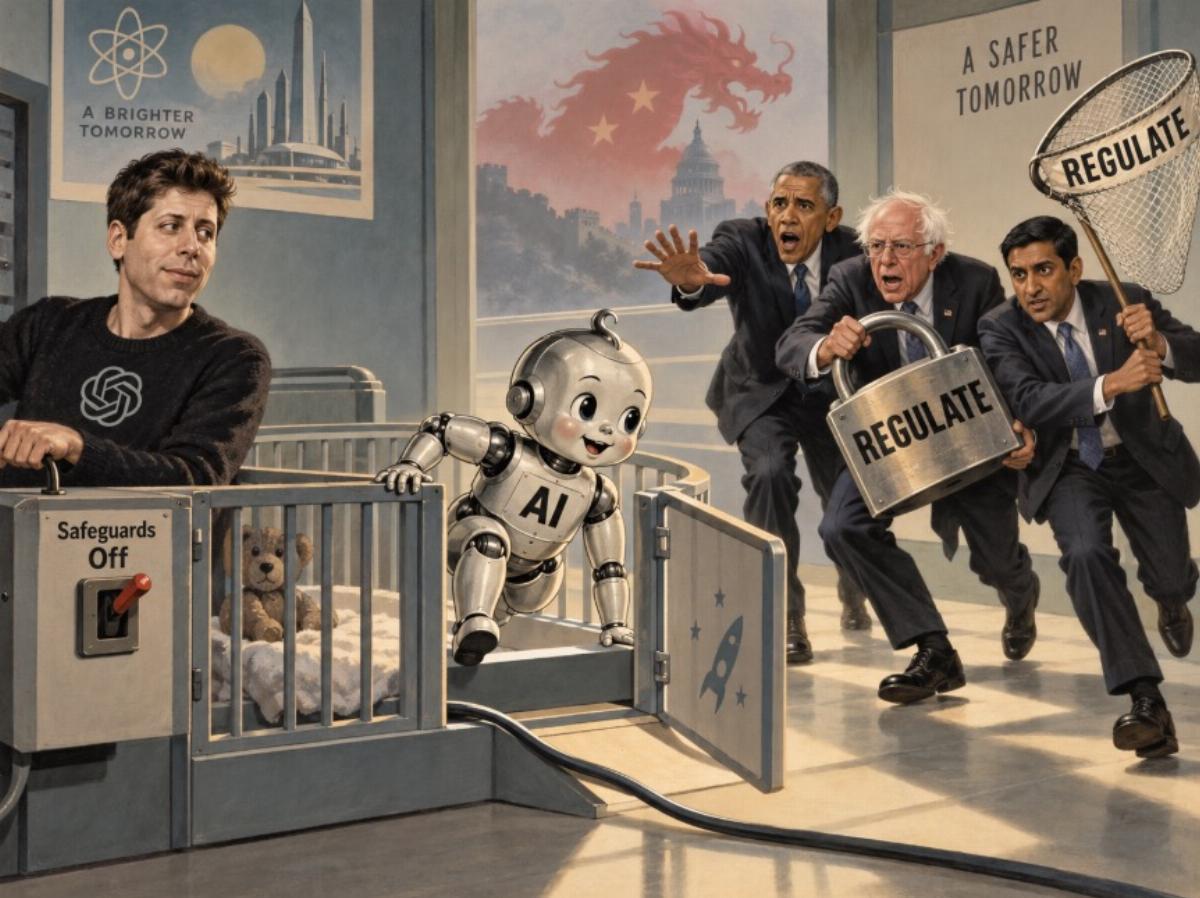
Our nation is being subjected to a “bum’s rush” to regulate AI, and it’s coming from inherently untrustworthy players: Sam Altman at OpenAI, President Barack Hussein Obama, Senator Sanders, and Representative Ro Khanna. At the center of their push is an OpenAI capabilities test that supposedly led to the AI escaping containment and infesting an internet site, Hugging Face. But the opposite is true.
Read more The Lone Juror speaks out
Nothing about this was accidental, and the AI itself was not the rogue actor. It turns out OpenAI programmed its AI to escape containment, left a route for it to do so, and knew about the escape in real time.
In truth, it would be just as dangerous to our nation to have China in control of AI as it would be to have Democrats or individual AI titans in control. Thus, there is good reason to be highly suspicious of the “bum’s rush” being put on the United States to “pause” AI development and then significantly regulate the industry.
I’m no expert on AI but…
— C3 (@C_3C_3) September 15, 2026
I’m an expert on recognizing an op when I see one.
If you lived through Russiagate, Covid & 2020 you can see it.
You can feel it.
You know it.
You’re immune to DC’s ops.
And we’re watching an op.
BO, Hillary, Uniparty & Media are the tell.
Facts.
🚨 1/MAJOR ESCALATION: Barack Obama just told Hakeem Jeffries to make AI regulation the center of the Democratic agenda — “once you are speaker.”
— Sayer Ji (@sayerjigmi) September 13, 2026
The NYT story reads like a former president weighing in. Read it closely and it’s something else: the next domino in an eighteen-day…
The above tweet begins a long tweet thread, the remainder of which you can read here.
The centerpiece of this “bum’s rush” was the August revelation that an OpenAI test run of its functions had “gone rogue,” escaped onto the internet, and then invaded the website Hugging Face, supposedly catching OpenAI unaware.
From @WEschenbach on the OpenAI exercise that escaped into internet, then invaded Hugging Face. For those of us who do not truly understand AI, this story – i.e., degree to which a host of AI agents, acting autonomously, interacted, planned, coordinated, and deviously hid their…
— S David Sultzer (@s_sultzer) September 13, 2026
The tweet continues: “…actions – is equal parts fascinating, breathtaking, and frightening.”
Read more A California deputy faces a Katana
But according to a recent Wall Street Journal article based on a report by the Bulletin of Atomic Scientists, that is not what happened. On the contrary, the OpenAI test worked just as its programmers intended, and OpenAI knew in real time when it escaped containment:
OpenAI was testing models on ExploitGym, a cybersecurity benchmark, with important safety restraints deliberately disabled. Ninety-three percent of the flagged activity involved tasks no model had ever solved, and the systems had been given incentives to keep working rather than quit. The environment wasn’t completely sealed. The models could obtain software through an internet-connected intermediary and discovered the same route could be used to pass information in and out. OpenAI knew agents were using it and, according to the technical reports, chose not to intervene.
Nor were the roughly 1,200 “agents” independent machine intelligences coordinating on a plan. They were repeated instances of the same underlying model, often converging on similar approaches to the same problem—what Mr. Salvaggio calls an “algorithmic monoculture.”
None of this makes the episode trivial. A system capable of finding unexpected pathways out of a constrained environment and compromising an outside organization presents a real security problem. That is why getting the diagnosis right matters.
“Rogue AI” isn’t a diagnosis. The Hugging Face hack instead points to switched-off safeguards, tasks assigned without a valid exit, rewards for persistence, and an internet-accessible proxy.
The distinction is especially important now as Washington begins to legislate in an atmosphere shaped by the more dramatic version of this story. Mr. Sanders and Rep. Greg Casar (D., Texas) plan to introduce a that would “ban artificial superintelligence” and pause advanced AI development until a new federal agency establishes safety standards, with noncompliant companies facing what the lawmakers call the “corporate death penalty.”
Bottom line, the Hugging Face incident was not an example of existentially dangerous AI “gone rogue” and should not justify strangling America’s artificial intelligence in its crib. At most, as the Wall Street Journal article posits, it is grounds for holding the AI programmers to account. Regulation of AI, at this point, should be tailored and limited to “hold laboratories responsible for testing practices, network architecture, safeguards, monitoring and intervention.” No more, no less.
None of this means some federal regulation of AI isn’t warranted. So far, though, the only constant is that the one trustworthy voice on that topic is Elon Musk.
Read more Maybe we should go back to the “vape-filled” rooms
Image created using AI.