
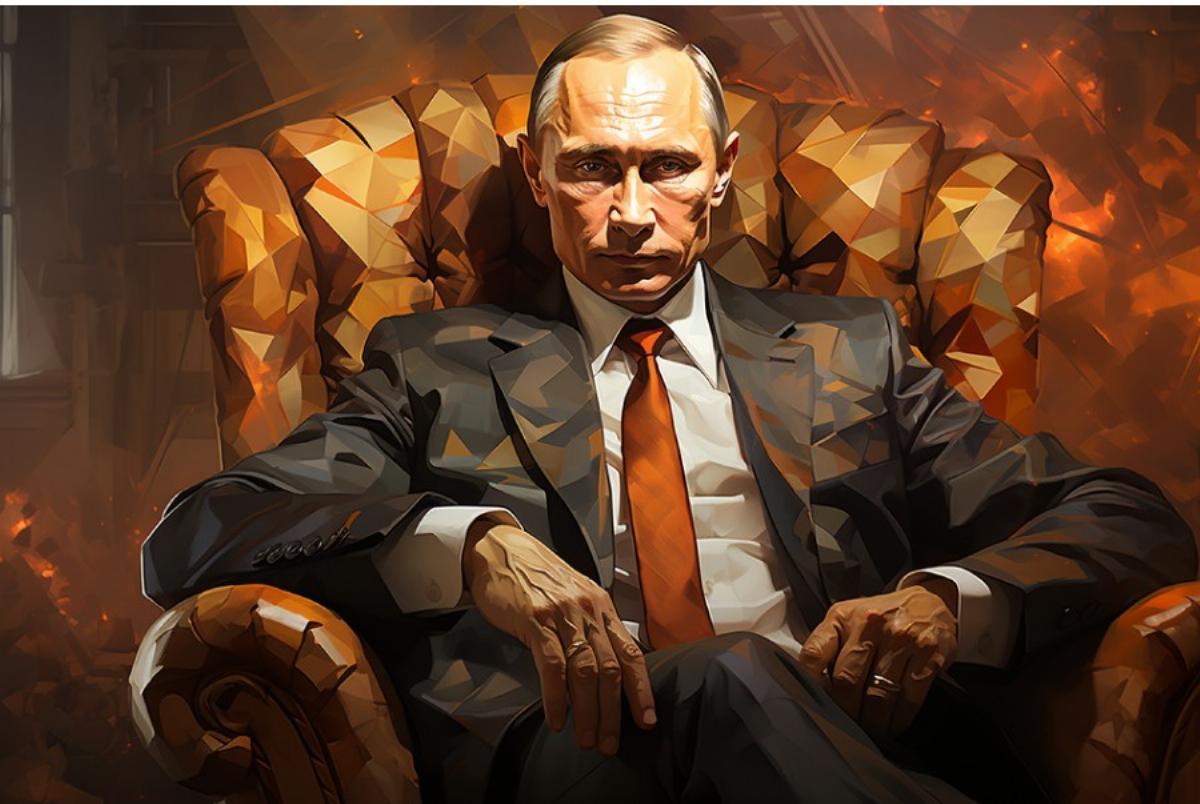
Congress and the mainstream media are politicizing President Trump’s diesel import agreement with Russia as somehow counter-productive because it “funds” Russia’s war chest. It does no such thing. I’ll explain why.
Read more Glad to be sitting on the sidelines
Russia’s oil and gas production, including LNG, reportedly makes up between 30 to 50 per cent of its total federal revenues.
It is initially selling a reported 300,000 metric tons of diesel to the U.S., which is about 2.25 million barrels. Russia produced 10,534,548 barrels of oil per day in 2025 (ranked third worldwide). The amount of oil being sold to the U.S. is so small in relation to their total annual production that it’s almost what they spill. And the revenue from it is not material: its impact on any Russian war finance is net zero.
The announcement did, however, have an effect on diesel futures because of the deal’s potential: they fell about 5% on the news, and last week were trading at $4.64 a gallon. The U.S., interestingly, exports about 1.5 million barrels of diesel per day. That may have to be adjusted for domestic priorities.
Invoking the Defense Production Act, which the White House is reviewing in order to expand refining capacity, along with temporary export bans, will also improve diesel economics in an important way by characterizing it in terms of national security.
The price of diesel is of course also subject to taxation. The biodiesel tax credit expired in 2024. It should be renewed. Truckers benefit immediately, and they need to.
Not surprisingly, Congress is the primary source of conflict over the president’s diesel deal with Russia.
Rep. Brian Fitzpatrick (R-PA) is making it a political cause to block it through an introduction of the “Ronald Reagan Peace Through Strength Act” and claiming he will “force a vote through a discharge petition.”
Perhaps. But it won’t go anywhere. The Senate has to approve it, and President Trump can veto it.
Interestingly, Rep. Fitzpatrick is co-chair of the Congressional Ukraine Caucus.
What is that? The Senate Ukraine Caucus (SUC) was launched on Feb. 9, 2015 by Sens. Rob Portman (R-OH) and Dick Durbin (D-IL) under the Clinton administration. The “Special Inspector General for Operation Atlantic Resolve, Promoting Whole of Government Oversight of the U.S. Ukraine Response,” published a report on the billions in U.S. taxpayer dollars allocated to this larger initiative, which gives a glimpse into how our own Congress prioritizes such interests over national ones, even if the national economy is stressed:
U.S. trucking transports over 70% of all products that Americans, and American businesses buy, including produce, packaged food, clothing, medicines, construction goods, industrial chemicals, and more. The [resident knows this; Congress apparently does not.
Our congressmembers, moreover, can apparently live with oil coming from the current Arab Middle East, flowing through the Hormuz Strait, which funds all manner of unrelated projects and programs that may not serve U.S. security, or Israel security either. That should concern Congress.
And consider that in 2025 we imported $538.96 billion in goods from Mexico, while that country runs what amounts to a narco-terror state that undermines the lives, and livelihood, of Americans. China? We imported $327.48 billion in 2025, providing liquidity for China to arm Iran with advanced defense and attack systems. Not surprisingly, there isn’t a peep of protest from our congressmen.
Meanwhile, Secretary of the Treasury, Scott Bessent, pointed out on Fox News on Sunday that Europe has paid more money to Russia through trade, than it has to finance the war in Ukraine.
Read more Hegseth expects warfighters to be…warfighters?!
The point? Global trade is fungible, and you can’t isolate a country with an international oil industry as complex as Russia. And if they don’t sell it to us, others are lined up. We have no disadvantageous impact on their military operations in Ukraine. The entire world economy is so intertwined, including in banking, that our congressmen couldn’t filter, let alone fully understand, the actual global “plumbing and wiring system” of energy and finance markets if they wanted to. Their criticism of President Trump is pure theatrics — except to our trucking industry.
One of the things that always stood out for me when President Trump first entered the presidential arena was his pragmatic position on Russia: he asked why we couldn’t be on productive terms with them. He was right then, and he is right now.
He is way ahead of Congress because, like it or not, the U.S., China and Russia make up the world power triad, and each benefits from normalized relations. This current oil deal may eventually grow to enhance the returns to shareholder capital, and Russia’s major oil companies have a lot of direct and indirect investors — upstream and downstream — with complex interlinked relationships all around the world. The entire oil supply chain is a global business enterprise.
As for Iran and Ukraine, their fate is tied to the same power triad. So is Israel: its ambitions in Middle East security, and economic growth, put it in a position of greater influence to the extent it enjoys a functional and stable relationship with the three superpowers: it already knows that. Too many in the U.S. government do not.
That raises an interesting question: Ukraine drone strikes on Russian oil targets do not come from Ukraine command per se. Ukraine is a U.K. and EU proxy in technical military operations, and they both are antagonizing the U.S. president publicly, while disrespecting U.S. power. President Trump just demanded that Ukraine stand down on such attacks. It is not only undermining oil markets, but is recklessly provoking Russia, and affecting the U.S.
At some point, if it continues, and if Ukraine ignores President Trump, the EU could, through its Ukraine entanglements, ironically find itself seriously, perhaps dangerously, at odds with the U.S. Along with their obsession to engage Russia in war, they could be faced with what amounts to an effective combined U.S.-Russia alliance. War has a funny way of creating unintended outcomes, even shocking surprises.
Such a U.S.-Russia alliance happened before. It could happen again: From 1941 through 1945, the U.S. sent $11.3 billion, or more than $200 billion in today’s dollars, in complex military goods and services to the Soviet Russians in order to defeat Germany. That should give our Congress something more consequential to think about, as they attack U.S.-Russia cooperation over oil, and blindly follow the U.K./EU project in Ukraine.
Israel also needs to watch its back in this regard. Trade and investment with Ukraine may represent a certain logic, but Israel could unwittingly find itself pressed in the unwanted crucible of a combined two-front conflict, with Russia in Ukraine, and China backing Iran. That could put the U.S.-Israel relationship in a potentially precarious state where the U.S. is unable to come sufficiently to Israel’s aid, and the EU is helpless, defeated and broke.
There is also growing risk in the U.S. from major donor support to the DSA, or “the New Left,” and its potential influence in U.S. government policy. It is a political party of extremist ideology resting in part on radical fundamentalism where Iran is a sympathetic cause, and which could complicate Israel and U.S. priorities in unforeseen ways, including in energy.
President Trump’s diesel fuel deal is more than a transaction: it breaks the ice in diplomacy with Russia at a time when it is smart to do so. The U.S. needs a major power ally given Chinese ambitions, and the Middle East and Israel depend eventually on an Atlantic-Eurasian axis created from these two superpowers. China is more of a Pacific nation.
The U.S. and Russia together make energy, finance and military activity stable within their axis, and it makes the Middle East its center of gravity, rather than its center of conflict.
Matthew G. Andersson is a former aerospace CEO and author. He is a graduate of the University of Chicago, and the University of Texas at Austin where he worked with White House national security advisor W.W. Rostow at the LBJ School of Public Affairs. He has worked in the former Soviet Union and has testified before the U.S. Senate.
Read more Justice finally comes for Nidal Hasan
Image: Pixabay // Pixabay Content License