
On September 28, the U.S. Department of Education formally rescinded the Biden administration’s 2024 Title IX regulations and restored the 2020 regulations to the Code of Federal Regulations. The 2024 rule had already been vacated by a federal court in January 2025.
Read more The AI Writing Jig
The law didn’t change; one word did: “Sex.”
That raises some strange questions: When did we forget what a man is? When did we forget what a woman is?
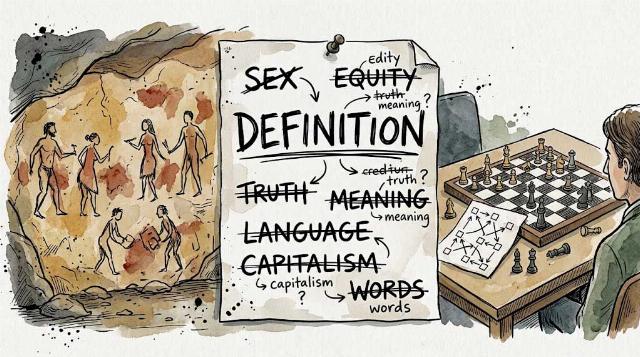
Graphic: Luis Gonzalaz, Chat GPT
Long before written language, prehistoric humans were already depicting human bodies. At Chauvet, more than 36,000 years ago, artists depicted the lower body of a woman, female genitalia, and human hands. At Lascaux, roughly 21,000 years ago, human imagery included an anthropomorphic figure and representations of female and, much less often, male sexual anatomy.
Whatever those ancient images meant to the people who made them, the physical distinction was not invented by a modern political argument.
A man was an adult male human being. A woman was an adult female human being. Those were descriptions of reality. Now they are political arguments.
So, what happened to the words?
Look at Title IX. The law prohibits discrimination “on the basis of sex.” The Biden-era regulations interpreted that language to include discrimination based on gender identity and sexual orientation. The 2020 regulations took a different approach.
Change the meaning of “sex,” and you change the argument about what Title IX protects, what constitutes discrimination, and what schools are required to do.
The statute remains. The argument moved. That is the trick. And once you see it, start paying attention to the words.
Take “equity.” Ask whether people should be treated equally and you’ve opened one argument. Ask, “Why are you against equity?” and you’ve opened another. Now the person answering isn’t merely explaining a position. He’s defending his character.
Then there’s “hate speech.” It sounds like a description. But once the label is attached, the audience has already been told how to regard the speech. We can argue about what was actually said later.
“Phobia” works the same way. Disagreement becomes fear. Fear becomes irrationality. And irrational people don’t need answers.
Then comes “words are violence.” Words can hurt. Of course they can, but “Your words hurt me” describes an experience. “Your words were violence” turns that experience into a claim about what happened.
Watch the conversion:
“I feel harmed” becomes “I was harmed.”
“What you said was harmful” becomes “What you said was violence.”
A feeling has become a fact. The fact has become an accusation.
The trick isn’t convincing people that feelings aren’t real; it is convincing them that feelings are facts.
Read more Escape From Rotherham
“Lived experience” can make the same leap. An experience is real because someone experienced it. That doesn’t automatically establish its cause or prove a larger proposition. And “my truth”takes the argument another step. Once an idea becomes part of someone’s identity, disagreement with the idea can be treated as an attack on the person. Now the proposition has a shield.
This is where political language becomes particularly effective as a weapon. Take a familiar word. Give it a new boundary. Add moral authority. Then make disagreement with the new definition evidence of some moral failing.
You don’t have to win the argument, you only have to make the other guy argue from your premise.
George Orwell understood this long before anyone had heard of Title IX. In Politics and the English Language, Orwell warned that political words could acquire different, even incompatible meanings while retaining their emotional force. He specifically discussed words such as “democracy,” “socialism,” “freedom,” “justice,” and “equality.” Orwell’s point was bigger than bad writing; words can become a way of avoiding reality.
Take “capitalism,” a word that once described an economic system can mean almost anything depending on who is using it. One person means private ownership and markets. Another means corporations. Another means monopoly. Another means exploitation.
Eventually the label stops clarifying the argument. It becomes part of the argument.
Then there’s the question we’ve all heard: “How are you going to pay for those tax cuts?” Sounds reasonable. But pay for what? A tax cut isn’t government spending. It’s less money being taken from taxpayers. So the obvious answer is: by spending less. Yet the question quietly assumes that government spending is fixed and the taxpayer’s money is the variable. The premise has already been chosen. That’s how this works.
Call taxation an “investment” and taking money sounds productive.
Call a tax cut a “cost” and letting people keep their own money sounds irresponsible.
Call censorship “content moderation,” and suppression becomes administration.
Call disagreement “hate,” and disagreement becomes hostility.
Call disagreement “phobia,” and disagreement becomes irrationality.
Ask, “Why are you against equity?” and disagreement becomes a moral defect.
Different words. Same mechanism. The weapon isn’t necessarily the lie; the weapon is the definition.
You don’t have to censor an opposing argument if you can make the vocabulary necessary to express it socially unacceptable. You don’t have to defeat an argument if you can redefine the terms so that anyone who disagrees begins by defending himself. The person who establishes the definition establishes the premise, and once the premise is established, the argument has already begun on someone else’s terms. That’s political power hiding in plain sight.
The great battles over political language aren’t really about dictionaries. They’re about who gets to decide what words mean, what those meanings imply, and whether everyone else must accept them before the argument can even begin. If we surrender the words, we surrender part of the argument.
Once someone else defines the terms, they aren’t merely changing the vocabulary;they’re changing the argument.