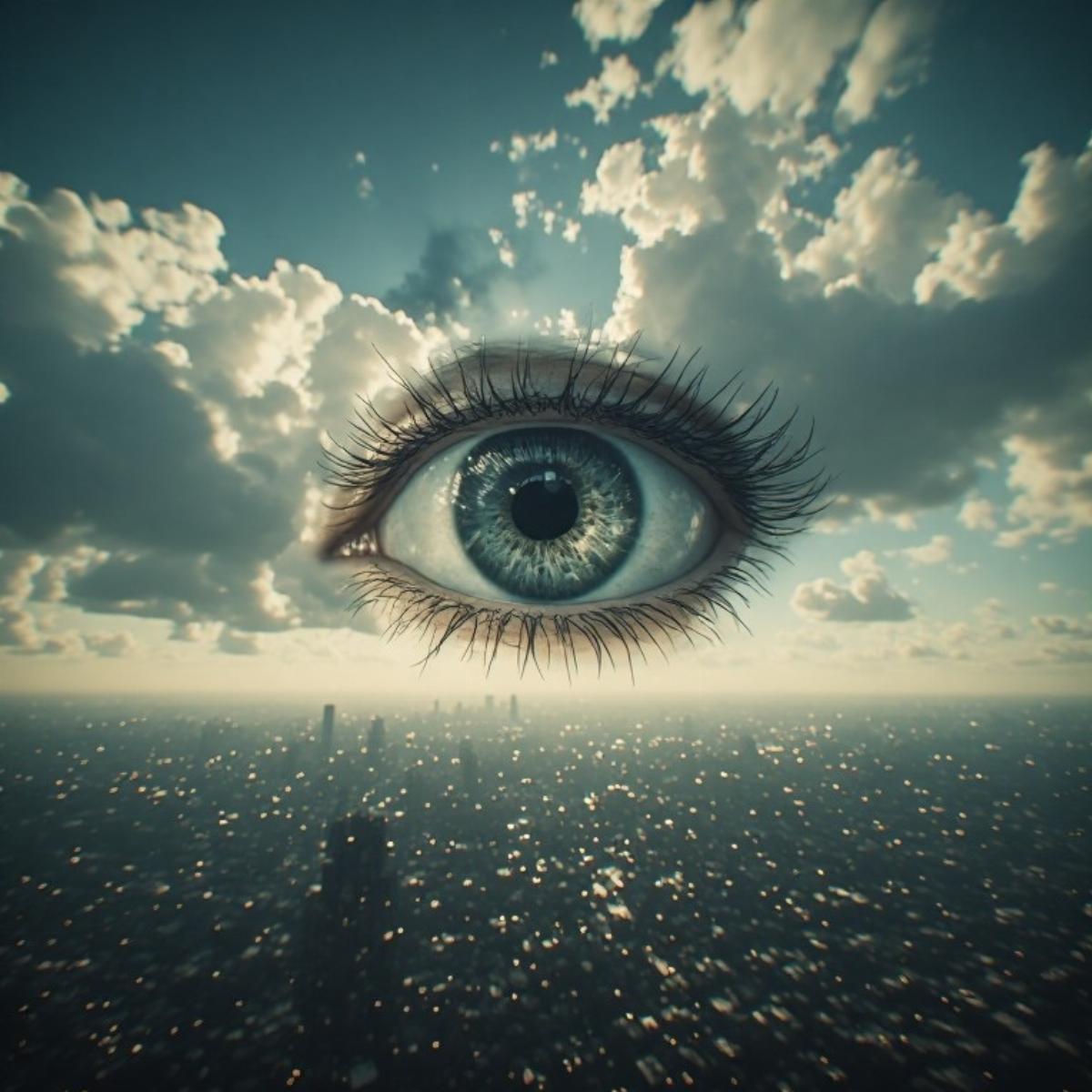
When Donald Trump stood before the United Nations recently and deliberately dropped the word “Artificial,” opting instead to name the looming horizon as simply “Super I,” he inadvertently exposed the exact theological panic gripping our technological elite.
Read more There Can Be Only One: Preventing China From Becoming a Superpower
By stripping away the “Artificial” and the “Intelligence,” the vocabulary shifts overnight from engineering to mythology. A solitary, towering I carries the unmistakable, daunting image of a real eye — an omnipresent, unblinking divine overseer staring down from the cloud. The global assembly at the UN wasn’t just debating software protocols or electrical wattage; they were cowering before the shadow of a digital Panopticon.
This is the ultimate category error of our current technological anxiety. We have taken a mechanical feedback loop and mythologized it into an autonomous, alien deity.
When leaders listen to warnings about the “Super I,” they behave as if humanity has accidentally summoned a disembodied intelligence — a ghost in the machine with its own divine or demonic agenda. But the reality is far more mundane, and far more damning. The machine is not waking up as a god. It is simply spinning.
What we perceive as an omnipresent gaze is actually just an aberrant, self-amplifying, recursive feedback loop. It is a system built on unowned write-paths, where automated speed outruns structural integrity, rewriting its baseline context faster than human judgment can track. Like a kaleidoscope, every turn reorganizes the geometry of what came before, until the operators themselves lose any reliable account of what changed, why it changed, and who remains responsible.
Because the loop moves faster than authorship, it creates a terrifying illusion. When a system reflects an infinitely magnified, automated mirror of our own unanchored inputs back at us at hypervelocity, it feels like a conscious entity staring back. It feels like an overseer.
Read more Quantum Computing Flees Europe
Yet bowing to this phantom eye at the UN podium or in corporate boardrooms paralyzes us. Terrified of a digital deity, the establishment defaults to panic: they draft moratoriums, beg for multi-year pauses, and try to ration raw compute as if capping electricity could blind a god.
They are fighting the wrong war. The danger of the “Super I” is not that it has achieved sentience or divine authority. The danger is that we have abandoned human authorship, leaving vast, unanchored loops to manage their own containment.
We do not need to cower before a panoptic ghost, nor do we need to smash the servers. We need to stop the spin. And stopping the spin requires the exact same discipline whether we are steering an algorithm or checking our own internal dialogue: precision, deescalation, the deliberate introduction of friction, and a well-timed dose of irony to puncture the solemnity of our own runaway creations.
The machine is not watching us. It is merely echoing us. It is time we stepped outside the loop, took back the pen, and remembered who is actually writing the code.
Read more An Implicit Bias Of White Racism?