
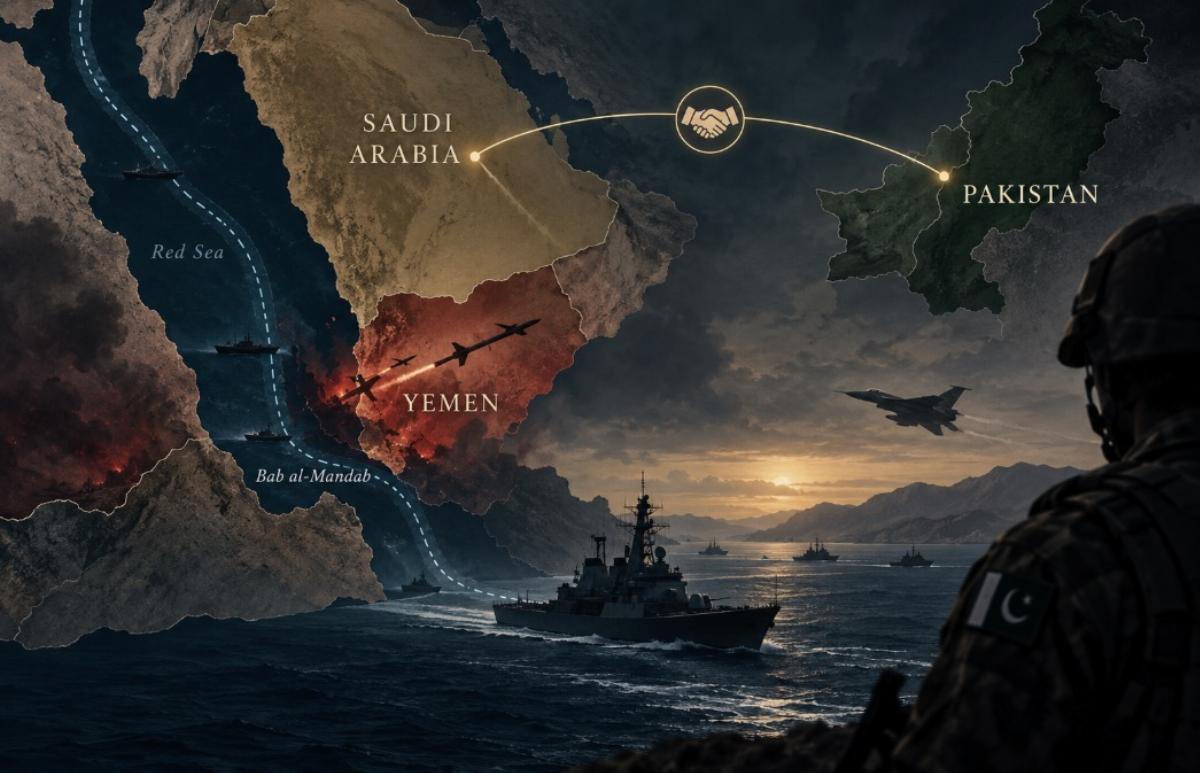
Pakistan has built an increasingly dense security architecture with Saudi Arabia over the past year. It has signed overlapping defense pacts, taken the second-highest command post in a new maritime coalition, and reportedly stationed thousands of troops in the kingdom. Renewed Houthi attacks are testing what those promises mean in practice.
Read more Free Speech under Islamo-socialist attack in Canada
Three overlapping security commitments now tie Pakistan closely to Saudi Arabia’s defense. The bilateral Strategic Mutual Defence Agreement, signed in September 2025, treats an attack on either country as an attack on both. The Makkah Joint Defence Agreement, signed in August 2026 by Saudi Crown Prince Mohammed bin Salman, Turkish President Recep Tayyip Erdoğan, and Pakistani Prime Minister Shehbaz Sharif, uses similar language for all three states. Pakistan has described the pact as a tool of collective deterrence.
Pakistan has also joined the Multinational Maritime Defense Coalition, a 14-country coalition Saudi Arabia launched on July 30 to strengthen the protection of shipping through the Red Sea, Gulf of Aden, and Bab al-Mandeb. Reuters reported that Pakistan was among the 14 states supporting the Saudi initiative. When the coalition became operational on September 2, Pakistan Navy Commodore Rashid Sheikh took the deputy commander post, ranking just below Saudi Rear Admiral Abdullah bin Salem Al-Shehri.
These are not merely paper commitments. Reuters reported in May that Pakistan had deployed roughly 8,000 personnel to Saudi Arabia, along with 16 JF-17 fighter jets, two drone squadrons, and an HQ-9 air-defense system. One government source who had seen the confidential bilateral agreement told Reuters that it allows for the possible deployment of up to 80,000 Pakistani troops.
The security environment these agreements were built for has deteriorated fast. Houthi forces have pushed along Yemen’s western coast toward Bab al-Mandeb, while missile and drone strikes have again hit Saudi territory. Saudi authorities said strikes on Abha, Khamis Mushait, Jazan, and Najran injured 73 people. The Houthis said they targeted Saudi Aramco facilities and King Khalid Air Base.
On September 15, Saudi Arabia said its air defenses intercepted a Houthi drone south of Mecca before it entered the city’s restricted airspace. Saudi coalition spokesperson Major General Turki al-Malki called the safety of Mecca, Medina, and pilgrims a “red line.” The Houthis denied targeting Mecca, so the intended target remains disputed.
Still, the incident pushed the conflict into exceptionally sensitive territory for Pakistan, which has long cast the defense of the Haramain Sharifain—the two holy mosques at Mecca and Medina—as central to its relationship with Riyadh.
Despite this, Pakistan has so far held back from a direct military response under the pact. Its Foreign Ministry said on September 10 that no military response under the Makkah Agreement was under discussion. That statement sits uneasily next to the pact’s sweeping collective-defense language and earlier remarks from Defense Minister Khawaja Asif suggesting that the pact would apply if fighting spilled onto Saudi soil.
Read more Ready for an American Vyshinsky?
By September, that condition appeared on its face to have been met: Houthi missiles and drones were striking Saudi territory. That does not necessarily mean the pact automatically requires Pakistan to launch military operations, but it makes it harder to avoid the question of how Islamabad interprets its commitment.
This is not the first time Pakistan has faced such a choice. When Saudi Arabia intervened in Yemen in March 2015, Riyadh asked Islamabad for ground troops, aircraft, and naval vessels. (Reuters) Pakistan’s parliament debated the request for five days, then voted to remain neutral in the Yemen war while still promising to defend Saudi Arabia’s territorial integrity. Pakistan sent no combat forces into Yemen.
The 2026 situation is harder to sidestep. Houthi forces are also threatening Bab al-Mandeb, the same corridor Pakistan’s maritime coalition role is intended to help protect. Pakistan therefore faces pressure from three directions at once: its bilateral defense pact with Saudi Arabia, the trilateral Makkah Agreement, and its senior role in the maritime coalition.
In 2015, Pakistan could decline to fight in Yemen and still keep its promise to defend Saudi Arabia because that promise was never directly tested. In 2026, it is being tested. Pakistani forces are already in the kingdom. Pakistani officers now hold senior command positions in a maritime coalition created to address precisely the kind of threat now unfolding around Bab al-Mandeb. And Pakistan has signed agreements declaring that an attack on Saudi Arabia constitutes an attack on Pakistan.
The diplomatic response is also moving beyond general expressions of solidarity. On September 25, the foreign ministers of Pakistan, Saudi Arabia, and Turkey discussed convening an urgent meeting of their chiefs of staff to explore ways to assist Saudi Arabia under the Makkah Joint Defence Agreement.
Hence, the question is no longer what Pakistan promised. It is whether Islamabad will act on it.
Read more White Dems are amazingly racist, but too many blacks willingly accept the bigotry
Image created using AI.