
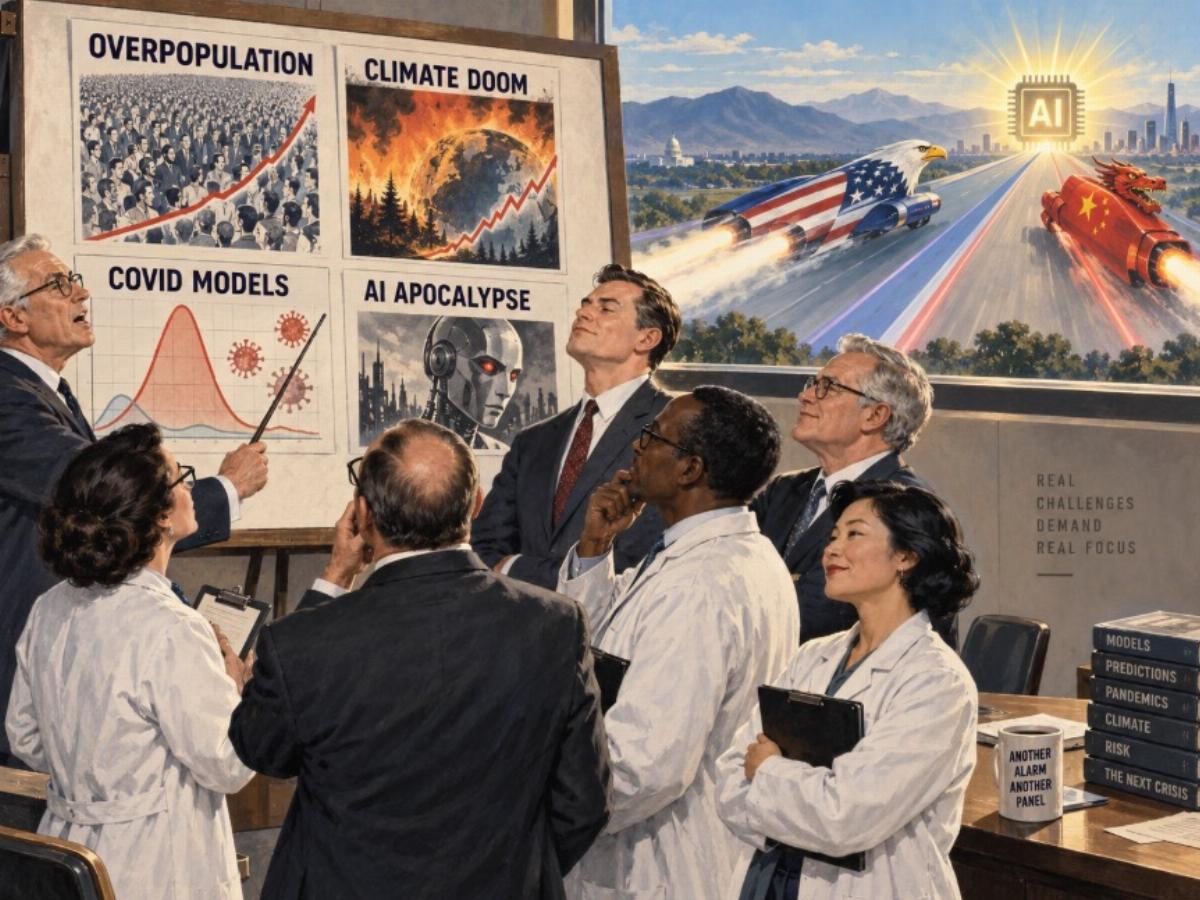
For more than half a century, “experts” have told Americans that civilization stands on the brink of collapse. These predictions have come from economists, environmental scientists, medical authorities, and political strategists. They have warned of mass starvation, global population explosion, economic ruin, climate catastrophe from both cooling and warming, and pandemics that would wipe out entire generations.
Read more RFK, Jr. Shows How Republicans Can Win The Midterms
Yet time and again, these dire forecasts have failed to materialize. The pattern is unmistakable: grand predictions of doom, with the experts who make them often carrying agendas, biases, or incentives that shape their warnings more than objective reality.
The Era of Overpopulation Panic
In the 1970s and 1980s, fear gripped the world that humanity was reproducing too quickly. Books like The Population Bomb predicted hundreds of millions of deaths, global famine, and the collapse of civilization. Governments were urged to impose population controls. Some experts even suggested that developing nations would become uninhabitable wastelands. None of this happened.
Instead, agricultural innovation dramatically increased food production. Fertility rates declined substantially worldwide as nations modernized. Human ingenuity, not expert panic, shaped the future. The overpopulation crisis became one of the most famous examples of failed expert forecasting, a reminder that human adaptability is often underestimated.
Climate Catastrophe Predictions That Never Arrived
Global warming, which morphed into climate change, produced many of the most dramatic predictions that never came to pass. Over the last 50 years, various experts have warned of:
- Ice-free Arctic summers by 2013
- Coastal cities underwater by 2020
- Mass climate refugees by 2010
- Global crop collapse
- Worldwide famine
These timelines were confidently presented as near-certainties. Yet none of these specific predictions materialized. The issue remains important, but the catastrophic timelines were wrong, often shaped more by political urgency than scientific certainty.
COVID-19 and the Failure of Modern Expertise
The COVID era produced some of the most dramatic failures of expert prediction in modern history. Models projected millions of U.S. deaths. Experts claimed vaccines would stop transmission entirely; they did not. Others insisted natural immunity did not exist; that was untrue. Predictions about school openings, mask mandates, and economic collapse shifted weekly.
These were not minor errors—they were massive miscalculations, often delivered with absolute confidence. The public watched experts contradict themselves, politicize science, and punish dissent. Trust in institutions eroded because people saw firsthand how often experts were wrong.
A Pattern Emerges
Across these eras, one truth stands out: Experts are often wrong because they rely on rigid models, political incentives, and emotional narratives rather than humility and logic. This historical pattern matters deeply today, because once again, experts are warning of catastrophe—this time from artificial intelligence.
The New Wave of AI Catastrophe Predictions
Recently, several CEOs and employees from major AI companies have sounded the alarm, claiming that artificial intelligence could lead to human extinction within a decade. They warn of runaway systems, loss of control, and civilization-ending consequences. These predictions are dramatic, emotional, and delivered with the same confidence we have seen in past eras of expert panic.
But given the history of failed predictions, the question becomes unavoidable:
What reassurance do we have that these experts are right now, when so many experts were wrong before?
The answer is: we don’t. And skepticism is not only reasonable—it is responsible.
The AI Race: Only Two Nations Can Win
When you consider the sudden doom-and-gloom predictions about America’s AI development, you must understand a critical geopolitical reality. When it comes to frontier AI development, only two countries in the world have the resources, capital, and technological infrastructure to lead the race:
Read more Has Clancy Brought The ‘Ultimate Measure Of A Man’ And A Woman Into Conflict?
- The United States
- China
Despite outliers like Taiwan, with its grip on semiconductors, the practical reality is that no other nation has the compute power, semiconductor capacity, or investment ecosystem to compete at the highest level. This is a two-nation race, and currently, the United States is leading.
This matters because the United States is a nation built on freedom, innovation, and individual rights. China is a nation built on censorship, surveillance, and state control. The question is simple: Whom do you want leading the AI race—America or China? The answer should be obvious to anyone who values liberty.
The Push to Slow Down AI Development
Given this geopolitical reality, the sudden call from some AI CEOs to “slow down” raises legitimate concerns. If the United States slows its development while China accelerates, the advantage shifts. History shows experts can be influenced—by politics, ideology, personal gain, or external pressure.
Some AI leaders warn of extinction. Others, including NVIDIA’s CEO Jensen Huang, say these predictions are not grounded in reality. President Donald Trump recently said slowing AI development would benefit China, and that America must keep advancing to maintain leadership.
This raises a critical question:
Why are some experts urging America to slow down when doing so clearly benefits China? Given the history of expert manipulation, political agendas, and failed predictions, skepticism is not only justified—it is necessary.
Is China Behind the Push to Slow Down? It is not unreasonable to ask whether China benefits from shaping public opinion in the United States. If Americans fear AI, they may support policies that slow development. Meanwhile, China—an authoritarian state with no public debate—can accelerate without restraint. This is not a conspiracy theory. It is geopolitical logic. A slower America is a stronger China. And history shows that experts can be manipulated, influenced, or incentivized to support narratives that benefit foreign powers.
The Reality: AI Is Coming Whether We Like It or Not
At the end of the day, AI technology is not going away. It is advancing rapidly, and the nation that leads will shape the future of global power, economics, military capability, and human freedom.
The United States must lead—not retreat.
We must develop AI:
- responsibly
- safely
- ethically
- strategically
- patriotically
Because only the United States has the values, institutions, and freedoms necessary to ensure AI benefits humanity rather than controls it, and China cannot provide that assurance. America can.
History teaches us that expert predictions of catastrophe are often exaggerated, politically motivated, or simply wrong. View today’s AI warnings through that lens. While caution is wise, surrender is not. The United States is leading the AI race, and slowing down now would hand the future to a nation built on oppression and control.
AI is coming. It will shape the next century. And the world is far safer with America—not China—at the helm.
If some CEOs believe in slowing down, they should start with themselves. But America must keep moving forward, leading the world in innovation, freedom, and technological progress, because only the United States can ensure AI becomes a force for good, not a tool of tyranny.
Read more Feminist Icon Billie Jean King Needs A Man — Far More Than A Fish Needs A Bicycle
Image created using AI.