
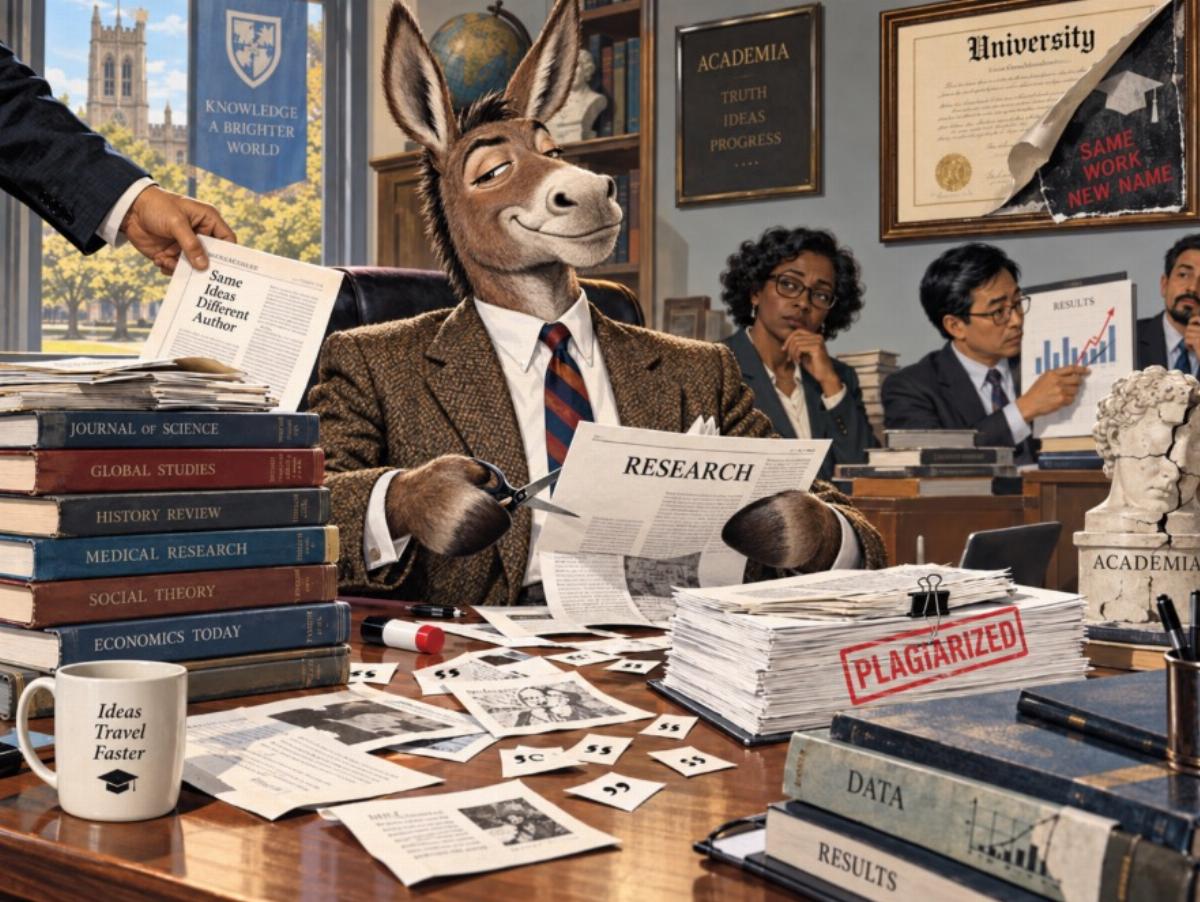
There’s yet another report of an “academic” who allegedly made it up as she went along. I was curious about the data on academics over the last 25 years who have either plagiarized or just faked it, and something interesting emerged: The problem is significantly greater on the left, whether it falls in the category of using fraud to push a leftist narrative or being a leftist generally engaged in intellectual fraud. This transcends race and falls squarely into ideology.
Read more Litigiousness has ruined America
The most recent report of academic fraud involves Kerri K. Greenidge, an academic who earned a PhD from Boston University, and who wrote The Grimkes, The Legacy of Slavery in an American Family (2022). The NY Times writes that the book, which looked at a South Carolina slaveholding family, was rapturously received:
Glowing write-ups came pouring in, including from The New York Times Book Review and Publishers Weekly, which named “The Grimkes” one of the 10 best books of 2022. In 2023, the American Historical Association awarded Greenidge with the Joan Kelly Memorial Prize, which recognizes scholars in women’s history and feminist theory.
The only problem is that Greenidge allegedly went beyond the facts and made things up. Again, from the Times:
Several other scholars, who described themselves as skeptical of some of Greenidge’s assertions in the book, started fact-checking her — scrutiny that Greenidge argued was racially motivated when asked for comment on Friday. Some of the criticism centered around whether Greenidge had properly credited sources.
“I said, ‘Where is she getting this?’” Myra C. Glenn, a retired professor of American history at Elmira College and the author of several books on U.S. history, said in an interview on Thursday. “Boy, it became a major problem.”
In March 2024, examining “The Grimkes” for Reviews in American History, a scholarly journal published by Johns Hopkins University Press, Glenn raised concerns about the book’s credibility.
“Although well-written, ‘The Grimkes’ is also a deeply flawed book,” she wrote. “All too often Greenidge lacks the evidence to substantiate many of her major claims. Her work is also riddled with factual errors and repeatedly omits needed endnotes.”
The article describes several serious problems, including Greenidge’s reliance on letters she claims are held at the University of Michigan but that no one can locate.
Read more Urgent! Republicans vs. Democrats 2026
Greenidge, unsurprisingly, cried racism:
In an interview on Friday, Greenidge, who is Black, said that her life’s work had been torn down by white scholars who disagreed with her conclusions about racism, slavery and white supremacy.
“I am heartbroken that a field I have given my life to can treat me this way,” Greenidge said. “The attack on Black women academics is real.”
Greenidge is correct that several black academics, both male and female, have been accused of fraud. I was curious about how many, but then stumbled on something more interesting: In the UK and America, political ideology, not race, is the best way to determine the likelihood of proven academic fraud.
I learned this by asking ChatGPT to find all headline-topping examples of proven academic fraud in America and the UK since 2000. What it found is fascinating. Those frauds intended to advance an agenda were always leftist. Or as ChatGPT said, “I don’t see a comparably strong, unambiguous right-leaning case among them.”
Additionally, while scientific fraudsters (and there have been many) seemed apolitical, those in the liberal arts who committed any type of fraud leaned left. The attached chart shows major academic integrity scandals in the liberal arts, per ChatGPT.
Note that ChatGPT is extremely conservative about political classifications, refusing to find even a hint of political bias if possible. Thus, it said Jason Arday’s bias was unknown, although testimony from people involved makes it clear that he was advancing a hard-woke consciousness. So, while I’ve kept ChatGPT’s text, I’ve highlighted in red the cases where a scholar is a leftist, whether that leftism affected the fraud or not, and in blue the single conservative: Monica Crowley.
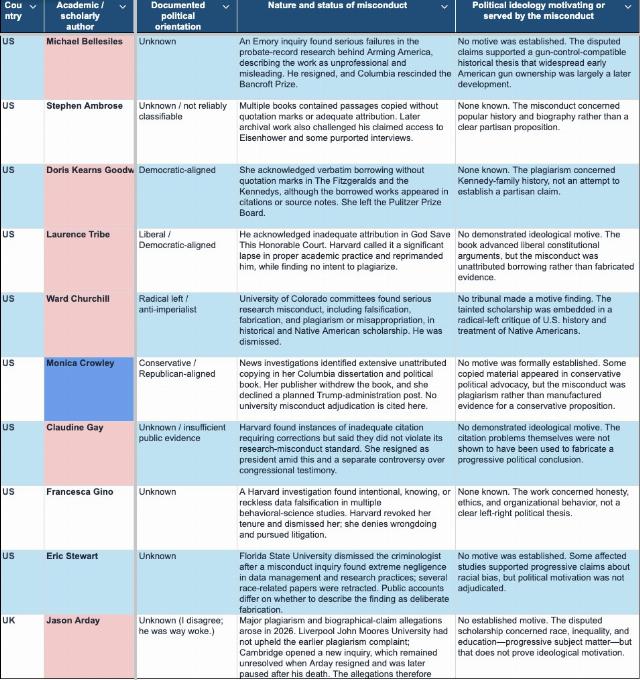
There’s an awful lot of red in the chart. And yes, I know it’s a very small sample, but I suspect it would have been much redder if I’d asked ChatGPT to drill down into less famous, but still newsworthy, academic fraud cases. For example, Greenidge isn’t famous enough, and the scandal isn’t widely known enough, to factor into ChatGPT’s analysis. ChatGPT also excluded people like Robin DiAngelo who stood accused but whose universities dismissed the charges.
I can’t say that I’m surprised by the result. If you remove morality from a profession—which is what has happened in academia, which is now a hard-left redoubt—you are left with nothing but an “end justifies the means” attitude. That attitude, of course, means anything goes, no matter how evil. It starts with plagiarism but has no stopping point. The people training the West’s best and brightest are Ground Zero for a society that has a moral vacuum at its heart.
Read more Don’t Give Government Another Buck
Image created using AI.