
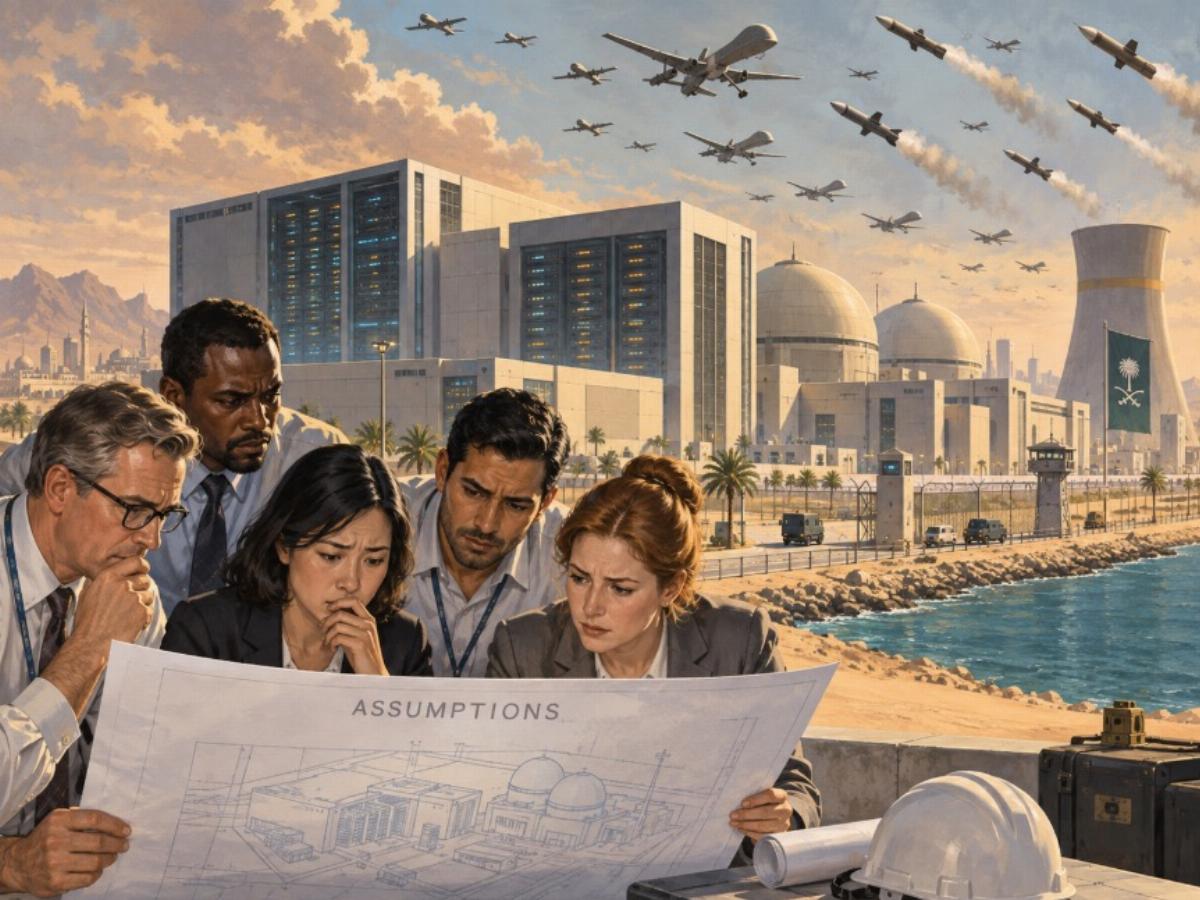
Amazon’s “cloud” customers in the Middle East have been seriously inconvenienced by Iranian mayhem. AWS data centers in Bahrain and the UAE were badly damaged earlier this year by Iranian missile and drone attacks.
Read more What’s going on in Minnesota?
When those data centers were built, what assumptions were made about regional stability? What risks were calculated? What risks were dismissed as too remote?
There are more than 400 operating commercial nuclear reactors in more than 30 countries, plus hundreds of smaller research reactors.
What assumptions are made there?
What threats are calculated into the designs? Earthquakes? Floods? Aircraft crashes? Terrorism?
And what threats are judged too remote, too extreme, or simply impossible to design against?
Julian Simon was vilified by population-control advocates and environmental pessimists because he rejected the Malthusian idea that more people necessarily meant greater catastrophe.
Simon argued that human beings themselves are the world’s greatest resource.
More people consume more resources, certainly.
But more people also mean more minds. More invention. More specialization. More people finding substitutes for scarce resources and solutions to problems that once seemed insoluble.
That was Simon’s “ultimate resource.”
His larger point was that history does not move in a straight line toward exhaustion.
Plagues, famines, wars, and other catastrophes have repeatedly reduced populations. Yet growing populations have also produced extraordinary innovation and progress.
Malthus saw mouths. Simon saw minds.
What’s happening now isn’t the only example of the recurring Malthusian mistake. Today, many developed nations face something Simon did not live long enough to see fully develop: fertility rates well below replacement level.
Read more James Talarico and the Democrat candidates who lie to win
Even China, once the world’s most aggressive practitioner of population control, now worries that there are too few births rather than too many and is trying to persuade its citizens to have more children.
At the far edge of population pessimism sits the Voluntary Human Extinction Movement, which advocates that people voluntarily stop reproducing until humanity disappears.
My point is this: How many assumptions, sooner or later, prove wrong as humans rush forward with new inventions?
Today, many people say we need more nuclear power because artificial intelligence, cloud computing, and gigantic data centers need enormous amounts of electricity.
Fine.
But what happens when increasingly complex civilization depends on increasingly concentrated infrastructure?
And what happens when nations and people still seek to blow things up?
A nuclear facility is not simply another target. Even an unsuccessful attack can create enormous fear. A successful attack on critical systems could create far worse consequences.
Human ingenuity keeps solving problems. Human beings also keep creating new ones: Terror. War. Anger. Revenge.
Too many people still possess the apparently unfixable human impulse to say: “If you will not give us what we demand, we will destroy you—even if destroying you destroys us too.”
So here is the problem: We are becoming more technologically sophisticated. Our infrastructure is becoming more interconnected. Our dependence upon it is becoming greater. But human nature has not advanced at anything like the same speed.
Read more Hawkish Warsh disobeyed Trump
How do we design around that?
Image created using AI.
John L. Smith is a pseudonym.