
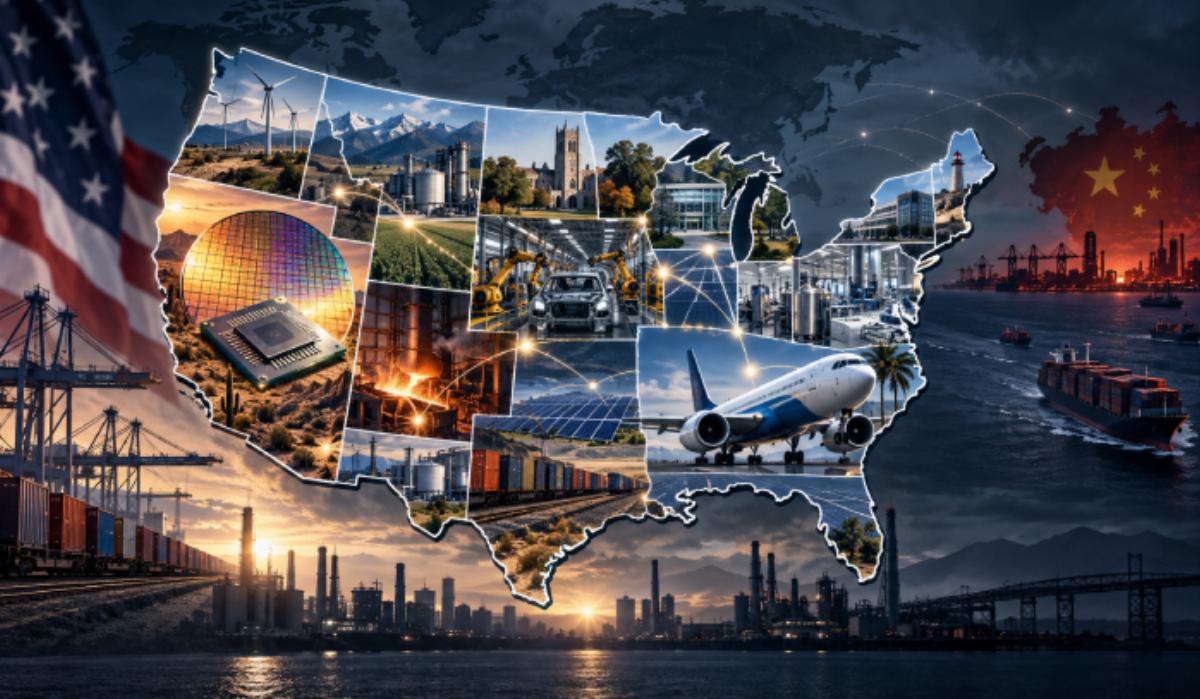
The United States needs to rethink its strategy and approach to its great-power competition with China. America’s competition with China will not be won in Washington alone. Federal tariffs, export controls, diplomacy, and military power matter enormously, but they ultimately depend on something Washington does not directly control: the industrial ecosystems being built in America’s states.
Read more The Mysterious 9/11 Apology By Condoleezza Rice
Individual states are already playing a large role in preserving American leadership in key areas, especially aerospace. When President Trump and Chairman Xi met in Beijing this past spring, Beijing made clear that one of its greatest interests in the United States was maintaining access to American-made aircraft and aviation equipment, much of it produced in states like South Carolina.
Despite the advances China has made in its aerospace industry, it continues to rely on many Western technologies that support modern commercial aviation. Even the COMAC C919 — China’s flagship airliner, proudly marketed as domestically produced and hailed as a symbol of growing self-sufficiency — still depends on Western engines, avionics, and other critical systems from firms such as GE Aerospace, Honeywell, and Collins Aerospace.
China’s problem isn’t a lack of engineering talent. China can build an airplane and manufacture its components. The problem is that it has yet to reproduce the broad aerospace ecosystem that the United States and its allies have spent decades perfecting. That ecosystem, partially hosted and fostered in South Carolina, enables the production of aircraft recognized internationally for their innovation and performance.
South Carolina didn’t become an ideal place for aerospace companies to do business overnight. In a state where the government is constitutionally required to pass a balanced budget and not run a deficit, lawmakers successfully used state funds to develop vital infrastructure, education, and workforce-university partnerships that attracted and sustained long-term investments from firms like Boeing.
What began largely as a state economic initiative has produced thousands of Boeing jobs and helped create a statewide aerospace sector with an economic impact exceeding $38 billion. It has also helped maintain America’s competitive advantage over China in large-scale commercial aircraft manufacturing.
South Carolina is not alone. States like Arizona have led the effort to secure America’s competitive advantage in other critical areas, including AI and the semiconductors needed for advanced chip production. Arizona, in particular, has successfully used both state and local government efforts to foster economic growth while helping to ensure the security of the United States.
The U.S. military has stated that microelectronics, including advanced chips and semiconductors, are fundamentally necessary to virtually every component of our modern military capabilities. In a 2025 report, the Government Accountability Office found that the foreign-dependent supply chains on which the Pentagon relies for microelectronics used in advanced weapons systems pose a credible risk to national security.
That is why Congress passed the CHIPS and Science Act in 2022 to boost domestic American capabilities for producing advanced microelectronics, semiconductors, and chips.
Read more The Smoke of September 11
But state governments appear to have beaten the federal government to the punch. Fueled by the desire for more jobs and tax revenue, states like Arizona began attracting foreign investment and establishing new domestic sources for technology the Pentagon considers paramount to national security.
In 2020, then-Arizona governor Doug Ducey announced that the Taiwanese firm TSMC, the world’s leading contract manufacturer of advanced semiconductors and chips, had chosen Arizona as the site of its first advanced semiconductor plant in the state. Arizona’s selection wasn’t random. It resulted from strategic planning and investment by authorities at all levels of government to make the state more attractive to foreign investment — in this case, from Taiwan.
State lawmakers created a law, A.R.S. § 41-1512, providing refundable income-tax credits for companies like TSMC to establish or expand facilities in Arizona. Local authorities also invested in the infrastructure a TSMC plant would need to operate. The City of Phoenix invested in expanding roads and critical water infrastructure required by the plant. The result was not only thousands of jobs for Arizona, but also the restoration of domestic production of leading-edge semiconductors that the United States had largely lost the ability to manufacture.
Notably, neither South Carolina nor Arizona needed to abandon fiscal discipline to make these investments. Both operate under constitutional or statutory fiscal constraints, yet their governments found ways to use targeted incentives, infrastructure spending, and workforce investments to attract strategically important industries.
The lesson should be clear. State and local officials might not think of themselves as part of America’s great-power competition, but they should. America’s power does not end with Washington. It begins in the communities, college campuses, industrial parks, and state and local economies spread throughout our country.
When states like Arizona and South Carolina compete for investment from firms like Boeing and TSMC, they aren’t conducting foreign policy. They are, however, building the industrial capabilities that will ultimately determine whether Washington’s foreign policies are tenable.
China understands that its national power depends as much on its ability to innovate and build at scale as it does on traditional military power. America needs to understand the same. While Washington will continue to establish policy and strategy, the efforts of America’s 50 states will determine whether the United States has the industrial backbone to see them through.
Read more The Terrorists’ Real Victory Wasn’t The Towers; It Was Much Worse