
General Thomas “Stonewall” Jackson, CSA, is quoted as saying, “Do not take counsel of your fears.” He advised avoiding letting fear dictate decisions, especially in moments of uncertainty or danger. And yes, I do know CSA stands for Confederate States of America, but that does not negate the universal power of his words.
Read more My favorite juror
America is now in the throes of panic over AI’s power. Several “Big Brain” AI thinkers, some worth billions, are symbolically “clutching their pearls” and taking to their fainting couches with end-of-humanity warnings about AI’s unchecked, unbridled power. (See, e.g., Dario Amodei of Anthropic and Sam Altman of OpenAI.) And to be fair to those who are worried, it’s true that AI can be “bigly” wrong, and that should be a concern.
AI is only as good as its design and the materials it reviews for information. Thus, the people behind AI tend to tell it that left-leaning publications are more reliable than information from conservative sites.
If AI had existed when Copernicus published On the Revolutions of the Heavenly Spheres, postulating that the Earth was not the center of the universe, with Galileo becoming its most fervent champion, an AI query would have totally agreed with Church leaders that Galileo was a certified heretic. To make their case for heresy, their contemporaneous AI database would have searched the Holy Bible, which was regarded as inviolate canon law, and that would have been that. As an aside, the Church finally apologized to Galileo in 1992—oops.
Hence, trustworthy AI should be of great concern, and legislating against it risks either stifling free speech or destroying an enterprise that sees us preemptively lose a national security race against China. Thankfully, there is a proven research path that can stop any current “Henny Penny” political overreaction foolishness.
“Trustworthy AI” was the research focus of Dr. Jeannette Wing’s presentation at the United States Naval Academy’s 2022 Michelson Memorial Lecture, named for Albert A. Michelson, a Naval Academy graduate and, later, a physics professor. In 1907, Michelson was the first American Nobel Prize recipient in the sciences, one year after Teddy Roosevelt received the Peace Prize.
Dr. Wing served as Executive Vice President for Research at Columbia University and formerly as Corporate Vice President of Research at Microsoft Corporation. In her lecture, she addressed the trustworthiness of artificial intelligence. She examined the rapid growth in AI development that directly affects human lives and focused on mounting concerns about whether AI decisions can be trusted to be correct, reliable, fair, and safe.
In parallel with Dr. Wing’s warning, Cornell also focused very early, in 2021, on the brave new world of AI research and offered a compelling framework for addressing and understanding the full scope of AI’s research utility. The university brilliantly saw the problems and answered the challenge in a statement:
“Artificial intelligence at Cornell is both a field of study and a powerful tool that shapes how we conduct research, teach, and support the university.”
Read more Banning AI in NY schools: Is the juice worth the squeeze?
Thus, the solution to the current very public AI kerfuffle is to take a lesson from physics research.
The history of physics offers a useful analogy. Theoretical physics seeks to understand fundamental principles without necessarily aiming at an immediate practical use. Applied physics takes those discoveries and turns them into technologies with real-world consequences.
Einstein’s work on mass and energy helped establish part of the scientific foundation for the nuclear age, but the development of nuclear weapons required decades of additional discoveries and engineering. The distinction matters: basic research expands human knowledge, while applied research forces us to confront the benefits, risks, and consequences of putting that knowledge to use.
Consequently, instead of any possible state-control overreaction, such as legislative remedies, simply divide AI into two categories. For example, one could have Theoretical AI, in which basic, ever-advancing research is limited only by human insight and creativity, and Applied AI, which can be studied independently as either good or bad using Dr. Wing’s warning about trustworthiness.
Theoretical AI research should be unbounded in order to fully understand its strengths and dangers. Applied AI, guided by Dr. Wing’s warning and Cornell’s approach, can and will be self-regulating as humans see both the good and bad consequences on a case-by-case basis.
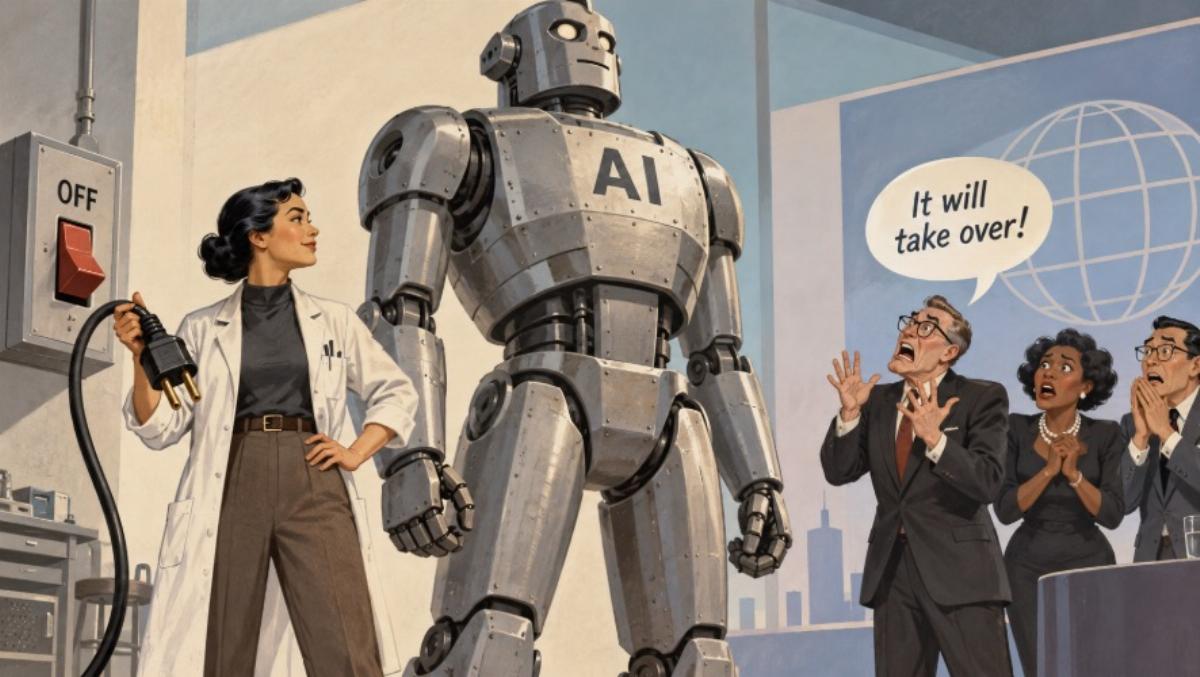
As far as AI taking over the world, humanity has creative geniuses who can literally “pull the plug” on AI power, both physically and intellectually. There are those of us who can outthink any machine creatively and probably make billions doing so, which is one heck of an incentive. So far, the debate smells of an attempt to establish an AI oligarchy of “we are aboard; pull up the ladder” self-promotion.
Why is this so hard to understand?
Image created using AI.
Ed Timperlake, Naval Academy ’69, was a graduate teaching assistant focusing on computers at Cornell. He learned the strengths and limitations of legislative action as a professional staffer on the House Committee on Rules.
Read more Democrats still want to keep black folks on their plantation