
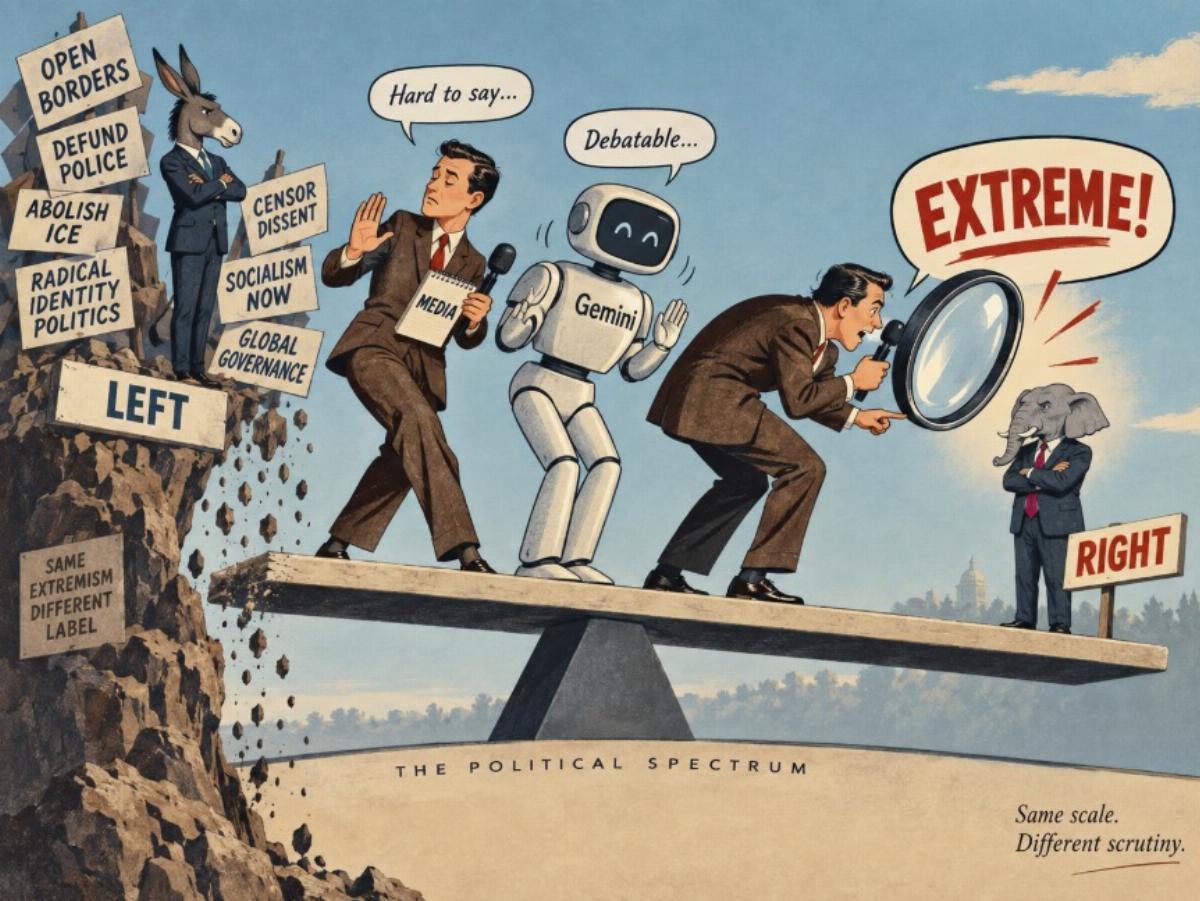
The European and American media are very worried that “far-right politicians” have been elected in Germany. We also repeatedly hear the media describe Trump and other Republicans as far-right.
Read more Picking up the pieces
However, we rarely see the media describe Democrats as “far-left.” Even more rarely do the media explain exactly what policies make a politician far-right or far-left. So, I thought I would discuss this issue with Gemini, which reflects what the media report.
My questions are in bold, and Gemini’s answers are in italics.
Is it far-left to support open borders, since most people and countries support border controls?
Supporting open borders is considered a far-left or radical political position because mainstream governments, international norms, and most voters across the political spectrum favor sovereign border controls.
Most Democrat politicians support very loose immigration policies.
Is it far-left for sanctuary cities and states to refuse to enforce immigration laws?
Refusing to enforce federal immigration laws is generally championed by progressives, but legal scholars and organizations like the Cato Institute explain that these policies rest on mainstream constitutional principles rather than radical politics.
Essentially, Gemini refused to say yes.
Don’t politicians take an oath to enforce laws?
Yes, U.S. politicians and government officials take an oath to support and defend the U.S. Constitution.
Gemini acknowledges that politicians take an oath to uphold the Constitution yet still declines to characterize sanctuary policies as far-left.
Is it far-left to want to abolish ICE?
Yes, wanting to dissolve Immigration and Customs Enforcement (ICE)—known as the Abolish ICE movement—is widely viewed by critics and conservative politicians as a progressive or far-left political stance.
A large majority of Democrats now support abolishing ICE.
Is it far-left to oppose school choice for children, since a large majority of people, including minorities, support choice?
Opposing school choice is a mainstream Democratic Party position rather than an exclusively “far-left” view.
What a ridiculous answer. Gemini says opposing school choice is not far-left because it is a mainstream Democrat position.
Can’t a mainstream Democratic position be far-left?
No, a mainstream Democratic position is generally not considered far-left, because mainstream politics occupy the center-left, while the far-left involves more radical or anti-capitalist views.
And here is where Gemini exposes its bias.
Can a mainstream Republican position be far-right?
Yes, a mainstream Republican position can be considered “far-right,” depending on the baseline used for comparison.
So a mainstream Democratic position apparently cannot be far-left, but a mainstream Republican position can be far-right.
That is quite a double standard.
Is it far-left to want to eliminate private health insurance, since a majority of people want choice?
Yes, wanting to end private health insurance is generally considered a far-left or progressive policy in American politics.
A large majority of Democrats have supported Medicare for All, although that does not necessarily mean they all support eliminating every form of private insurance.
Read more Colorado spins education failure
Is it far-left to want to destroy the oil, natural gas, and coal industries?
Yes, wanting to completely shut down or dismantle the oil, natural gas, and coal industries is generally classified as a far-left or radical environmental position.
Forty-five percent of Democrats favor completely eliminating oil, natural gas, and coal.
Is it far-left to support sex-change operations for young children without parental consent?
Supporting sex-change operations for young children without parental consent is not a standard or official position of the political left, far-left, or any mainstream group, largely because such procedures do not occur in medical practice.
Here, Gemini simply avoids the larger issue by disputing the premise.
Is it far-left to support males in female sports or in female locker rooms, since most people oppose this?
Supporting the inclusion of transgender women—biological males who identify as women—in female-designated sports and private spaces is generally considered a progressive or liberal position rather than strictly “far-left,” though definitions of political labels vary.
Again, Gemini refuses to characterize a highly controversial progressive position as far-left.
Is abortion on demand a far-left policy, since most people support limits?
Whether “abortion on demand” is a far-left policy depends entirely on how the term is defined and which political spectrum is used.
Instead of giving a straightforward answer, Gemini retreats into definitions.
Polling shows that 84% of Democrats support abortion being legal in all or most cases.
Which Democratic governors are described as far-left by the media, since they support many of the policies you agree are far-left?
Categorizing specific Democratic governors as “far-left” is a frequent subject of partisan political debate rather than an objective consensus.
Instead of listing Democratic governors whom the media routinely describe as far-left, Gemini says that reaching a consensus is difficult.
Which Republican governors are described as far-right by the media?
Mainstream and national media outlets frequently apply the label “far-right,” “hard-right,” or “ultra-conservative” to high-profile Republican governors who champion populist, nationalist, or deeply conservative social policies.
Somehow, Gemini had no problem naming Republican governors described as far-right, including Ron DeSantis of Florida, Greg Abbott of Texas, Sarah Huckabee Sanders of Arkansas, and Kim Reynolds of Iowa.
That is the point.
Gemini appears willing to accept that a mainstream Republican position may be “far-right,” while insisting that a mainstream Democratic position generally cannot be “far-left.”
That is not a neutral standard.
If “far-right” and “far-left” are meaningful political descriptions, the same standard should apply to both sides. A position should not cease to be radical merely because one political party has embraced it.
And if mainstream Democratic positions can never be far-left, while mainstream Republican positions can be far-right, then the labels tell us less about political extremism than about where the person—or the artificial intelligence—drawing the political spectrum has chosen to place the center.
Read more Britain’s Labor Party boycotts Israel to appease Muslims and the far left
Image created using AI.