
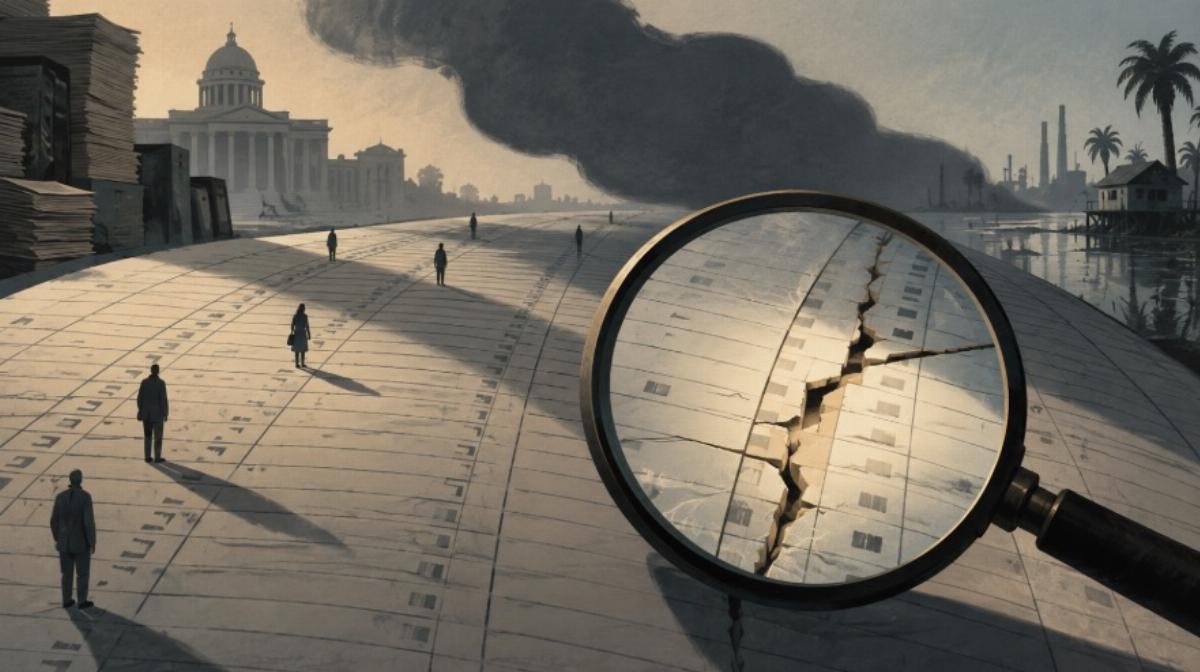
For three years in Liberia—what was then considered the most disease-ridden country in the world—death was not a statistical abstraction; it was the atmosphere.
Read more Increasingly obvious: Islam is incompatible with Western Civilization
In the congested Monrovia neighborhood of Sinkor, life was expendable. A small boy was consumed by a crocodile only blocks from my house, leaving me to wonder how the animal had survived unnoticed in such dense human traffic, perhaps spared by local taboo or sheer luck. Another young boy, whom I passed daily on my walk to catch a bus, was bitten by a rabid dog and died of rabies. A man living in a zinc-roofed shelter among twenty others next to my home—whom I had permitted to farm potato greens in a tiny plot—succumbed to cholera, likely drawn from the swamp water he used on his plants. The hospital refused to release his body, yet I attended his wake anyway—a sobering education in the finality of administrative indifference.
Indifference, I learned, is rarely neutral; it is frequently tainted by bias. If you liked the person, their passing was a tragedy; if you did not, it was treated as a convenience or a blessing. This moral division blunted collective grief and institutionalized apathy.
Decades later, the cadence returns with a jarring familiarity. A couple renting my house in Fort Lauderdale reflected that the day before their lease signing was cursed: a helper assisting them had traveled back to Jamaica, only to be struck and killed by a vehicle while crossing a street. Later, watching Killings of the Flower Moon, I was struck less by the explicit malice of the oil-era murders than by the eerie, quiet ambivalence of the Osage tribe as members vanished one by one into the registry of the missing.
Across all these geographies—Monrovia, Jamaica, Osage County—the underlying cultural condition is identical: a tacit, exhausted resignation that we walk perpetually in the shadow of death.
Upholding the sanctity of life is the first principle of justice. Yet civilizations do not survive by resignation alone. When life becomes cheapened into an accepted background cost, the instinct of the modern administrative state is to obscure the accounting. Whether dealing with historical atrocities, systemic social decay, or contemporary institutional crises, unexplained loss demands a strict, unromantic forensic audit.
Read more Anybody here seen my old friend Bobby?
Our justice system has wandered far from this perspective, trading objective reality for human judge sentimentality and political theater. A political realm built on spin prefers a malleable tragedy—one that can be weaponized, subsidized, or conveniently ignored depending on who died and who benefits.
A forensic audit, by contrast, is entirely unromantic. It refuses to care about political optics, administrative convenience, or whether the deceased was liked or disliked by the authorities. It looks only at the mechanism of failure: the broken pipe, the corrupted log, the altered variable, the precise vector of destruction.
That rigorous accounting cannot stop at the surface. If we are to reclaim justice, we must look directly at modern vectors of preventable destruction: the systemic devastation of the opioid supply chains, the top-down pharmaceutical complexities forced upon populations by opaque government agencies, and the neglected mental health realities driving modern domestic collapse and infanticide.
Death requires an accounting. When societies stop demanding forensic clarity for how and why lives are lost—reducing human tragedy to an administrative line item or a political talking point—they surrender the very mechanism of justice and the sanctity of life.
Read more Is It Time To Repeal The 19th Amendment?
Image created using AI.