
A conspicuous lack of geopolitical knowledge has left many here and in Europe unable to identify real enemies. But not so the Baltic states, where decades of subjugation remain fresh in the minds of people who only recently regained their freedom. They see Russia for what it is: a warmongering Putin intent on restoring Greater Russia.
Read more The Ottoman Empire and 9/11: A Bad-Luck Number Like 13 in the West
Yet even as NATO provides a formal Article 5 shield for these nations, another, more ambiguous arena of conflict receives far less attention in the West: the “grey zone” between peace and open war. Here Russia applies pressure through sabotage, cyber intrusion, disinformation, political interference, and other activities designed to destabilize its neighbors without provoking a military response. For the Baltic states, this shadow conflict is not theoretical; it’s a harbinger of what’s coming. Moscow undermines sovereignty by exploiting the space below the threshold of war, where Western legal structures and political hesitation expose Western weakness.
You might notice that I did not mention Ukraine once in the preceding paragraph. That’s because the grey-zone conflict has been ongoing longer than the war in Ukraine. Russia’s campaign of deniable aggression commenced well before the 2022 invasion. Moscow has spent decades testing Western tolerance through political interference, little green men, disinformation, cyberattacks, espionage, economic coercion, sabotage, and exploiting ethnic and political divisions. The Baltic states have experienced this pressure since regaining their independence. Russia’s actions against Georgia in 2008 and Ukraine beginning in 2014 demonstrated a broader strategy. The 2022 invasion was not the beginning; it simply marked the moment when Russia moved beyond the pretense that its ambitions were other than naked aggression.
Poland does not see Russian behavior as disconnected provocations or merely Putin being Putin. It sees a recurring strategic threat from a power whose ambitions have repeatedly brought it war and subjugation. That explains why Poland has become Europe’s most outspoken advocate for confronting Russia realistically.
The grey-zone environment is dangerous because repeated probing can lead to unintended consequences. NATO was designed primarily to deter conventional aggression, not cyberattacks, sabotage, disinformation, and covert operations. Russia continuously mines those weaknesses: where legal definitions, political divisions, or reluctance to escalate create opportunities. Moscow can damage us politically and economically while maintaining enough ambiguity to keep us frozen in place.
The evidence is piling up. In August, Germany accused Russia of orchestrating an attempted drone strike at Leipzig/Halle Airport. German authorities said the explosive-laden drone failed only through blind luck, and Berlin subsequently announced diplomatic measures against Russia. More consequential examples occurred in the Baltic Sea. In December 2024, the tanker Eagle S dragged its anchor across the seabed, damaging an undersea power line and four telecommunications cables connecting Finland and Estonia. Then, on New Year’s Eve 2025, Finnish authorities seized the cargo vessel Fitburg after two telecommunications cables were similarly knocked out. Finnish prosecutors allege that Fitburg dragged its anchor for at least 130 kilometers, damaging two cables and attempting to damage eight additional subsea connections. Non-NATO member Moldova has experienced repeated airspace violations—60 since 2022, including drones and missiles carrying explosives.
Whatever the individual circumstances, the pattern dares the West to act. Russia’s objectives are insidious. Probing, disrupting, and intimidating—threshold testing—allows Moscow to test how quickly NATO detects intrusions, how it responds, and whether an incident triggers a coordinated response or just another investigation. Cables will be repaired; the knowledge gained is the objective. The strategic effect is to create insecurity about our infrastructure, our willingness to respond, and ultimately NATO’s reliability. That makes the grey zone attractive to Moscow: Russia imposes costs and tests Western resolve with little risk.
This is where Poland comes into focus. Poland sits between Germany and the Baltic states, borders Belarus and Ukraine, faces Russia’s Kaliningrad exclave to the north, and controls many of the land routes through which NATO must reinforce its eastern flank. The Suwałki Gap, the narrow corridor between Belarus and Kaliningrad that connects the Baltic states to the rest of NATO by land, is vitally important. NATO maintains forces in Poland specifically to protect this corridor.
Read more The Election 2028 Presidential Prospects as of Now
But geography isn’t the fulcrum; Poland is. Poland is building what it describes as Europe’s largestpeacetime land army, with more than 220,000 military personnel, while devoting 4.7% of GDP to defense in 2026.
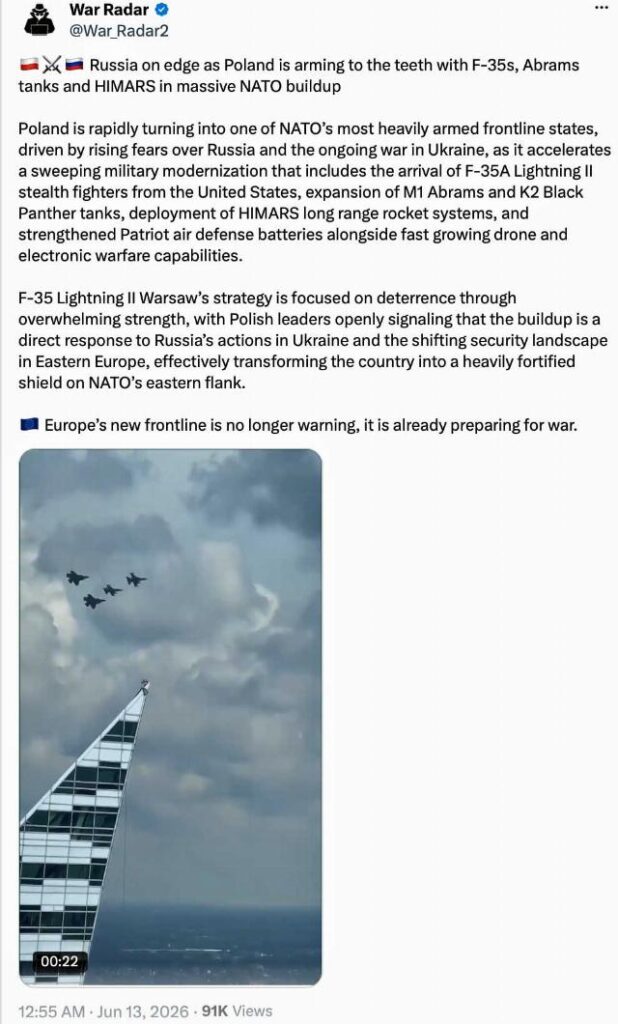
Graphic: X Post
That investment matters beyond the size of Poland’s own military. Poland is NATO’s principal platform for defending its eastern flank. American and Allied forces train and operate there, while Polish territory provides the roads, railways, ports, airfields, and logistical infrastructure needed to rapidly reinforce its frontier. In other words, Poland is not simply another NATO member; it’s a place where NATO will make its initial stand.
That distinction becomes particularly important in a grey war. The traditional question—“Would NATO respond if Russia invaded Poland?”—is easy to answer. Article 5 exists for precisely that circumstance. The harder question is what happens when Russia damages a cable, disrupts an airport, conducts a cyberattack, interferes with an election, sponsors sabotage, and the evidence screams Moscow without an armed attack. If incidents are treated individually, Russia wins by watching NATO debate rather than act.
This is how wars become “hot.” Each provocation can be dismissed as too small to justify a corresponding response; collectively, they form a pattern. Russia depends on governments, politicians, and commentators to minimize its actions, question attribution, or argue that responding would be “provocative.” That calculation is dangerous. Failure to respond doesn’t preserve peace; instead, it teaches an adversary that aggression works.
There’s something new percolating that may be even more consequential and telling: On August 25, CIA Director John Ratcliffe traveled to Moscow to deliver a message to the Russian government, an extraordinary mission that the Institute for the Study of War says may reflect U.S. intelligence indicating Russia is likely contemplating aggression against a NATO member in the near term. ISW says such an attack would be unlikely to resemble a full-scale invasion and could instead be designed to test or invalidate NATO’s Article 5 commitment. Ratcliffe’s arrival on a C-17 is suggestive that Washington regarded the matter as unusually sensitive and urgent. We do not know what intelligence prompted the visit, but if Moscow is contemplating a limited attack intended to probe NATO’s willingness to respond, the grey zone may be approaching its most dangerous threshold.
Eventually, an operation intended to intimidate or probe will kill someone, destroy critical infrastructure, or trigger a response neither side anticipated. By then, the opportunity to de-escalate may have passed. The West therefore needs to stop treating each incident as an isolated nuisance and recognize the larger campaign for what it is: an ongoing grey war. Poland apparently understands the stakes. Its history has taught it that geography, preparation, and resolve matter most before the shooting starts. The rest of NATO should pay attention. The time has come for the Alliance to establish a unified, unmistakable response to grey-zone aggression—before the next provocation chooses us.
Author, Businessman, Thinker, and Strategist. Read more about Allan, his background, and his ideas to create a better tomorrow at 1plus1equals2.com.
Read more When Grievance Enters The Huddle