
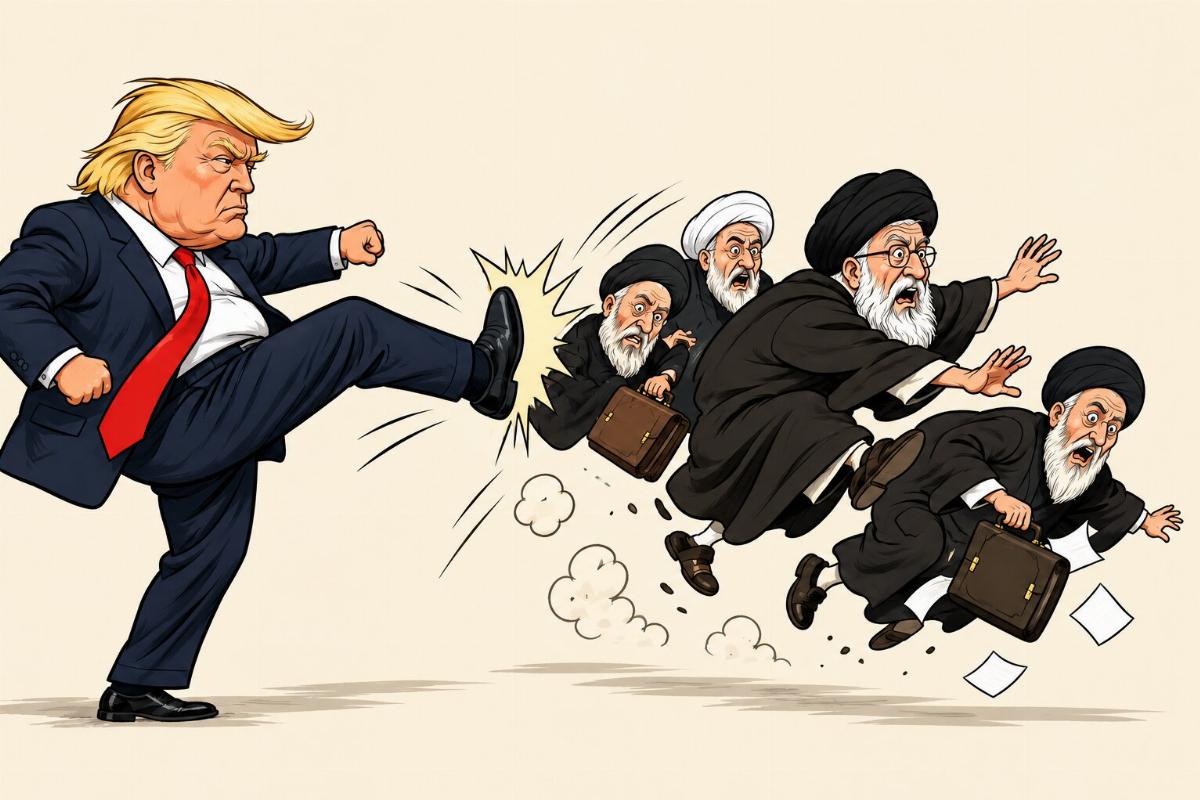
There are only two ways we will ever know that war with Iran is really over and the U.S. has achieved its goal of ending the nuclear threat Tehran presents.
Read more So now fitness is fascist?!
It is important to remember the mullahs of today are a financially different breed from the mullahs who came to power under Supreme Leader Ayatollah Ruhollah Khomeini in 1979. The 20th-century mullahs were fairly poor, their income emanating primarily from their preaching at mosques. So poor were they that their primary mode of transportation was, quite appropriately, the ass.
But, after coming to power, the mullahs established an institution known as “Setad” which gradually increased the state assets that fell under the direct control of the Supreme Leader Khomeini. As a result, today’s mullahs enjoy the abundances of a gravy train established for them—a group of religious leaders whose private greed for wealth is hidden under the guise of furthering the cause of Allah according to their version of a religion known as Twelver Shiite Islam.
At the time the recent Supreme Leader, Ayatollah Ali Khamenei, was killed in an Israeli air attack on February 28, 2026, he had risen from the poverty level to one that would put Donald Trump to shame. Khamenei’s wealth was estimated to be somewhere between $95–$200 billion. Not bad for a religious leader who had ruled for 37 years and was able to access whatever state assets he desired.
Publicly, Khamenei appeared to live a simple life, devoted to the spiritual growth of his people and the expansion of Islam beyond Iran’s borders. But his personal assets were hidden from public view, including evidence of his hobby of raising horses—an enterprise alone worth tens of millions of dollars.
However, as the late Khamenei learned in February, regardless of how wealthy one is, one is unable to take it with him when death calls.
The point is, today’s mullahs have no shortage of money. In January 2026, national protests by the Iranian people caused Khamenei to prepare a contingency plan that would fly him to Russia. Although he never implemented it, undoubtedly it caused many other senior mullahs to give thought to similar contingency plans. Many may already be revisiting those plans as domestic protests become more active.
A dictator who saw the rebellious writing of his people on the wall early enough to safely implement his own personal contingency plan now lives in exile in Russia. He is former Syrian President Bashar al-Assad, who ruled for 24 years. He quietly evacuated his country in the dead of night on December 8, 2024 after lying to his followers that Russian troops would be coming to their aid.
Read more The SEALs clean up
But the Assad example is just one way for us to be able to claim victory should Iran’s mullahs follow suit. The ultimate result would be an inability for them to wield direct influence any longer should the will of the Iranian people prevail. With the wealth the mullahs have accumulated over the years, they have the assets to beat feet out of the country, as did al-Assad. And, hopefully, the departure of one mullah departing would quickly trigger a chain reaction causing the other mullahs to follow.
The only other way for us to be able to claim victory would require that the mullahs follow in the fateful footsteps of another dictator—Libyan strongman Muammar Qaddafi.
In 1969, Qaddafi took power by coup, ruling brutally for 42 years. By 2011, the Libyan people had finally had enough and revolted. Qaddafi did what cowardly dictators historically do and sought to evacuate the capitol.
For some reason though, he opted to evacuate on the ground, seeking only to leave Tripoli and relocate to a part of Libya where he might have more support. A 75-vehicle convoy was organized to transport him. Such a sizable convoy quickly gained attention and was attacked by French aircraft. The attack split the surviving vehicles into smaller groups. The one in which Qaddafi rode was soon identified and was attacked again. The eleven vehicles in the group were destroyed, leaving the dictator to flee on foot. He was subsequently caught by his own people, who executed him.
There is a common element in the thinking of Middle East autocrats. Imprinted upon their psyche is the fiction that they somehow have ownership rights to the countries they rule. Thus, there are only two ways to dispossess them of this fantasy. They involve going the way of al-Assad—forcing a dictator to abandon his country and seek refuge outside of it—or the way of Qaddafi—allowing the people to determine his ultimate fate. Clearly, the change ultimately brought about in Libya and Syria is a direct result of the fates these two leaders experienced. Today, their countries are cleansed of their personal autocratic influences (although things remain chaotic in Libya as reflected by a recent US State Department travel advisory warning). In this vein, we must recognize that any peace treaty with Iran leaving the mullahs’ influence in place is totally meaningless.
Clearly, the change ultimately brought about in Libya and Syria is a direct result of the fates these two leaders experienced. Today, their countries are cleansed of their personal autocratic influences. In this vein, we must recognize that any peace treaty with Iran leaving the mullahs’ influence in place is totally meaningless.
Frankly, it would make for a much better world should the mullahs go the way of Qaddafi.
Read more Mamdani’s 9/11 pen: A socialist’s contempt for the dead
Image generated by ChatGPT.