
One of the wisest teachers I’ve ever known summed it up concisely:
“A writer is one who writes.”
A writer’s clarity, quality, and quantity define them, but you have to actually do it. On our first class day, I used to tell my students that if they paid attention and worked hard, I could help them all to become better writers. Great writers are rare. They simply have the genetic endowment that makes writing easy for them, abilities that confound everyone else. My students taught me a lot about writing, and about teaching writing.
Read more The death of moral absolutes, revealed by the Lindsay Clancy trial
However, during my teaching career, I also learned that many English teachers weren’t very good at teaching others to write. Joanne Jacobs, a prolific education writer, writes about a young, enthusiastic first-year English teacher who realized he didn’t know how to teach his high-poverty, low-achievement NYC kids how to write.
He was a product of the “facilitator” school of education: the idea that traditional means of teaching were “inauthentic” and “oppressive,” that teachers should not be “the sage on the stage,” but should allow students to essentially teach themselves and let their inner brilliance blossom.
When he took master’s degree courses at Teachers’ College, Columbia, Hunt thought his charismatic graduate-school professor would explain how to teach writing in The Teaching of Writing class. Nope. “Every class discussion found its way to the subjects of power and identity,” writes Hunt. There was “Writing As Social Action,” but nothing on how to give effective feedback to students.
“Literacy” has become “a general skill that could be bolted onto any domain or concept,” he learned. That opened the door to “digital literacy, critical literacy, media literacy, and something we talked about ad nauseum called racial literacy.”
Traditional literacy was considered outmoded and oppressive. “The usual tools and techniques English teachers employed to teach writing — graphic organizers, rubrics — were actually bludgeons used against disadvantaged students,” the professor explained.
The five-paragraph essay was “formulaic and inauthentic,” most of the class agreed. It was “Eurocentric.” And “carceral.”
The five-paragraph essay is a basic, beginning way to learn a useful format. Unfortunately, for years it was taught as the one true way to write, but woke orthodoxy wiped even that away:
“But maybe its rigid structure actually helps struggling writers?” Hunt said, recalling the “jumbled mess” of essays his students had turned in after three weeks discussing a single poem. He made a pitch for coherence. “Topic sentences. Supporting details. Transitions. Shouldn’t our students learn how to do all this?” (I spent four years in high school learning how to write a 3-3-3 paragraph with topic sentences and supporting details. We hated it. It turned out to be very useful.)
“There is not one way to write,” the professor told the class. Teachers’ biggest “challenge is to question our deficit mindsets, especially about particular populations of students, and to think deeply about how that informs how we teach writing.” When Hunt asked what that meant, the professor said, “Based on some things you’ve shared, I do wonder how you see the children in your classroom.”
Perhaps as kids who desperately needed structure, clear examples, and a steady, guiding hand?
Read more Only two ways to ensure US victory in Iran
In the end, he had to teach himself how to teach writing through trial and error and borrowing ideas from colleagues, Hunt writes.
Teacher-prep programs should teach the “coherent body of research-informed principles and techniques” that might be called the Science of Writing, he writes. “It’s not as if this doesn’t exist. It . Very much so.”
I began by giving my students handouts of criteria for intelligent writing about different genres of expression, such as movies, poetry, and literature. We started by viewing “Plan 9 From Outer Space,” the Ed Wood movie that’s so bad it has become a classic. With the criteria for good filmmaking in mind, it was easy for them to identify how badly Wood used those criteria. I had them take notes and helped them find examples as we watched.
Then, using the handout, they wrote their first essay, which I returned to them, fully edited, the next morning. Next, I handed out a sample essay using all the criteria, which we briefly discussed, and it was on to revising their original essay, again handed back the next day.
They had the option of keeping that grade or doing another revision for more credit. The serious students took that option.
Graphic: X Post
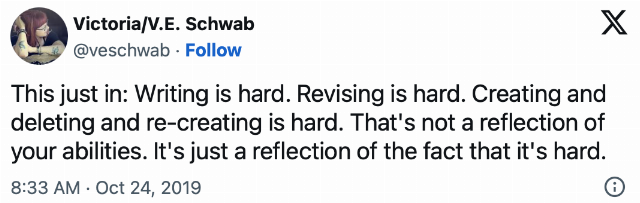
Teaching writing, like teaching a sport, is a step-by-step process, with each new skill building the foundation for the next. Writing is hard. It takes time and effort, but so does anything else worth doing.
How do you become a better writer? By having a teacher who believes it’s possible, who provides sane, constant guidance, who specifically demonstrates how to do it, and who keeps political and sexual indoctrination out of the classroom. Rapid editing turnarounds are also essential.
Become a subscriber and get our weekly Friday newsletter with unique content from our editors. These essays alone are worth the cost of the subscription.
Mike McDaniel is a USAF veteran, classically trained musician, Japanese and European fencer, lifelong athlete, firearm instructor, retired police officer, and high school and college English teacher. He is a published author and blogger. His home blog is Stately McDaniel Manor.
Read more So now fitness is fascist?!