
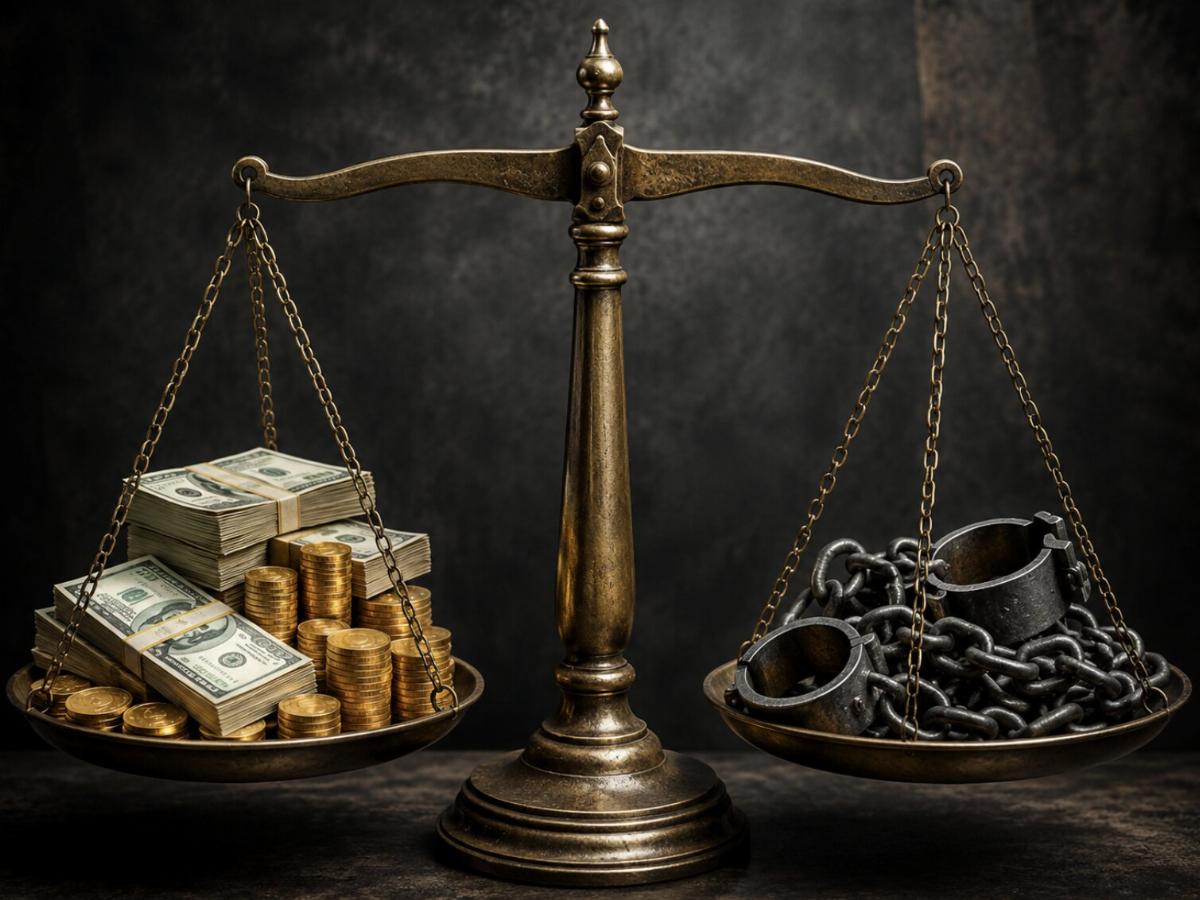
Beginning with the 2026-2027 academic year, millions of K-12 students will have to complete a personal finance course to graduate from high school. Thirty states are either phasing in the course requirement, or have already done so, and nine states require the content to be integrated into other courses.
Read more Denmark’s Competitiveness is Under Pressure — Not Everything Green is Gold
Yet many students will learn far more than how to buy a car, shop for insurance, and manage their household budgets. In schools using the free open education resource, NextGen Personal Financial Literacy (NGPF), each year five million students in more than 50,000 classrooms in all 50 states will learn that they are victims of slavery that ended in 1865 — 161 years ago. They will learn how reparations “redress the harms of slavery and violence against Black Americans and other historically excluded communities.”
Using Culturally Responsive Teaching, race-based Marxist propaganda is fused into units on “racial discrimination” in financial wealth, banking, housing, education, and employment.
In the financial wealth unit, students are to analyze how “financial practices have led to modern racial inequities in the United States.” The housing unit claims that racial discrimination is creating a barrier to black ownership of a home. Students must analyze “housing practices and policies that have prevented, and continue to prevent, communities of color from generating wealth.” Ignoring that affirmative action has favored blacks over whites, the unit on education and employment examines how racial discrimination “has impacted access to higher education and student debt” and “employment and wages.”
By offering professional development for teachers, NGPF can be assured its free curriculum reaches the classroom regardless of whether the district or state approves its use. Because the open resource can be downloaded by teachers from the internet without taxpayer funding, there is no penalty for using it.
For their reparations project, student research should include the seminal work by Thomas Sowell, Civil Rights: Rhetoric or Reality, in which he concludes that the vast majority of whites and blacks believe there are more blacks living in poverty than there actually are. Indeed, it is a well-documented public misperception, which has been tracked in public polls for decades, that three out of four blacks — 75 percent — live in poverty. According to the 2020 “Current Population Survey Annual Social and Economic Supplement,” the poverty rate for blacks is not three out of four, but rather 18.8 percent or fewer than one out of five.
The narrative that the majority of blacks are very poor is fostered by racial demagogues, such as Al Sharpton, who stand to gain politically and financially from having constituents believe they are oppressed by whites.
As they ponder the effect of slavery on the presumed wealth gap between blacks and whites in America, students should also read Out of America: A Black Man Confronts Africa, in which Keith Richburg concludes that descendants of slaves brought to America from Africa are far better off than the descendants of those who were left in Africa. “Thank God my nameless ancestor, brought across the ocean in chains and leg irons, made it out alive,” he concludes. “Thank God I am an American.”
Even with modern medical technology introduced into Africa during European colonization, Africa still lags behind the rest of the world. Sub-Saharan Africa has some of the poorest countries in the world, with disease, war, famine, and military dictators.
Read more The Red and the Green
Rather than being an “oppressed class,” American blacks are richer than 90 percent of the people in the world, and they live longer than African and Caribbean blacks and even whites in much of Eastern Europe and Latin America. They have higher rates of literacy and have achieved more postsecondary degrees than African blacks.
Who should pay? The descendants of Civil War-era Southerners who had no slaves? The descendants of post-Civil War immigrants who had little to do with slavery and who now comprise the majority of whites living in America?
Who should receive reparations? The descendants of blacks who were free before slavery ended? The descendants of African and Caribbean émigrés from the post-Civil War era?
Implicit reparations have been, and are being made, in the form of welfare payments and affirmative action that has allowed blacks to enter universities and obtain employment based on preferential criteria. Not only are reparations unnecessary as a corrective measure, but are an insult to the millions of successful blacks who have lifted themselves out of poverty.
The problem of poverty is not slavery. It is the black culture with single-parent families. It is the adoption of Democrat Party government programs that encourage dependency.
The NGPF curriculum is Critical Race Theory fused with personal finance lessons. This pre-determines that students will be indoctrinated into the ideology of victimization rather than conducting unbiased discovery. The student outcome will be further radicalized students who believe that the U.S., and specifically whites, is inherently racist.
Parents must be vigilant about what their children are learning as well as the school climate. If any NGPF materials are used in classrooms, parents must exercise their rights to get the materials removed. A better solution is to educate one’s child in non-government schools, including homeschooling, microschools, and private schools.
Carole Hornsby Haynes is a national education policy advisor, curriculum advisor, historian, and national commentator shaping curriculum standards, legislative outcomes, and academic models grounded in historical and cultural literacy.
Read more A Dose of Reality for You DSA Kiddies
[email protected] www.drcarolehhaynes.com