
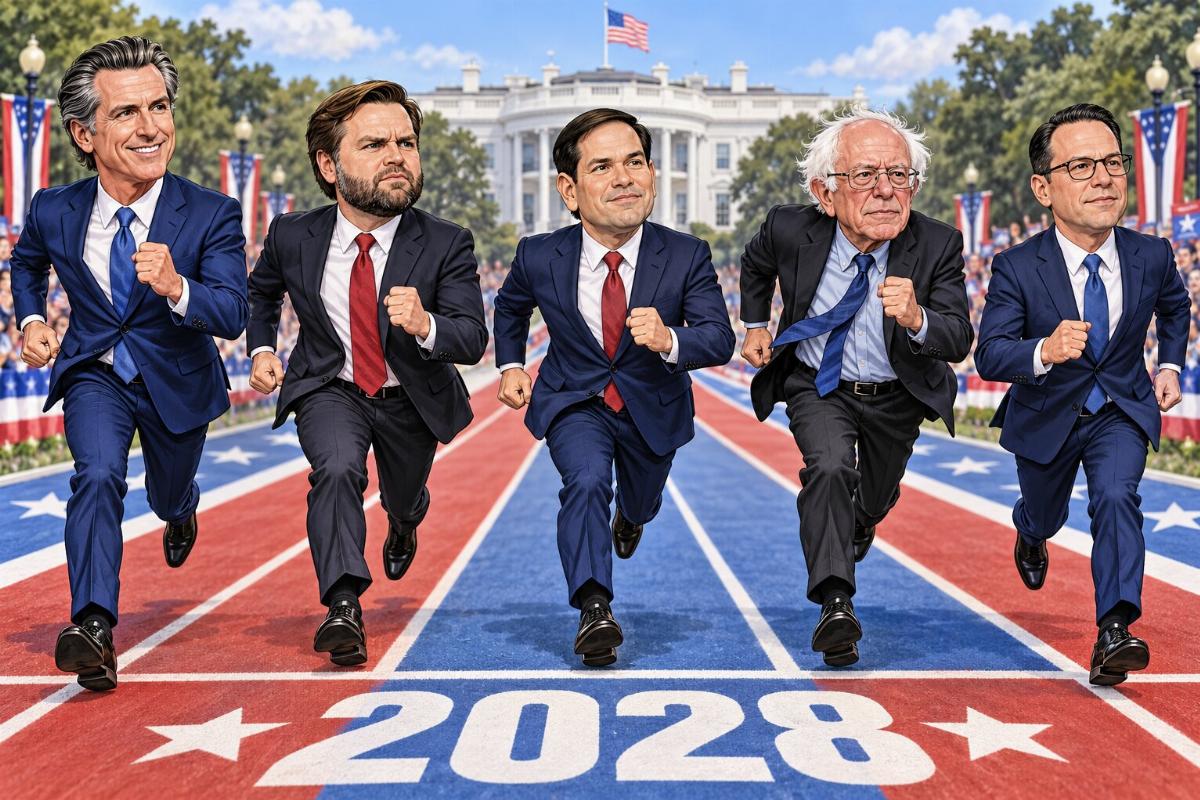
The 2026 elections are almost upon us. You all know what that means: before the end of the year, presidential candidates will be throwing their hats in the ring for 2028.
Read more When Grievance Enters The Huddle
The tradition is all but ingrained at this stage. When the Republican Party collapsed across the board in 2006 due to President George W. Bush’s deep unpopularity, plus massive scandals in the House and Senate, Republican contenders began scrambling to get ahead of the mess: define themselves early while distancing themselves from the GOP mess at the time.
Senator John McCain got sandbagged with the 2008 nomination, in part because he was the next in line, having lost to Bush in 2000. Former Senate Majority Leader Bill Frist and Florida Governor Jeb Bush were considering a bid, but they wisely avoided an election that would only compound Republican losses.
Presuming Republicans will exceed political projections in 2026, perhaps even hold on to the House and the Senate, they may face a rougher 2028. After all, Republicans expected to do very well in 2022, but they barely won the House. They should expect a similar turnaround against them.
Republican calculations also depend on what the Democrats plan for their standard-bearer. Will the DNC establishment and the liberal ground-game organizers resolve (i.e., neutralize) their socialism problem? Will they mitigate their anti-Zionist crazies? Or will they have to find a way to create a two-state solution within their party so that pro-Palestinian elements will coexist peacefully with the still-extant pro-Israel Democrat caucus? I doubt they will find peace, since the pro-terrorist elements are gaining, and they show no sign of slacking or moderating their abusive disdain for Israel, Jews, and the Western tradition.
Granted, the Arab-Israel foreign policy divide has emerged within some Republican circles, but it’s not a severe divide among the electorate. The nominees will have to make their case, and the more isolationist faction can cause trouble.
The 2028 Republican line-up will face the biggest challenge: Who succeeds Trump? The New York real estate mogul turned Top Five president in American history is a once-in-a-lifetime figure, impossible to imitate. His platform of lower immigration, cultural restoration, and populist confirmation has reshaped the Republican brand. The next GOP presidential candidate must embrace this new MAGA message while connecting with disaffected suburbs and dissident Republicans repelled by Trump’s brashness and bombast.
Vice President JD Vance is the frontrunner. Critics will charge that he has a thin resumé, but the vice-presidential office is about as useful as a warm picture of spit, and John Adams found it to be one of the most useless offices devised by man. Not Vance’s fault that he hasn’t done much.
His main strength is communication, which matters most for a national office. He helped message MAGA to the country in 2024, and he articulates working-class angst against a government and corporate complex determined to put power and profit ahead of the people. However, he is advocating more government spending and overreach, including a federal program for stay-at-home parents. He has frequently praised the economic interventionism of Senators Elizabeth Warren and Bernie Sanders. Socialism-lite is still socialism, JD. His ongoing friendship with Woke Right anti-Zionist carnival barker Tucker Carlson will trouble his presidential bid.
Republicans should not settle for a JD coronation, an outcome so unbecoming of a Republican Party that has become more grassroots-oriented. Vance either needs to shift his stance on free enterprise issues and make a clear, clean break from the podcastistan Woke Right, or he’s going to face some major headwinds in the 2028 primary, a divide that will hobble the conservative cause going into the general election.
For all the JD Vance liabilities above, Republicans should be looking for someone else to take up Trump’s mantle.
Secretary of State Marco Rubio has generated a growing following, established himself as an effective executive, a real on-the-ground administrator who gets things done, advancing a true America First agenda without anti-Zionist rantings. His stance on economic issues might be more tolerable to the free-market elements within the GOP, and his record on stopping illegal immigration is impeccable.
My first pick remains retiring Florida Governor Ron DeSantis. He not only messages the MAGA, but he makes it manifest and marketable across the country. He has a keen vision and attention to ideas, programs, policies, and personnel. The only problem is that a lot of MAGA will never forgive him for challenging King Trump, and governors have a hard time breaking out of their statewide followings. Florida is the new standard for conservative political prowess, but it doesn’t guarantee DeSantis a chance. Then again, before Trump, two of the last three Republican presidents, who served two terms as president, had been governors. Perhaps DeSantis needs to invest in a PR program and follow the pathways laid out by Reagan and George W. Bush to make himself known in the national discussion. No doubt he will run for president in 2028. Then again, his best bet may be angling for a VP slot with Vance or Rubio.
There is one other presidential wild card: Senator Ted Cruz. He ran his course—he had his chance in 2016, and I think that the MAGA movement swept him aside. Cruz is an excellent essential fighter in the Senate. If he doesn’t want to be a Supreme Court justice, he should settle for a leadership position in the upper chamber or consider statewide office in Texas, perhaps even running for governor once Greg Abbott retires. With ten years gone, Cruz has no viable means to exceed his results after his considerable yet unsuccessful 2016 bid for president. And this is coming from a guy who supported him in that contentious primary!
Now let’s look at the potential Democrat presidential contenders. They face some soul-searching (if there’s a soul to search for). Democrat pundits suggest the following are in the running for chief executive: AOC, Pennsylvania Governor Josh Shapiro, California Governor Gavin Newsom, who has made no pretensions of hiding his ambitions, Michigan Governor Gretchen Whitmer, and former transportation secretary Pete Buttigieg.
They face a raucous, divided liberal caucus. The Bernie Bros and their progressive peers are out for blood. They’ve been screwed for the last 10 years, and they demand not just a seat at a table, but the chairman’s corner. If they can’t get their progressive pick, they will insist on claiming final dibs on who carries the Democrat party banner. Clinton-era campaign manager James Carville can complain all he wants, but the DSA is here to stay, having infiltrated the inner workings of his party. The current DNC roster is pulled in so many directions and is desperate to placate the anti-Zionist elements in the National Conference, which proves that the DSA militants are determined to have their say.
This divide presents a golden opportunity for a 2028 GOP win.
Republicans must resolve foreign policy differences and reassert commitments to free enterprise and cultural restoration. If they channel Trump without the bluster and focus on the DSA cluster of craziness, they can carry the MAGA agenda for years to come.
Read more The real problem with mail-in ballots
Image generated by ChatGPT.