
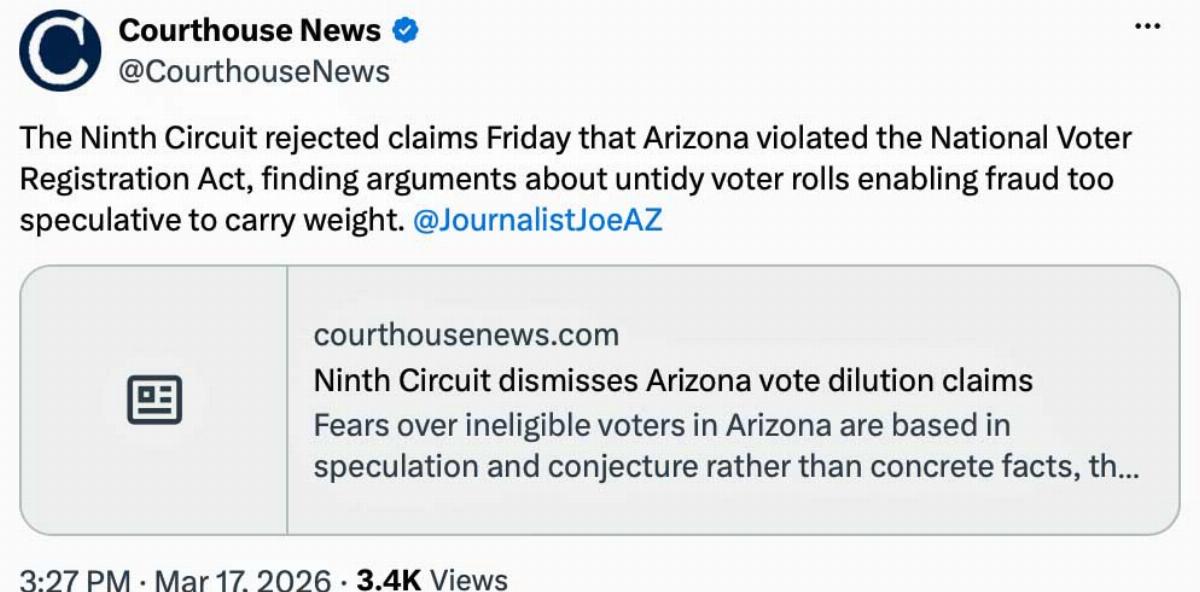
While Congress is essentially twiddling its thumbs over the SAVE America Act, an important election-integrity issue will play out before the Supreme Court. The federal government, by using the National Voter Registration Act, is trying to override the states’ efforts to rid their voter rolls of illegal aliens.
Read more Tucker Carlson: J. D. Vance needs to clarify things and fast
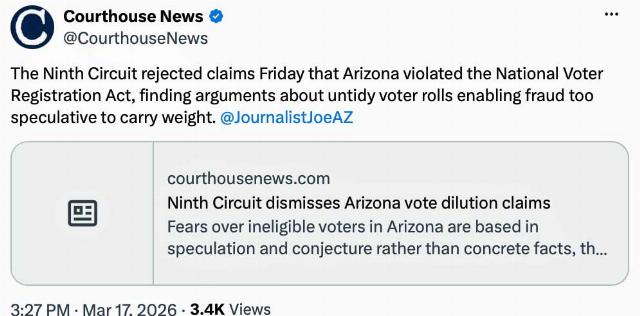
Graphic: X Post
A few issues arise regarding eligibility for voting in state and federal elections, and also the timing of when illegal aliens can be removed from the voter rolls. Three secretaries of state have filed a friend-of-the-court brief in the RNC v. Mi Familia Vota case:
Republicans and election-integrity advocates argue that the 9th Circuit Court of Appeals ‘erased’ a ‘constitutional boundary’ in declaring Arizona’s election integrity laws unlawful. The secretaries of state note that the U.S. Constitution ‘confers upon States the authority to determine who is qualified to vote’ through the voter qualification clause.
‘The Ninth Circuit was wrong in this case. States determine voter qualifications and perform voter list maintenance. Nothing in the National Voter Registration Act changed this longstanding tenet of federalism,’ Nebraska Secretary of State Robert Evnen, told The Federalist exclusively in a statement.
Arizona’s election integrity laws allowed applicants to vote in congressional and local races without proof of citizenship, but not in presidential elections or by mail. But in 2024, SCOTUS stayed lower court decisions that allowed individuals to use the federal registration form to vote in the presidential election and by mail. In so doing, the 9th Circuit decided that Arizona’s election integrity laws were unlawful, even though the states are the ones who determine whether voters are qualified or not to vote.
Also, at issue is what is called a 90-day “quiet period,” when no changes are supposedly to be made to the voter rolls. That is not, however, what was intended by the NVRA rule:
Read more America is running out of Americans
The plain text of the statute does not require states to keep an individual registered who was never eligible to be registered in the first place, and any interpretation of the NVRA that would require states to keep an alien registered to vote when both state and federal criminal laws bar an alien from registering would render the NVRA unconstitutional.
Aliens Barred from Registering or Voting by Federal Law
Aliens are barred from registering or voting in federal elections. It is a felony under 18 U.S.C. § 1015 (f) for an alien to ‘claim that he is a citizen of the United States in order to register to vote or to vote in any Federal, State, or local election (including an initiative, recall, or referendum).’ Another federal statute, 18 U.S.C. § 911, makes it a felony to ‘falsely and willfully’ claim to be a citizen.
Key to understanding the 90-day limitation is that it does not apply to an illegal alien who wasn’t permitted to register to vote at all and who was committing a criminal act by registering to vote. He should be removed from the voter rolls, even within the 90-day “quiet period.”
The case can be summarized in this way:
The case centers on two critical questions: whether states can require documentary proof of U.S. citizenship to register to vote, and whether they can remove confirmed noncitizens from voter rolls during the 90 days before a federal election, the so-called ‘quiet period’ established by the NVRA.
If SCOTUS does not rule on these two questions, the NVRA should be ruled unconstitutional.