
I recently took a road trip to Texas, and I can testify that from the Wyoming border at least to a point somewhere south of Colorado Springs, I-25 is an exercise in frustration. It’s a wonder there isn’t a road rage incident every five seconds. Colorado seems to be working as hard and fast as possible to be as inhospitable to Normal Americans as California, and they’re making excellent progress.
Read more The Clancy case may damage mental health research and treatment
I was going to write that Colorado is progressing toward progressivism, but they passed that station long ago. Colorado is going full Communist. Never go full Communist.
This is going to sound awfully familiar:
Early this week, Colorado’s Front Range Passenger Rail District released its Plan for Colorado Connector – CoCo, the name it has given to a proposed passenger train between Fort Collins and Denver.
The plan calls for spending $332 million in phase 1 (three trains a day each way), $1.7 billion for phase 2 (extending trains to Pueblo), and $2.7 billion for phase 3 (increasing frequencies to up to 10 daily roundtrips).
My first thought is that, as someone who actually went to planning school for a year or so before becoming disillusioned by the profession, I resent it when government agencies call documents like this “plans.” A real plan considers a wide range of alternatives, carefully evaluates the benefits and costs of each alternative, and then, as a part of implementation, sets up targets and a monitoring process so that it can change or cancel the plan if it fails.
This document contains none of that. Instead, it simply proposes to spend a lot of money, after which it would spend a lot more money, and then spend even more money. No alternatives are considered, and there is no suggestion that if the first step in the project fails in some way, they will modify or abandon later steps.
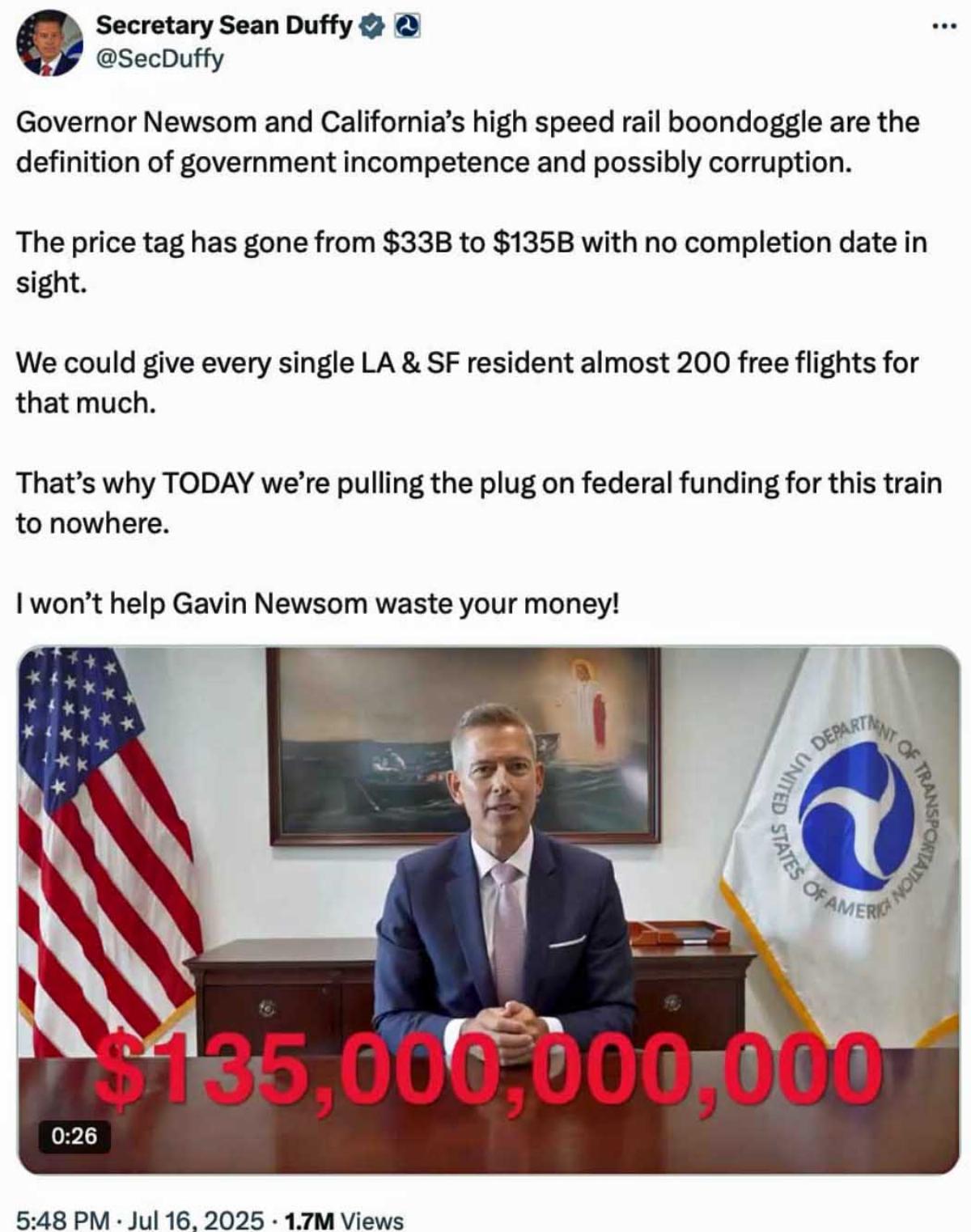
As I wrote not long ago, California’s high-speed rail to nowhere, initially funded in 2008, was supposed to cost $33 billion for an 800-mile network and be completed by 2020. Circa 2026, the route has compressed to about 170 miles, not a foot of track has been laid, no trains exist; and completion—God knows when—is projected to cost at least $135 billion (Hahahahahahahahaaaa).
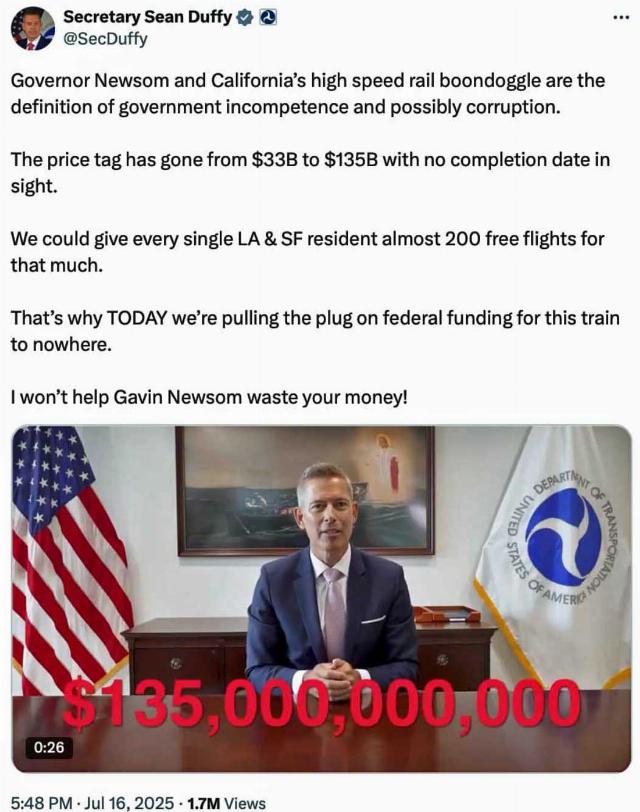
Graphic: X Post
California is at least $18 billion in the hole, and the federal DOT isn’t forking over another dime, at least not under Trump. Gavin Newsom is desperate to continue the project, which will probably leave future archeologists to wonder what all those unfinished concrete monoliths were: tombs? Temples? Astronomical observatories?
Fort Collins to Denver is only about 60 miles, only a bit over an hour by car. One can ponder the rest of their life to discover what the need for a train between those cities might be:
Read more Taking down drones the old-fashioned way
The document makes a point of saying that people will be able to ride the train to football games and concerts at the Broncos Mile High Stadium. Let’s see: the typical train will carry 500 or maybe 600 people, while the stadium has 76,000 seats for football games and 85,000 seats for concerts. So a trainload of people isn’t even going to fill 1 percent of the seats. During phase 1, the state will own only one train, but even in phase 3 it will probably only have six or eight trains, and even if all trains were diverted from their usual duties to go to the stadium, they wouldn’t fill many of the seats.
But hey, it’s a train! Democrats just love choo-choos, and they like wasting public money even more:
Spending $4.7 billion on passenger trains that will produce so few benefits is ridiculous, but voters should know that the cost is likely to be a lot more. Denver International Airport was supposed to cost $2.9 billion; it cost $2.0 billion more. “Fastracks,” Denver’s regional rail transit plan, was supposed to cost $3.8 billion for six major lines and three minor extensions; so far Denver’s Regional Transportation District has spent and says it will need another $1.6 billion to finish all of the lines.
In short, the District wants to spend more than $4.7 billion on trains that aren’t going to relieve congestion, generate economic development, or bring many people to sporting events and concerts. I am sure we all could think of a lot of better ways to spend that money that will produce far greater benefits, but the “plan” failed to consider any alternatives.
The article suggests the only people who will benefit will be the suppliers and contractors, and of course, the companies that build the trains. But like California, this boondoggle, if voters fall for it, will almost certainly never get that far, and it will cost a lot more than they’re letting on.
Become a subscriber and get our weekly Friday newsletter with unique content from our editors. These essays alone are worth the cost of the subscription.
Mike McDaniel is a USAF veteran, classically trained musician, Japanese and European fencer, lifelong athlete, firearm instructor, retired police officer, and high school and college English teacher. He is a published author and blogger. His home blog is Stately McDaniel Manor.