
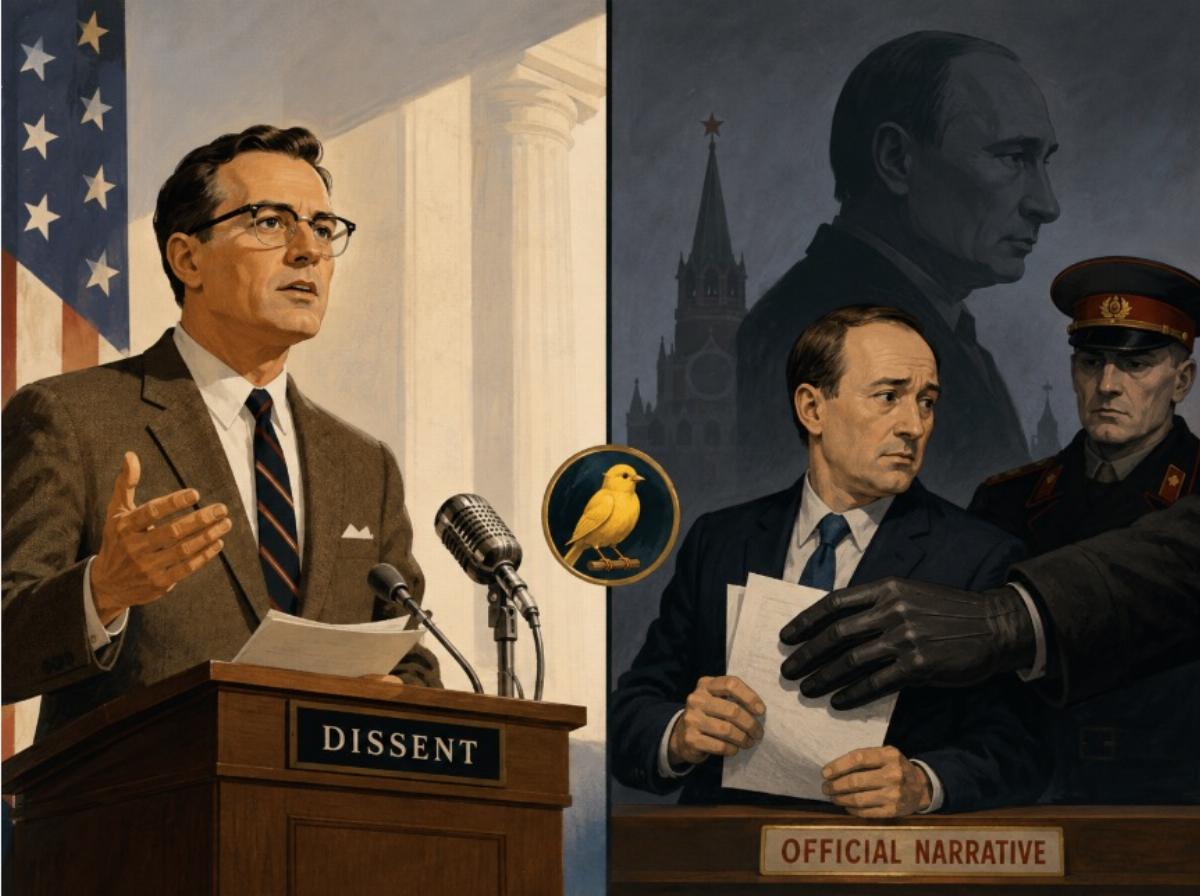
American conservatives who admire Putin or excuse Russia’s conduct should remember that the authoritarian “strength” they admire depends on suppressing dissent, while America’s constitutional disorderliness is inseparable from the freedom to challenge the government without fear of state punishment.
Read more Banking Regulation: The Gates Are Slowly Closing
Americans take for granted a “free” press and other First Amendment rights; Russia, not so much! An August 17th article by Efrat Lachter, a Fox News correspondent, immediately had me visualizing Arte Johnson as the infamous German soldier “Wolfgang.” The line: “Verrry Interesting.”
The article, titled “Russian state economist fired after publicly releasing a stark warning about Moscow’s economic future,” is remarkable, not just because of what the now-former Russian chief economist said, but for what it says about Putin’s ability to control the narrative that Russia will soon be able to declare victory in Ukraine and prosperity will return to the motherland. If only it were that easy.
Andrei Klepach, then chief economist of Russia’s state development bank VEB.RF, publicly warned that Russia was losing the economic and technological competition with the West and, in some respects, even with Ukraine. He said Russia would not win the economic “war of attrition.”
Russia is paying a higher price than even its staggering battlefield losses. The war has accelerated structural weaknesses that were already eroding the country’s competitiveness: chronic underinvestment, technological isolation, and a shrinking labor force. Klepach himself warned that Russia faces a “social crisis” driven by stagnating productivity and widening inequality.
The post-invasion exodus of young, educated workers has only intensified these pressures, leaving Russia with fewer engineers, entrepreneurs, and skilled professionals—the very people needed to modernize an economy now cut off from Western technology. Tanks and shells can be replaced; human capital cannot.
Klepach’s remarks were made in May but attracted attention only after Reuters reported in August that he had been dismissed. VEB did not publicly say that his comments led to his removal, but the timing and circumstances raise an obvious question: What happens to people in Putin’s Russia who buck the party line?
The answer is not merely that they risk losing their jobs. Russia has imprisoned citizens for publicly opposing or contradicting the Kremlin’s position on the war. People have received lengthy prison sentences for anti-war speech. The issue, therefore, is larger than what happened to one economist.
Authoritarian governments don’t merely seek to control what people do. They seek to control what people are permitted to say is true. If a government insists that victory is coming, the economy is succeeding, and the costs of war are manageable, an influential official publicly saying otherwise challenges not merely a policy but the government’s narrative and veracity.
We have our own naysayers here at home. But the contrast between us is extraordinarily revealing.
Consider how Andrei Klepach and American political scientist John Mearsheimer have been treated so differently. Klepach warned that Russia was losing the economic and technological competition surrounding the war in Ukraine and was subsequently dismissed from a state institution.
Mearsheimer has spent years making arguments sharply at with much of the prevailing American foreign-policy establishment: that NATO expansion helped provoke the war, that U.S. policy bears substantial responsibility for it, and that Ukraine cannot realistically defeat Russia and recover all of its territory. Russian state media have repeatedly quoted his arguments because they reinforce Moscow’s explanation of why the war began.
Yet Mearsheimer, a University of Chicago professor, remains free to make those arguments publicly. He continues to write, lecture, teach, and appear in public forums and media. Americans may consider him wrong, irresponsible, or even dangerous. He may encounter professional or social consequences. But the American government does not make his disagreement with official policy a matter of personal survival.
That distinction is easy to take for granted precisely because Americans have lived with it for so long. And that is where our Russian canary in the mine begins to sing.
Read more Pandering to Predation
A significant number of American conservatives admire Russia, not necessarily because they understand or endorse its political system, but because they see Putin as a successful counterweight to cultural and political forces they see undermining the West. Russia presents itself as a defender of traditional values, nationalism, and Christianity and as a resister of progressive ideology.
Putin projects the image of a strong leader willing to confront institutions and elites that many American conservatives distrust. Too often, however, that admiration requires looking past ugly issues that should change the picture.
There is an understandable frustration behind some of this. America has serious institutional failures. Our political system is starkly polarized, our government often seems incapable of long-term thinking, and many Americans believe institutions that once commanded broad confidence are now politicized or ineffective.
The frustration is real. So is the temptation to believe that a stronger hand, i.e., someone like Putin, could sweep the dysfunction away here.
But there is a dangerous step between recognizing America’s failures and admiring a system that suppresses dissent about its own. America can be deeply flawed without making Russia a model to emulate. Our foreign policy can be wrong without making Putin right. Our political opponents can be misguided or even evil without making a strongman like Putin the answer.
Our presidency remains constrained by courts, Congress, elections, federalism, and the Constitution. That is our strength, not our weakness, even with its warts.
The fundamental test of a free society is not whether its government is always competent or whether its citizens agree with it. It is whether citizens remain free to tell their government that it is wrong. Klepach appears to have discovered the limits of that freedom in Russia. Mearsheimer demonstrates its extraordinary breadth in America.
That distinction should concern conservatives in particular. The answer to America’s institutional failures is not to abandon the principles that made our freedom possible. Political speech—even speech we find abhorrent—is fundamentally different from using governmental power to silence, intimidate, or punish those who dissent.
The Russian canary isn’t warning us that Russia is about to collapse. It is warning us about something more fundamental: what happens when a government becomes unwilling to tolerate inconvenient truths. Some Americans may find Putin’s willingness to impose order attractive, particularly when our own institutions appear incapable of providing it.
But political order that depends upon political obedience comes at a price far greater than Americans should be willing to pay.
America’s greatest protection against that fate is not perfect institutions. It is the ability of ordinary citizens, journalists, academics, and public officials to challenge them without fear of the state. We should be careful not to lose sight of how extraordinary that is.
God Bless America.
Image created using AI.
Author, Businessman, Thinker, and Strategist. Read more about Allan, his background, and his ideas to create a better tomorrow at 1plus1equals2.com.