
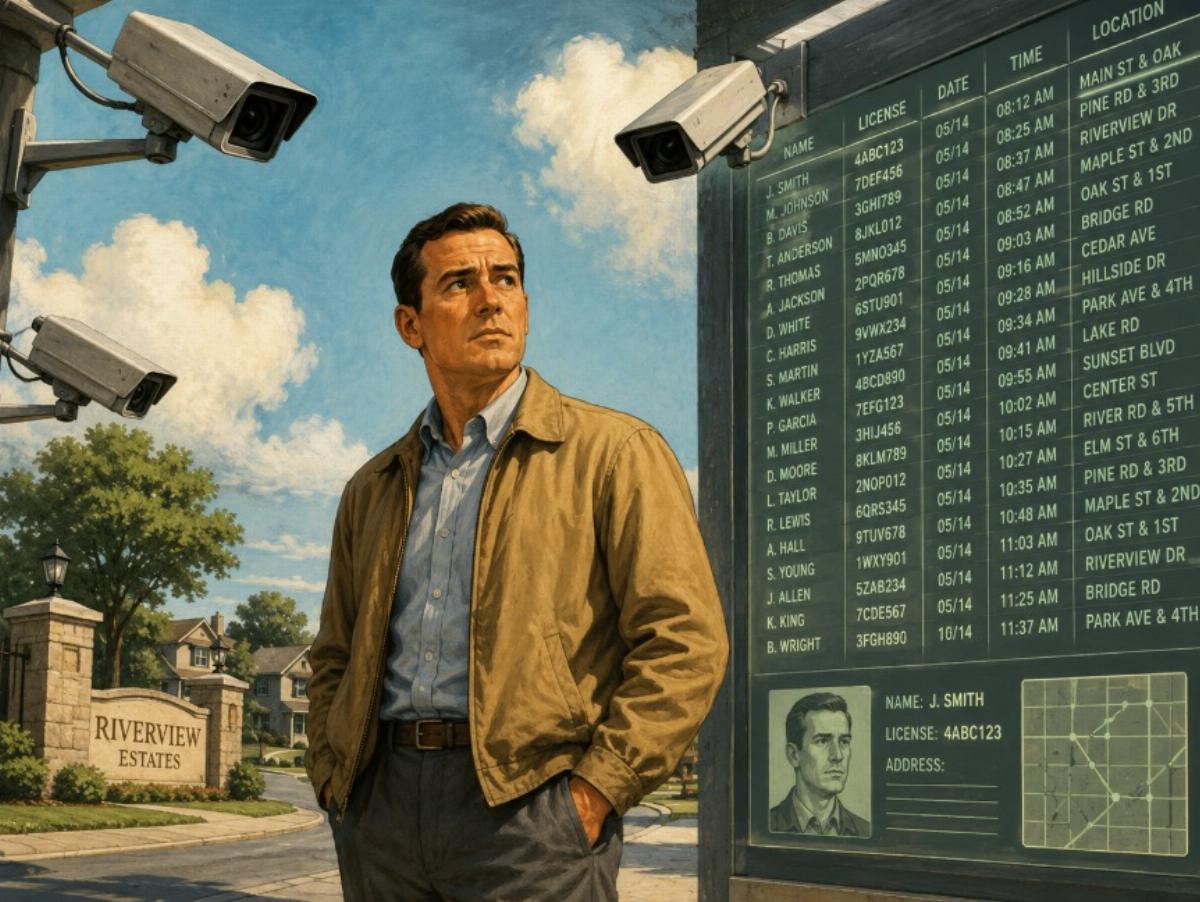
On my community Facebook page, a notice went up: The entrance to our community has not one but two Flock cameras. Responses ranged from “Good, that’ll keep out criminals” to “This is a 1984 escalation.” Both responses are correct. Criminals should be deterred, and we are all being watched. The main thing is that law-abiding citizens must protect themselves from a government run amok, and there are ways to do that.
Read more Measuring meaningless climate actions
As M. Walter wrote a couple of weeks ago, most of us are probably under Flock’s watchful eye. Reading that reminded me of the rise of CC cameras in London. Back in the 1990s or early 2000s, if I remember correctly (and I no longer know whether that’s true), London had more CC cameras than any other city in the Western world.
The Brits were assured that their government wasn’t spying on them. Instead, the cameras would just be used after the fact to catch criminals, not beforehand, to spy on citizens. They would make London safer, not more totalitarian.
It sounded like such a good idea.
Now, of course, all of Britain has become one of the most totalitarian places in the Western world. If you’re not British, you get passes on just about everything from hate speech to violent crime. However, if you’re a Brit and deviate only slightly from the new norm, whether in public behavior or tweets, you will find the police at your door. Those CC cameras no longer seem so innocuous.
And that’s what increasing numbers of Americans are worried about when it comes to Flock cameras. Yes, we want criminals dissuaded, and our communities made safer, but the idea of our every move being in easily accessible databases is unnerving, to say the least. Many think, as I do, that a better way to dissuade criminals is to impose serious consequences, rather than relying on a revolving-door prison system and spy cameras.
And in 2026 America, how much do we really trust the government? It seems to be so rife with fraud and corruption that it is light-years distant from the America of Leave It To Beaver’s day or before.
Sure, there was corruption then, but most people felt that was confined to a few big, corrupt cities (e.g., New York, Chicago, and L.A.), or certain malevolent areas in the Jim Crow South. Otherwise, Americans felt that they could trust most of their politicians and government employees.
But now, we read about a Massachusetts police officer, not in a big city like Boston, but in Stow, Massachusetts (population 7,174), who is alleged to have misused Flock cameras and conducted unauthorized searches in other law enforcement databases:
The town of Stow is pursuing termination proceedings against Officer Jason Rogers, while the Stow Police Department has filed a criminal complaint seeking charges against him, Police Chief Michael Sallese and Town Administrator Denise M. Dembkoski announced in a Stow Police Department press release [the link does not work].
Police learned of the alleged misconduct on June 18, when a person Rogers allegedly searched for filed a complaint with the department. Police said Rogers and the complainant knew each other.
Read more The Crucial Midterm Elections
[snip]
A four-week internal affairs investigation determined that Rogers unlawfully accessed Criminal Offender Record Information through the Massachusetts Criminal Justice Information Services system on at least five occasions, police said.
Rogers also allegedly ran vehicle information through both Flock Safety and CJIS on multiple dates without a legitimate law enforcement reason.
The town was so perturbed by Rogers’ alleged conduct that it terminated its relationship with Flock Safety and removed the town’s automatic license plate reader.
Officer Rogers isn’t the only one. The New York Times recently reported on numerous instances in which police overstepped themselves, although the Times seems most outraged about Flock’s use to track people who violated abortion and immigration laws:
A Texas officer used Flock’s cameras to track a woman across state lines who was suspected of self-administering an abortion. Officers across the country have abused their access to Flock’s cameras, including to track romantic partners, resulting in discipline and termination. Los Angeles and Dayton, Ohio, among other cities, recently suspended their contracts with Flock to prevent immigration authorities from accessing data from the cameras. Dayton resorted to covering the cameras with trash bags. In cities like Houston, Oakland, Calif., and Grand Junction, Colo., residents have taken matters into their own hands, with police reports and surveillance footage documenting Flock cameras being cut down, splattered with paint and even shot.
The reality is that information can be both used and abused. Flock and other similar cameras aren’t going anywhere, and they can serve useful purposes.
The trick for normal Americans is that, now that we know these databases are out there, we take responsibility to protect ourselves. Along the way, we should also keep up the pressure for people who have committed serious crimes to get meaningful prison sentences. In a safer world, we wouldn’t need flocks of cameras all over the country.
Image created using AI.
Presented by Incogni
You cannot opt out of the cameras your town bolted to a pole, but a plate number is only a string of characters until something connects it to you. That connection is for sale. Data brokers and people-search sites compile your name, home address, phone number, and the names of your relatives, then sell the package legally to anyone with a credit card, police departments and private operators included. The cameras are a fight for your city council. The file with your name on it is one you can close yourself.
Incogni finds the brokers holding your information, sends legally binding removal requests on your behalf, and keeps sending them as your data reappears. Its Unlimited plan lets you submit custom removal requests for anything the major databases miss.
Read more Why Lefties and Islamists Believe the Way They Do.
Get 55% off Incogni’s Unlimited Plan with code AT55.
Presented by Incogni. Sponsors have no input into editorial content.