
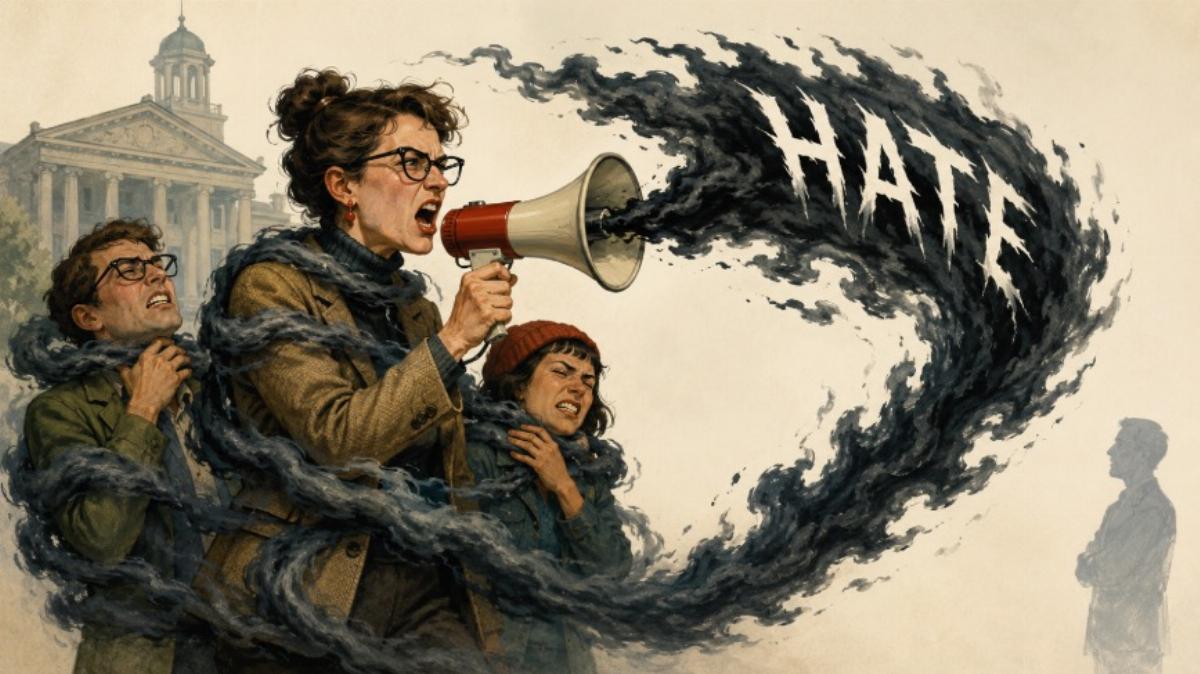
No one would likely deny that hatred is part of the human condition and that hatred can transform into rage and violence. Recent years alone demonstrate hatred’s manifestation through riots, attacks on Immigration and Customs Enforcement, and abundant verbal attacks (especially from the Left) that seem to be increasing in number and intensity.
Read more De Niro vs. Mamdani
But what lies behind this destructive vitriol and these acts of hate? Is hatred actually getting worse in recent years? Is there anything we can do about it?
To better understand the nature of hate, I went to several sources to create as complete a definition as possible:
Hate is not an emotion but a learned response fueled by fear, anger, and stress.
It flourishes on division, misinformation, and social conditioning, yet it can be unlearned; hatred is an emotion we experience when we feel someone or something is a threat to our happiness, success, and well-being; hate is an intense, lasting hostility toward someone or something, usually paired with a wish to harm, devalue, or shut out whatever you’ve aimed it at.
As you can see, hate has a variety of attributes, some of which even contradict one another. But even from these three definitions, three elements stand out: hate is learned; we hate something that threatens us; and hate can become a lasting hostility.
If we use this as our working definition, we can try to understand hate when it appears in the political arena and consider whether there is any way to moderate it.
One way hate manifests itself is through fear, especially fear of something unfamiliar:
The unfamiliar makes people uncomfortable, and in that discomfort, hate is cultivated. Stress and anger also fuel hate. When individuals feel powerless, overwhelmed, or frustrated, they search for something to blame. Hate becomes a means to direct negative emotions outward. This is evident in scapegoating, where specific groups are held responsible for economic hardship, crime, or societal decline.
Hate is often blamed for its destructiveness to society, but it can also be destructive to those consumed by it:
Hate is destructive not just to its targets but also to those who hold it. It consumes energy, distorts reality, and fosters resentment. Research shows that people who cling to hate experience higher levels of stress, anxiety, and even physical health issues. Hate undermines mental and emotional well-being.
So, when the Left indulges in hatred toward the Right, its members may not realize that, although they feel empowered by their views, those same views can become self-destructive.
People may join a Leftist group because it reduces their sense of loneliness and isolation, but the group may condition belonging on hating “the enemy”:
Read more Not guilty by reason of alcoholism
The trouble starts when belonging to “us” comes to depend on rejecting “them.” Announcing what you’re against draws a fast, bright line around your circle, and it can bond a group as tightly as anything they share a love for. It scratches a real itch: we all want to feel connected to others.
Hate can also play a powerful role for those who are insecure. It gives them a sense of moral superiority and can justify whatever harm results from the positions they have taken. Group members then reinforce one another’s belief in their own superiority.
We’ve seen plenty of examples of hatred demonstrated by the Left in many different settings. In Jonathan Turley’s book, “The Indispensable Right: Free Speech in an Age of Rage,” he tells us that there are more dangerous enemies than individuals and groups:
Turley believes we have far more to fear from governmental rage than we do from popular rage. He further believes that the former often begets the latter and strengthens it by creating martyrs and driving such speech underground where it cannot be combated. He opposes elevating political speech above other types of speech, which are also conducive to human flourishing.
And academia, from the elementary level through the university level, has been at the forefront of attacks on Republicans:
Recently, in Chicago, elementary school teacher Lucy Martinez was shown on video reacting to an image of Kirk by mockingly making a gesture akin to being shot in the neck, mimicking how Kirk had been assassinated.
Another educator, Wilbur Wright College Adult Education Manager Moises Bernal, screamed to a crowd that ‘ICE agents gotta get shot and wiped out.’ Bernal told the crowd, ‘You gotta grab a gun!” and ‘We gotta turn around the guns on this fascist system!’
[snip]
Faculty have thrilled their colleagues and students by talking about ‘detonating white people,’ abolishing white people, calling for Republicans to suffer, strangling police officers, celebrating the death of conservatives, calling for the killing of Trump supporters, and supporting the murder of conservative protesters.
Even school board members have referred to taking faculty ‘to the slaughterhouse’ for questioning diversity, equity and inclusion policies.
Trying to eliminate or even moderate hatred is a nearly insurmountable task. Hatred empowers those who indulge it, making the emotion itself addictive. Although it may alienate those on “the other side,” it creates a comforting haven for those within the group.
Are these incidents merely reflections of a temporary period in our history that will eventually die down? Is there any indication that the political climate is becoming more temperate? Will enough people come to their senses to realize that hatred is a destructive political strategy?
Read more Data Centers: our domestic and foreign enemies are lying to us
I’m not optimistic. And I see no strategy that will calm the waters.
Image created using AI.