
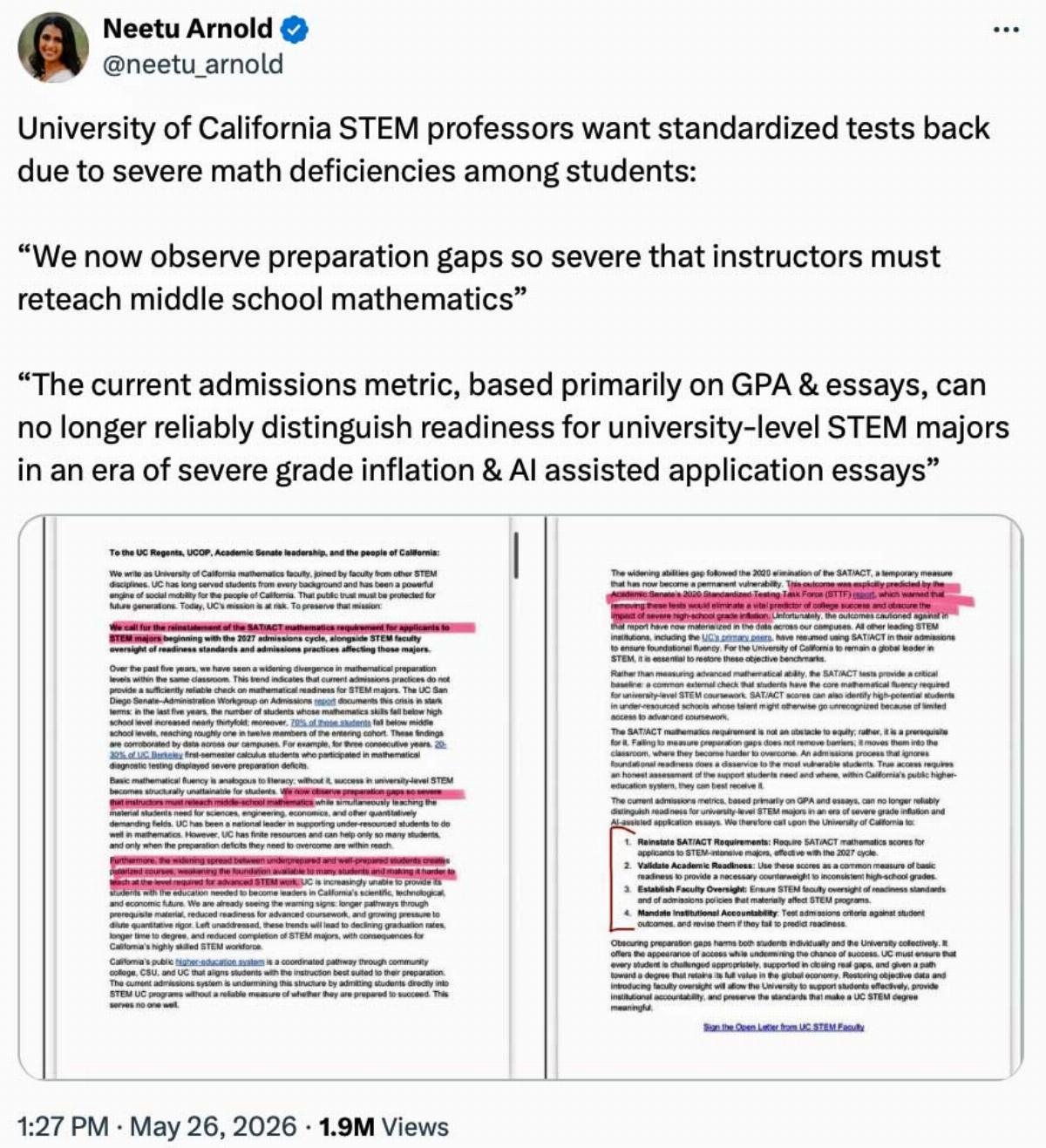
I was born without the math gene. I do not gaze upon equations and see the inherent majesty and wonder of the universe. Oh, I can do math quite well. Being a musician/composer/arranger helps, and because I work with wood am a fractions whiz, but I’m no mathematician. Neither, it seems, are a great many people entering college STEM programs at the University of San Diego:
Read more Blue Origin reminders

Graphic: X Post
Many freshmen arrive on campus completely unprepared for even high-school-level math. In recent years, UCSD has seen a significant increase in enrollment in Math 2 (remedial math) and Math 3B, which now cover skills from elementary through Algebra II. Alarmingly, some students have knowledge gaps in concepts taught as early as grades 1-8.
The University of California system used to be one of the greatest in the world, with ten campuses, three affiliated national laboratories and five medical centers. It turned out innumerable doctors, scientists, engineers, and contributed materially to America’s technological prowess.
That there’s trouble in academic River City should be unsurprising. When Barack Obama declared everyone should go to college and federalized the student loan industry, colleges, suffering from demographically foreseeable enrollment declines, began admitting anyone with a pulse and a student loan. All of a sudden, they discovered many of them didn’t have the IQ for genuine college-level work and were otherwise unprepared. So, colleges dumbed down classwork, eliminated or inflated grades, and established remedial high schools on campus with full tuition for no credit. It was a win-win for colleges and Obama, and a disaster for students who never graduated and for STEM education.
To help hide that disaster, with colleges hiring more administrators than enrolled students, and admitting minorities even less prepared for college, it was necessary to do away with the SAT for admissions. STEM professors were, eventually, not impressed:
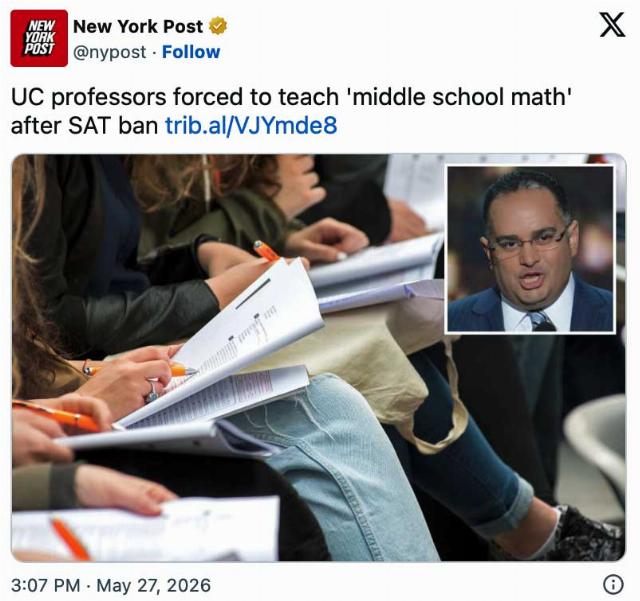
Graphic: X Post
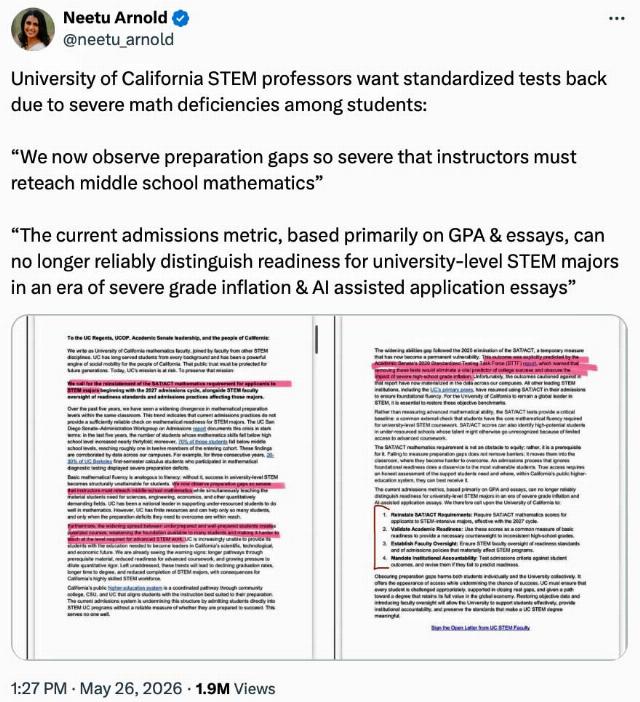
“We now observe preparation gaps so severe that instructors must reteach middle school mathematics.”
“The current admissions metric, based primarily on GPA & essays, can no longer reliably distinguish readiness for university-level STEM majors in an era of severe grade inflation & AI assisted application essays.”
I’ve long argued against single-minded reliance on mandatory, high-stakes testing in K-12 education, because it skews the entire system toward single test scores and wipes out months of actual learning in favor of test drills to boost schools’ scores. It ultimately tests not knowledge but test-taking skills and tactics for those particular tests. However, tests like the SAT have proved useful indicators of general skill and knowledge levels and predictors of college success. However, they can also be gamed. I taught SAT prep classes and could raise kids’ scores substantially by simply showing them the expectations of test makers and effective tactics to maximize scores.
UC Professors had to get serious if they were going to graduate competent scientists:
Read more The Biden Administration’s Contribution to the October 7 Massacre
Graphic: X Post
Unfortunately, the outcomes cautioned against in that report have now materialized in the data across our campuses. All other leading STEM institutions, including the UC’s primary peers, have resumed using SAT/ACT in their admissions to ensure foundational fluency. For the University of California to remain a global leader in STEM, it is essential to restore these objective benchmarks. [skip]
The SAT/ACT mathematics requirement is not an obstacle to equity; rather, it is a prerequisite for it. Failing to measure preparation gaps does not remove barriers; it moves them into the classroom, where they become harder to overcome. An admissions process that ignores foundational readiness does a disservice to the most vulnerable students. True access requires an honest assessment of the support students need and where, within California’s public higher-education system, they can best receive it.
Sadly, it’s likely the professors’ concerns will be ignored. This is, after all, California, where DEI is akin to the most fanatic religious faith, and anything the Trump Administration wants—and common sense–is reflexively and fervently opposed. This is particularly so where any application of merit is concerned.
Yet, when we’re talking about training doctors, scientists, and engineers, we need the very best, most capable people possible. Unless, of course, we don’t mind incompetent doctors, scientists who can’t do college math, and engineers whose calculations result in collapsing bridges and exploding motor vehicles.
With even California university professors once again arguing for the bare basics of merit for college STEM admissions, we get to see whether college administrators mind those disasters, or whether DEI—and their exorbitant salaries—matter more.
Become a subscriber and get our weekly Friday newsletter with unique content from our editors. These essays alone are worth the cost of the subscription.
Mike McDaniel is a USAF veteran, classically trained musician, Japanese and European fencer, life-long athlete, firearm instructor, retired police officer, and high school and college English teacher. He is a published author and blogger. His home blog is Stately McDaniel Manor.