
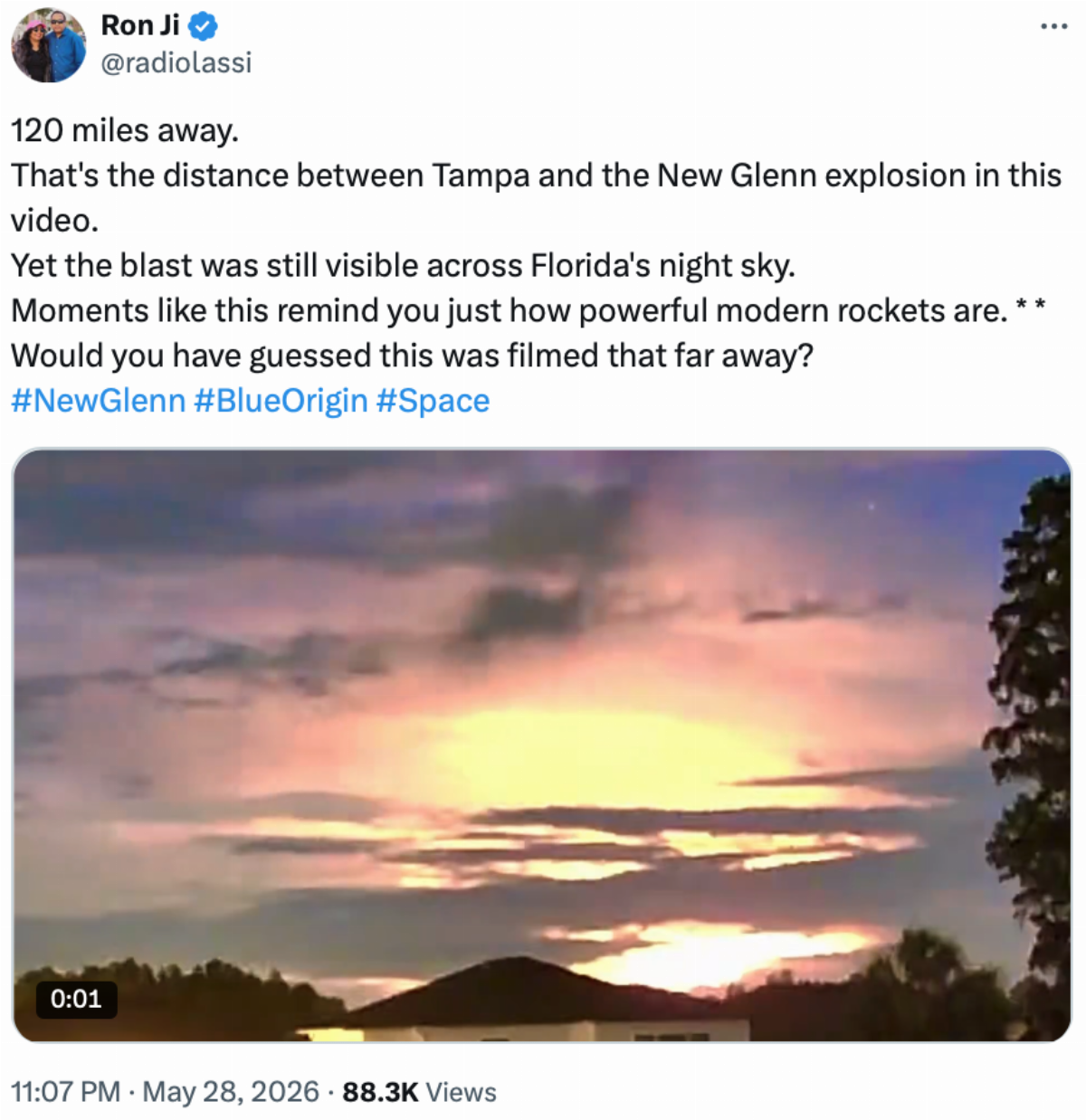
Watching the burgeoning private space-launch industry surpassing NASA has been informative. When two astronauts ended up stuck on the ISS from June 2024 through March of 2025, Elon Musk’s Space X was asked to rescue them. They had originally been scheduled to stay on the ISS for just a handful of days, but the Boeing Starliner capsule was badly flawed. It took a very long time for the facts to come out, but we eventually learned the astronauts nearly died on the trip to the ISS. NASA finally decided not to risk their lives on a return trip, and the unmanned capsule made it back, apparently unscathed. Both astronauts retired, and Boeing hasn’t been able to certify the Starliner for flight.
Read more The Biden Administration’s Contribution to the October 7 Massacre
That incident, as well as several in the past, demonstrates just how difficult and dangerous manned space flight is. NASA used to make it look sort of easy, but not anymore, and in terms of safety, capability, and the sheer numbers of successful spaceflights, private operators have left NASA, which routinely pays them for launches NASA can’t do, behind.
This is surely a lesson about the inefficiency of government compared to the efficiency of private enterprise, unrestrained by DEI. Yet we were reminded of the dangers of spaceflight when a Blue Origin rocket spectacularly exploded on the pad at Cape Canaveral.
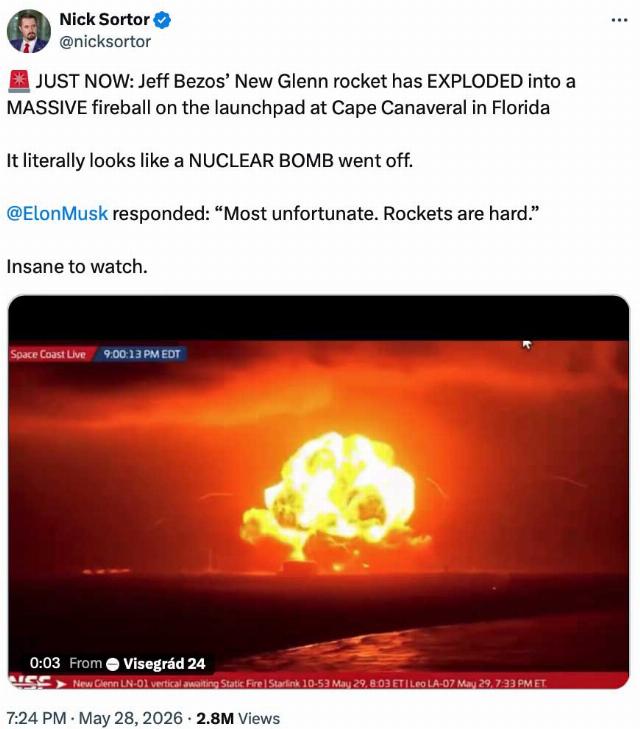
Graphic: X Post
During a static fire test of the first stage tonight in preparation for the next launch (scheduled for June 4), Blue Origin’s New Glenn rocket exploded just as the test began, destroying the first stage and much of the only launchpad the company has to launch this rocket.
The link above is cued to just before the explosion, shown in a screen capture to the right. BtB’s stringer Jay just sent me a link to a different video view, from farther away but is in some ways as spectacular. According to Blue Origin’s statement, all workers are accounted for, so fortunately there were no fatalities.
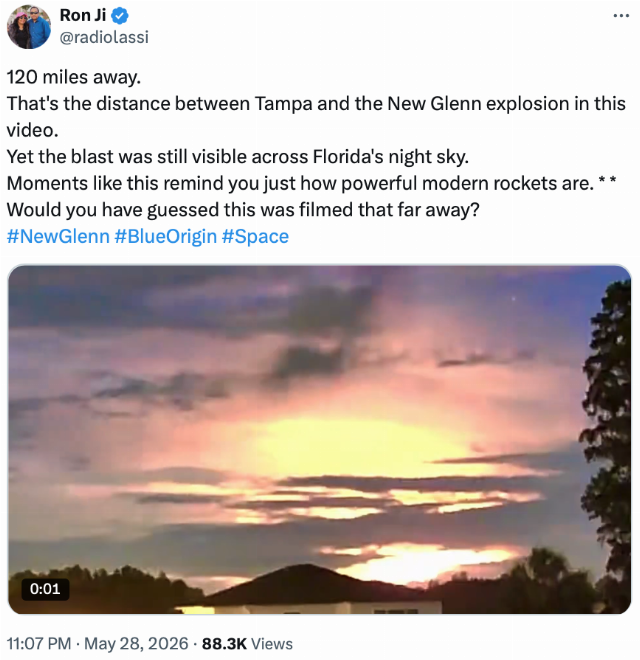
This photo from 120 miles across the state is equally awe-inspiring:
Graphic: X Post
Thank God, but much surrounding the rocket, including the enormously massive, concrete-and-steel pad, was destroyed or badly damaged. Elon Musk wryly observed: “Rockets are hard,” and Jeff Bezos expressed similar sentiments:

Graphic: X Post
The rocket was to launch 48 Amazon Leo satellites. As those satellites were not on the rocket during this test, they are safe and can be launched elsewhere.
The failure will likely prevent any further New Glenn launches by Blue Origin for at least three to six months. Not only does the company have to determine and fix the cause of the failure, it will need to rebuild the launchpad. At best I expect the company will at best manage one test launch before the end of the year.
It appears Space X, despite its own heavily contracted launch obligations, will have to pick up the slack.
This also will impact NASA’s just announced unmanned lunar lander program. One mission planned for this year, Blue Origin’s Blue Moon Mark-1 unmanned lander, was scheduled to launch on a New Glenn. In addition, a second New Glenn was set to launch NASA’s Viper rover next year. Neither will happen as scheduled.
Some observers described the explosion as akin to a nuclear detonation, but that’s an exaggeration. Still, it’s a reminder of how much energy is required to escape our gravity well, and how very limited, compared to the anti-gravity spacecraft of science fiction, we are by our rocket technology. We can’t lift very much into space, and it requires enormously heavy rockets and enormous amounts of volatile fuel to do that much. Yes, we’re now able to do more than ever before, but we’re likely reaching the outer limits of rocket technology. It’s a wonder that brave men and women are willing to sit atop devices capable of that kind of energy release, over which we obviously have limited control.
It’s also a reminder of our species’ relative youth. We’re promised new information on UFOs, including potential revelations that we’ve recovered alien bodies and spacecraft. I used to explain to my students the vastness of space and the fact that we can travel at comparatively toddler speeds. We have yet to visit even Mars, to say nothing of the rest of our solar system. If there is alien life, and it is routinely visiting us, they must be alarmingly advanced, because they’d have to be capable of faster-than-light speed. The technology that would require suggests even more frightening things about their weapon technology. Or perhaps they’re capable of dimensional travel, which is another can of terrifying worms.
In the meantime, we’re reminded yet again of not only our fragility, but our bravery and determination. That, and the danger of over-reliance on government, and ignoring merit when lives are at stake.
Become a subscriber and get our weekly Friday newsletter with unique content from our editors. These essays alone are worth the cost of the subscription.
Mike McDaniel is a USAF veteran, classically trained musician, Japanese and European fencer, life-long athlete, firearm instructor, retired police officer, and high school and college English teacher. He is a published author and blogger. His home blog is Stately McDaniel Manor.
Read more Europe Turns to Digital Currency