
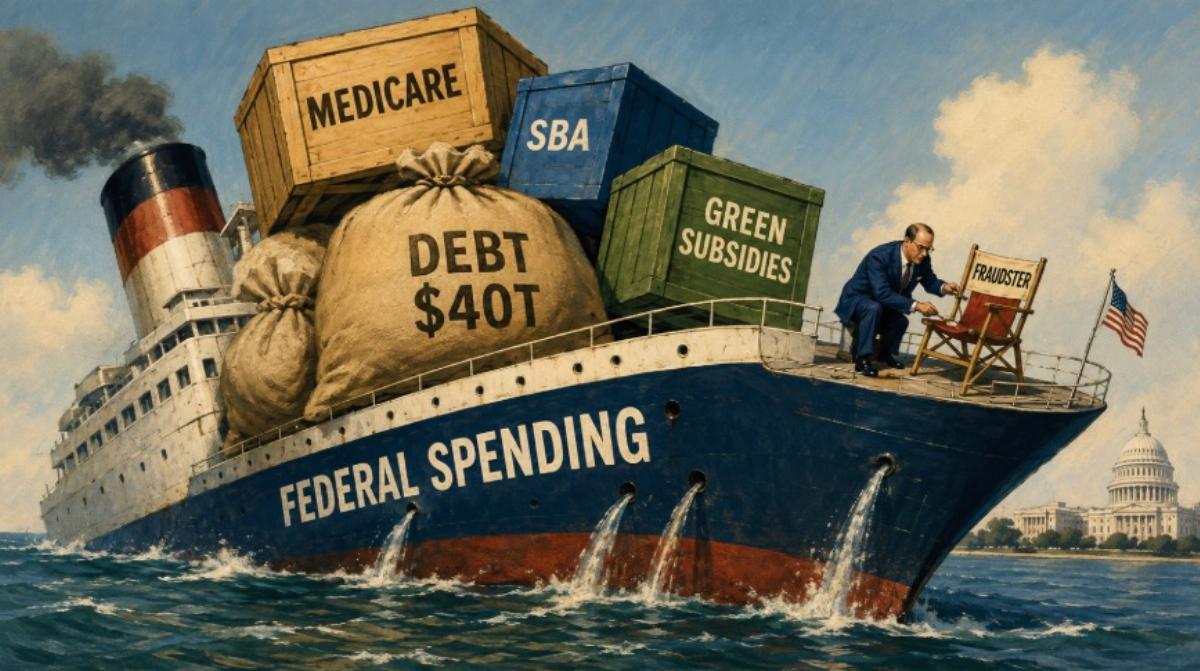
Every day (if you read real news) we see multiple new cases of documented fraud. Medicare fraud. Election fraud. Small Business Administration fraud. “Green” fraud. And on and on.
Read more Because Pride Goeth Before the Fall
Elon Musk originally estimated that his “lower bound guess for how much fraud there is nationally is ~20% of the Federal budget, which would mean $1.5 trillion per year. Probably much higher.” That guess is now being proven to be conservative. It gives life to the late Illinois Senator Everett Dirksen’s (possibly apocryphal) comment that “A billion here, a billion there. Pretty soon you’re talking about real money.”
Our national debt has just passed $40 trillion. That’s real money.
Every time we catch a fraudster, we take one bad actor off the field…out of thousands. That’s like fixing one dent on your car that you left out in a hailstorm. Somehow the car still looks like a huge golf ball.
We simply cannot pull a single weed from the field. We must pull them all, but that’s impossible because, as the prophet Jeremiah told us, “The heart is more deceitful than all else and is desperately sick; Who can understand it?” (Jer 17:9). There will always be more fraudsters. If you don’t read the Bible, just check your phone at dinner time.
The real answer to the dents is to pull your car into the garage before the storm. But we’ve left the government out in a field full of weeds. As long as there are government programs dropping c-notes out of helicopters, there will be evil people out there figuring out how to push others out of the confetti and keep it for themselves. And that’s the problem.
Every time someone cries out, Congress decides it must intervene to solve the “crisis.” And Congress never argues with Rahm Emanuel, who declared that we should “never let a crisis go to waste.” Of course, no federal program ever fails. It just “hasn’t gotten enough money to actually work,” so Congress always increases funding, taxpayers be damned.
The real problem with federal spending is that it is almost all unconstitutional. Congress says that’s not true and relies on U.S. v. Butler (1936) and Helvering v. Davis (1937). These two Supreme Court decisions declared that the General Welfare Clause (Art. I, § 8, cl. 1) gives Congress the power to spend on whatever it wants. Helvering literally says, “discretion belongs to Congress, unless the choice is clearly wrong, a display of arbitrary power, not an exercise of judgment.” In short, Congressional spending is constitutional because Congress spent the money.
Any beginning student of logic can see that this is a circular argument. Justices Owen Roberts and Benjamin Cardozo were not constrained by the meaning of the Constitution. They were political animals, and Roberts’ change of heart in West Coast Hotel Co. v. Parrish (1937) is commonly called “the switch in time that saved nine” because it defused FDR’s push to pack the Court to get his way with the New Deal.
It seems that history doesn’t repeat itself, but it’s pretty clear from current events that it does rhyme.
To understand why the General Welfare Clause does not grant unlimited spending power to Congress, we must get into our time machine. The first likely legal use of the term “general welfare” or similar is in the Articles of Confederation of the United Colonies of New England in 1643. Yup, they did have written language back then.
The Articles were a mutual defense pact between Massachusetts Bay, New Haven, Plymouth, and Connecticut. If Indians attacked, the four colonies were to defend jointly. It was an agreement to defend the colonies, not any specific group of people in them.
The same concept appeared in the Articles of Confederation and Perpetual Union in 1777. It clearly had the same meaning as in 1643. Then, when it was copied into the Constitution, the Framers clearly stated that it meant exactly the same thing again. This fits with the Corpus of Founding Era American English (COFEA) data, which shows that there are no examples during the ratification of the Constitution in 1787 where “general welfare” meant anything like our modern concepts of Medicaid, AFDC, and so on. It always meant just what I said it meant.
Read more Socialism and New York City’s Housing Crisis
If we examine The Federalist, the letters of the Framers, and the ratification debates, we find no support for the idea that “the general welfare” meant anything other than the well-being of the United States as a polity. This is repeated in a table-pounding drumbeat by James Madison, Alexander Hamilton, and many other Federalists.
Anti-Federalists feared that the “sweeping clause” (Art. I, § 8, cl. 18), which we now know as the “Necessary and Proper Clause,” might grant Congress “sweeping powers.” Federalists repeated that it merely states that Congress has only the power to pass laws to do the things it is permitted to do by the sixteen clauses between the General Welfare and Necessary and Proper clauses. Justice Joseph Story echoes the same theme in his 1833 Commentaries on the Constitution of the United States.
The reason for all the limitations on Congress comes from George III’s track record of “repeated Injuries and Usurpations.” The problem, put simply, was that the King and Parliament declared their absolute power to legislate on whatever they wanted regarding the American colonies.
Colonials had developed a robust understanding that government should work so each level (personal, state, and central) had governing relationships primarily between peers. The Creator gave all rights to individuals. Those individuals then ceded a limited number of powers to the state to solve problems between individuals. The states then ceded power upward to a central government to solve state versus state issues and to handle foreign powers.
The entire parade of horribles in the Declaration of Independence is drawn from the Crown’s violating that structure. Colonists were happy to remain Englishmen as long as Whitehall tended to those things that only a central government could handle. But when a trivial tax was put by Parliament on tea, the cry rose that “Taxation without representation is tyranny!” It wasn’t London’s business to interfere in local issues.
Justices Roberts and Cardozo either did not know this history, ignored it, or lied about it, claiming that the meaning of the General Welfare Clause had been disputed at the Framing. They selectively misquoted Hamilton and Story to create the impression that those luminaries thought that the Clause granted Congress near-plenary powers, when Madison, Hamilton, and Story all agreed that the Clause was a purpose clause, not a grant of power. If the Constitution did not expressly grant powers, those were reserved for the States or the People (Amendment X).
The Constitution prohibits virtually everything in the federal fisc that is presently spent on what we loosely call “welfare.” Let me put that in basketball terms. It’s time for the Supreme Court to call a flagrant-2 foul on Congress and kick it out of the “welfare” game. It doesn’t matter whether it’s an SBA loan, job training program, or Green subsidy (all corporate welfare); it’s all off limits. Medicaid is just more welfare that’s off limits.
The list is long and repetitive. And yes, Social Security and Medicare are equally unconstitutional. Their “reliance interest” must be tackled, even if they aren’t kosher. We must figure out how not to take away what current retirees rely on while preventing Congress from compounding the injury.
Every “welfare” or subsidy program is a magnet for fraud. And every one of them is properly off-limits for Congress. But simply punishing a fraudster or eliminating an urban renewal program is simply rearranging the deck chairs on the Titanic. The ship of state is sinking fast under its debt load. Throwing every program that doesn’t closely follow the actual enumerated powers in Article I, § 8 overboard will right the ship and allow us to sail safely into the future.
Image created using AI.
Ted Noel is a retired physician who posts on social media as Doctor Ted, @Vidzette on X, and occasionally hosts Doctor Ted’s Prescription podcast on multiple podcast channels.
Read more The British Nanny State: No Guns Allowed