
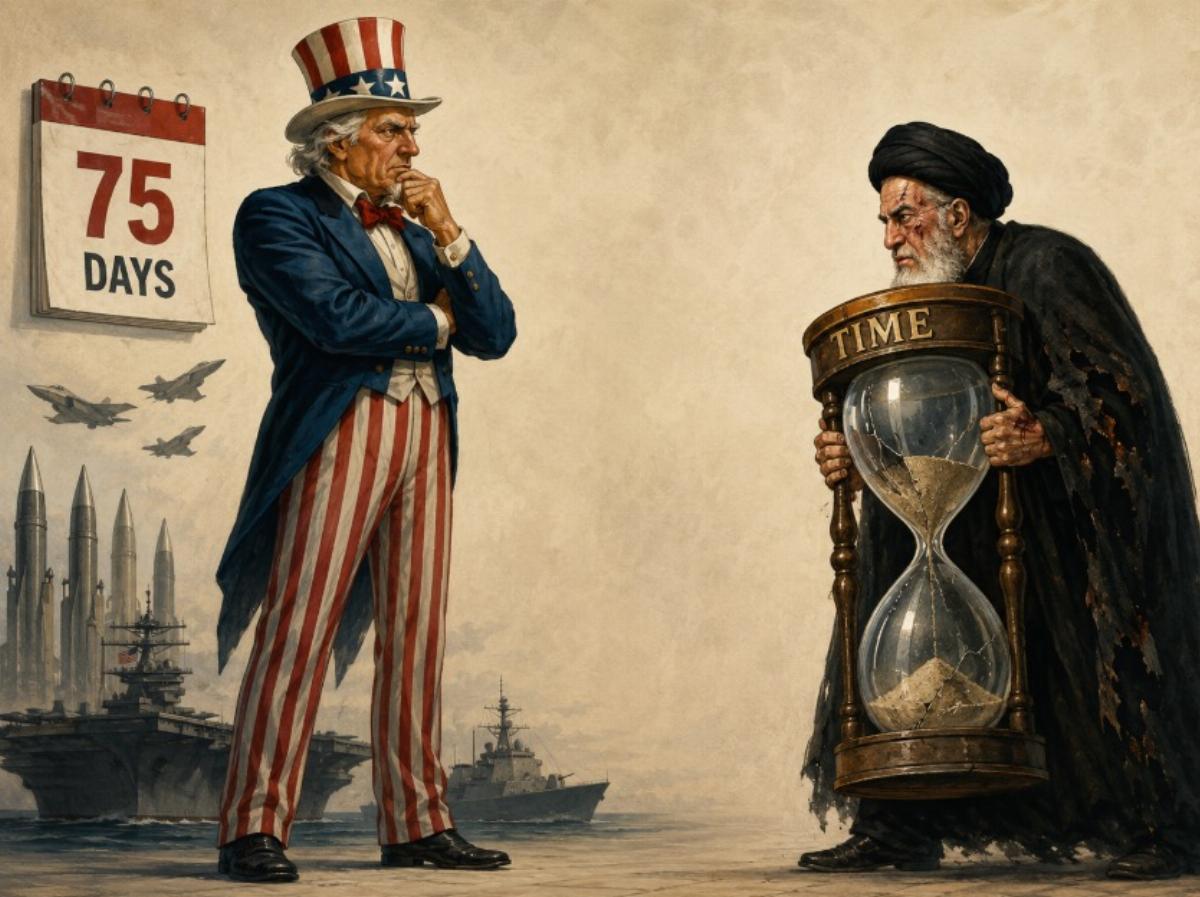
Iran has stymied the United States for the moment, even though, by almost any conventional measure, it should be decisively defeated. The American people grudgingly believed their president when he said the conflict would be over quickly. Unfortunately, the enemy got their vote.
Read more The Mohammunist Manifesto—Control of Education and Formation of the Young
Let there be no mistake: Iran has not achieved any victory, much less a military one. It has suffered hundreds of billions in damage and a decimated pool of former leaders. Yet, like a punch-drunk fighter, it still stands. Don’t confuse defiance for victory, though.
Iran’s strategy isn’t about defeating America, but surviving long enough to see America’s political will fracture, as it repeatedly does. America, with Israel’s willing help, has the military ability and logistics to destroy much of Iran’s ability to make war. What it lacks is the political freedom to use that power without domestic and international consequences.
Iran’s risk calculation differs from ours. The Islamic Republic’s revolutionary leadership operates within a religious worldview that anticipates the eventual return of the Hidden Imam, the 12th Imam, and the triumph of divine justice.
There have long been allegations that some senior Iranian officials believe creating conditions favorable to the Mahdi’s return is essential. That does not mean Iran necessarily seeks nuclear Armageddon or that its leaders are suicidal. It does mean we should be circumspect about a regime with an intensely religious conception of history and destiny.
Iran knows it cannot defeat the West militarily today. But nuclear weapons would change that calculation, giving Tehran a weapon capable of imposing extraordinary costs on its enemies and potentially shielding the regime from the consequences of its aggression. We dare not give it time to acquire that capability.
The question is no longer whether America can defeat Iran militarily. It is whether America has the political will to apply enough military power, for long enough, to make Iran conclude that continuing the war is futile, even suicidal to its survival.
A small cadre of IRGC commanders and civilian leaders remains unwilling to abandon Iran’s maximalist demands. The Strait of Hormuz remains contested, while Iran’s Houthi proxy is expanding the conflict into the Bab el-Mandeb. The United States has expended roughly two-thirds of its prewar stock of Patriot interceptors, a depletion Iran undoubtedly understands.
We have another national election in roughly 75 days. Iran believes American political pressure will grow as that election approaches. If Tehran can continue fighting, absorbing punishment and creating economic pain while waiting for American politics to intervene on its side, time becomes its most important weapon.
The regime understands the power of internal dissent. Since the war began, Iranian authorities have arrested thousands on alleged national-security grounds. Iran’s police chief said in May that more than 6,500 people had been arrested as “traitors and spies.” Amnesty International has documented thousands of arrests, along with torture, forced confessions, disappearances and accelerated prosecutions. Reports also describe security personnel being arrested for refusing orders and morale deteriorating.
These developments matter because the people who must sustain a war are not the same as those who started it. The mullahs and senior IRGC leadership may be willing to fight to the end because their survival is tied to the regime’s. The middle and lower ranks face a different calculation. They have families to feed, understand the odds, and know that if they back the regime, they may die.
This is where overwhelming force becomes decisive.
Overwhelming force is not merely the ability to destroy things. Its ultimate purpose is to alter the calculations of those who must sustain the resistance. If sustained military pressure makes continued fighting increasingly dangerous while making victory increasingly implausible, desertion, refusal to fight, and loss of cohesion can become more consequential than destroying any number of target sets.
Read more Jehu and Trump: Reformers at a crossroads
During the Vietnam War, Robert McNamara surrounded himself with young analysts and managers known as the “Whiz Kids.” They brought a corporate management mentality to war, believing that metrics, models, and quantifiable indicators could make a fundamentally human and political problem manageable. Body counts, sortie rates, and other measures could tell commanders what was happening on the battlefield, but not whether the enemy’s will to fight was breaking.
War is not an efficiency problem.
The lesson is not that measurement is useless. It is that measurable destruction doesn’t necessarily translate into strategic success. An enemy can absorb enormous punishment and continue fighting if its leadership believes time is on its side. Conversely, an enemy can retain substantial military capability while losing the will, cohesion, or political capacity to continue. Overwhelming force must therefore be applied not simply to maximize destruction, but to make continued resistance increasingly irrational.
Whether that produces regime change or simply collapses the regime’s ability to continue fighting, the military effect is the same. The objective should be to create such overwhelming pressure that Iranian leaders are forced to think about survival while those below them begin to question whether futile resistance is worth dying for.
We need a new playbook, and it requires Iran to believe our strategy has changed. The United States is already demonstrating that it does not intend to starve the Iranian population. Despite the naval blockade, Washington has continued to permit vessels carrying food, medicine and other humanitarian necessities to enter Iranian ports. By August 8, CENTCOM said more than 30 humanitarian vessels had been allowed through.
But humanitarian exemptions cannot become a back door for sustaining Iran’s military machine. A ship does not become strategically irrelevant because some of its cargo is humanitarian. Dual-use materials, fuel, spare parts, and communications equipment can have military value. The same problem exists with land routes.
Even with the maritime blockade, Tehran retains overland supply routes through Turkey, Pakistan, and Iraq. Military components and other dual-use goods are moving through those corridors. If Iran can continue receiving the material necessary to fight while waiting for American political pressure to build, we are helping it solve the very problem we are trying to create.
War is for keeps. Once war has begun, achieving victory is preferable to disengagement. Waffling is dangerous if it convinces an adversary that American resolve has a political expiration date.
We should stop pretending that the objective is to preserve our political fortunes in November. If ending this war requires accepting political consequences in the midterms, then so be it. Iran should not be allowed to calculate that it can buy time waiting for regime change in America. The choice is not between war and peace. We are already at war.
The choice is whether we finish it while we still possess the overwhelming military advantage, or allow Iran to turn time, American political division, and the exhaustion of our military stocks into weapons of its own.
Iran has not won. But neither has its will been broken. It is time to finish the job.
God Bless America.
Image made using AI.
Author, Businessman, Thinker, and Strategist. Read more about Allan, his background, and his ideas to create a better tomorrow at 1plus1equals2.com.