
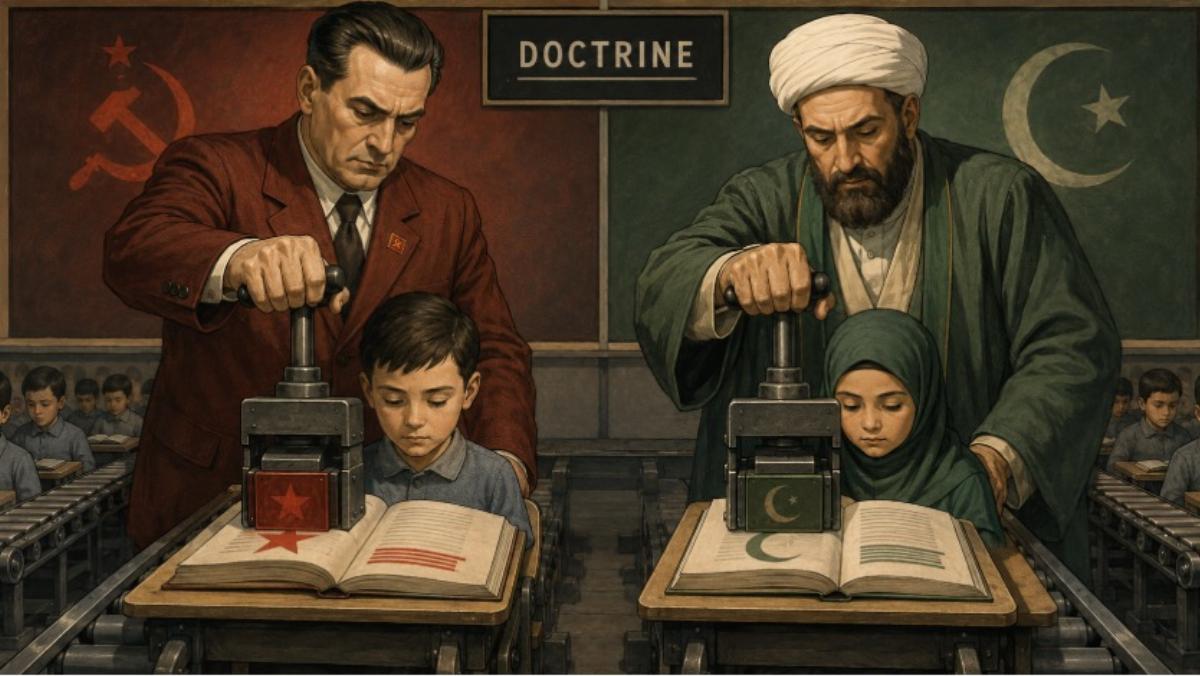
In revealing the commonalities of the Reds and the Greens in the Red-Green Axis, we have elucidated the shared goals of communists and Muslims, including violence, monopoly rule by elites, slaughter, etc. (See the full list of essays exposing these commonalities at the end of this article.) Here we explore the control of education and the formation of the young.
Read more Jehu and Trump: Reformers at a crossroads
Islamic political systems and Marxist-Leninist communism both treat the education and formation of the young as a central political instrument, not a neutral transmission of skills. Both claim the authority, and the practical necessity, to shape the beliefs, loyalties, and habits of the next generation according to the doctrine, and both built dedicated institutions to guarantee it—the Bolsheviks from the founding moment of their state, and Islamic rulers the moment a doctrinal threat demanded it.
In 1065, the Seljuk vizier Nizam al-Mulk opened the first of a network of state-funded madrasas in Baghdad, standardizing Shafi’i law and Ash’ari theology across the curriculum. He explained his own reasoning in his political testament, the Siyasatnama. Ismaili Shia da’wa was a doctrinal infiltration eroding loyalty to legitimate rulers, and education was the countermeasure.
The network extended within decades to Nishapur, Herat, and Isfahan, training the scholars and officials of the Seljuk state. The Baghdad madrasa alone enrolled some three thousand students by the 1090s and drew Abu Hamid al-Ghazali, later Islam’s most influential theologian, onto its faculty. Classical jurisprudence had already established the parental and communal duty to raise children in correct belief. Nizam al-Mulk’s contribution was to make that duty an instrument of state policy, not a matter left to families and mosques.
Marxist-Leninist communism reached the identical position by different means, less than two years after seizing power. Lenin, in his 1920 address to the Third Congress of the Russian Young Communist League, insisted that education under the dictatorship of the proletariat must break entirely with bourgeois content and method. The Decree on the Unified Labor School, issued October 16, 1918, nationalized and secularized Russian schooling.
The Komsomol, founded two weeks later, extended party formation into organized youth life beyond the classroom. Both were built before the Civil War had even been won, on the premise that a socialist state could not wait for a settled peace to begin forming its children.
The parallel is that both treated the education of children as too consequential to leave to families, markets, or rival authorities, and both built state or party institutions specifically to close that gap. Nizam al-Mulk and the Bolsheviks were separated by eight and a half centuries and were answering different threats—Ismaili da’wa in one case, bourgeois pedagogy in the other—but they reached for the same instrument: a curriculum the state itself controlled, extended by an organized youth structure operating outside the classroom entirely.
The instinct persists into the present, at the level of the state curriculum and below it. In Lebanon, Hezbollah’s Imam al-Mahdi Scouts, founded in 1985 and still operating under the party’s own Executive Council, enrolls tens of thousands of children as young as four in Shia indoctrination combined with military training. Former leaders say most members enlist in Hezbollah’s fighting ranks by sixteen or seventeen, and more than two hundred alumni have since died in combat.
The London-based IMPACT-se institute’s analysis of the Palestinian Authority’s 2025–2026 curriculum, used by 1.3 million students, found the Arabic word for “martyr” taught as a first-grade spelling term, fourth-grade arithmetic adding First and Second Intifada death tolls, and a science textbook illustrating Newton’s Law with a girl firing a slingshot, imagery IMPACT-se ties to attacks on Israeli soldiers. Fifth graders in at least one UNRWA-run Gaza classroom were separately instructed to honor Dalal Mughrabi, who led a 1978 attack that killed thirty-eight Israeli civilians, as a role model.
The pattern is not confined to state curricula, and it is not limited to isolated incidents. Pakistan’s Darul Uloom Haqqania, founded in 1947 and still operating today with public funding from the Khyber Pakhtunkhwa provincial government, has trained more than eight thousand students over its history and produced a roster of Taliban leadership that includes the movement’s founder, Mullah Omar, and Haqqani Network founder Jalaluddin Haqqani. Its longtime chancellor, who called himself the “Father of the Taliban,” urged his students in a 2009 interview to fight American forces and described Mullah Omar as an “angel.”
In London, the imam of Finsbury Park Mosque, Abu Hamza al-Masri, was convicted in 2006 on charges that included soliciting the murder of “a person or persons who did not believe in the Islamic faith,” three of the charges naming Jews specifically. His sermons helped radicalize worshippers who went on to include the “shoe bomber” Richard Reid and September 11 plotter Zacarias Moussaoui, and he was later extradited and convicted again in the United States. Speaking of the United States, a Philadelphia chapter of the Muslim American Society published a video of children reciting lyrics about beheading enemies. (For more, see here.)
Communist practice shows the same durability. Pavlik Morozov never did what the Soviet state told two generations of schoolchildren he did. Historians have since shown his canonical story—a boy denouncing his own father to the authorities—was substantially invented by Soviet propagandists.
The state did not merely exploit a tragedy. It manufactured one, then made the lie compulsory reading, commemorated with statues, an opera, and biographies, all built around a single lesson: the state outranks the family. China’s Patriotic Education Law, effective January 1, 2024, mandates that instruction in Chinese Communist Party ideology be integrated into every level of schooling, preschool through university, and makes parents legally responsible for reinforcing it at home.
Classical Islamic education did tolerate genuine scholarly disagreement, and communist systems did sometimes prioritize technical training over ideology. Neither fact does the work an objection needs it to do. Diversity of opinion within an authorized tradition is not pluralism about the tradition itself, and technical competence taught alongside ideological formation is not technical competence taught instead of it.
The Nizamiyya trained jurists who disagreed on points of Shafi’i law, not students free to conclude Shafi’i law was mistaken, and Soviet polytechnic education produced engineers required to master Marxism-Leninism alongside their engineering, never exempted from it. The exception that would actually unsettle the claim is a system that left parents or guardians free to withdraw their children from the foundational doctrine, or that left older students, once capable of genuinely evaluating competing claims, free to reject it outright and still count as properly educated. Neither tradition has ever produced that system.
Neither system relies on adults alone to keep itself alive. Both invest specifically in children, because children can be formed before they are old enough to object, and by the time they might, the formation is already the person. Nizam al-Mulk built his schools to keep a rival doctrine from reaching the next generation.
The Bolsheviks built the Unified Labor School and the Komsomol to do the same for a different doctrine. Both traditions still run the machinery today, in different countries, teaching children to become adults who will not need coercing, and reserving the coercion neither has ever abandoned for whoever that formation fails to reach.
Image created using AI.
Previous essays in this series
- The Mohammunist Manifesto
- The Mohammunist Manifesto’s Wealth Redistribution Agenda
- The Mohammunist Manifesto’s Inequality Before the Law
- The Mohammunist Manifesto—The World as a Binary
- The Mohammunist Manifesto—Monopoly Rule By Elites
- The Mohammunist Manifesto—Public Or Private, Nothing Is Beyond Our Control
- The Mohammunist Manifesto—The Promise of ‘Transitional Phase’ Slaughter
- The Mohammunist Manifesto—Trojan-Horsing Society’s Institutions
- The Mohammunist Manifesto—Rejection of Pluralist or Limited Government
- The Mohammunist Manifesto—Transnational Loyalty Overrides National Borders
Endnotes
1. Nizam al-Mulk’s founding of the Nizamiyya madrasa network beginning in Baghdad, circa 1065, and his stated rationale for countering Ismaili Shia da’wa: George Makdisi, The Rise of Colleges: Institutions of Learning in Islam and the West (Edinburgh University Press, 1981); Nizam al-Mulk, Siyasatnama (“The Book of Government”), trans. Hubert Darke.
2. V. I. Lenin, The Tasks of the Youth Leagues, speech to the Third All-Russia Congress of the Russian Young Communist League, October 2, 1920. Primary text at marxists.org/archive/lenin/works/1920/oct/02.htm.
3. Decree on the Unified Labor School (October 16, 1918), published in Izvestiia; the Komsomol (All-Union Leninist Young Communist League) was founded October 29, 1918. Both fall within the Russian Civil War, dated by standard scholarly convention from November 1917 to October 1922, fought between the Bolshevik Red Army and the White Armies and their allies; the war’s outcome remained genuinely contested when both institutions were created.
4. Imam al-Mahdi Scouts: founded by Hezbollah on May 5, 1985, operating under the party’s Executive Council Education Unit; membership and training details from the Alma Research and Education Center, “Imam al-Mahdi Scouts (Hezbollah): 40 Years” (2025) and “Hezbollah’s Imam al-Mahdi Scouts” (2026); on recruitment into Hezbollah’s military wing and combat deaths among alumni, see the Meir Amit Intelligence and Terrorism Information Center profile and the IDF’s public background report, “Hezbollah’s Youth Movement of Terror.” A shorter-lived parallel: the Islamic State’s Ashbal al-Khilafah (“Cubs of the Caliphate”) recruited children for sharia instruction and military training after the 2014 caliphate declaration; the Syrian Observatory for Human Rights documented at least four hundred new child recruits in 2015 alone, cited in Newsweek, “ISIS Recruit 400 Children for ‘Cubs of Caliphate,’” March 2016. The program lapsed with the caliphate’s territorial collapse and was documented reviving in 2021–22 (Dass and Singh, 2022).
5. IMPACT-se (Institute for Monitoring Peace and Cultural Tolerance in School Education), analysis of the Palestinian Authority’s 2025–2026 national curriculum (290 textbooks, 71 teacher guides), reported in the Times of Israel and JNS, November 2025. On the fourth-grade arithmetic problem requiring students to add First and Second Intifada martyr totals, see “In UK-Funded Schools in Gaza, Pupils Learn Maths by Counting Martyrs,” The Jewish Chronicle, December 2023. On the Grade 10 general sciences textbook using a slingshot image to illustrate Newton’s Law, which IMPACT-se ties to attacks on Israeli soldiers, see “New Report Finds Palestinian Textbooks Still Glorify Terror and Erase Israel Despite EU Reform Deal,” Jewish News, November 2025. On Dalal Mughrabi glorified as a role model, see Arabic Language, Grade 5, Vol. 2, pp. 51–61, cited with page locators in “Palestinian Authority’s School Curriculum Amplifies Terrorism,” The Ettinger Report, December 2025, corroborating the UN Watch/IMPACT-se joint report, December 2023.
6. Darul Uloom Haqqania, founded 1947 in Akora Khattak, Khyber Pakhtunkhwa, Pakistan, and its alumni including Taliban founder Mullah Omar and Haqqani Network founder Jalaluddin Haqqani: “Darul Uloom Haqqania,” Wikipedia, citing contemporaneous reporting; on public funding and the chancellor’s statements, see “‘University of Jihad’ Gets Public Funds Even As Pakistan Fights Extremism,” Radio Free Europe/Radio Liberty, March 2018.
7. Abu Hamza al-Masri, imam of Finsbury Park Mosque, London, convicted February 2006 on eleven of fifteen charges including soliciting murder of non-believers and inciting racial hatred, sentenced to seven years; later extradited to and convicted in the United States: contemporaneous reporting by BBC, CNN, and Al Jazeera, February 2006; U.S. Attorney’s Office statement on the 2014 conviction, reported by CNN, May 2014.
8. Philadelphia MAS “Ummah Day” event (April 17, 2019): MEMRI translation and dispatch (May 2019); contemporary reporting by JTA, Snopes, and PhillyVoice.
9. Pavlik Morozov (1918–1932): “Pavlik Morozov,” Encyclopaedia Britannica; Catriona Kelly, Comrade Pavlik: The Rise and Fall of a Soviet Boy Hero (Granta, 2005), demonstrating the fabricated and shifting nature of the official account and its compulsory use in Soviet schooling.
10. Patriotic Education Law of the People’s Republic of China, passed October 24, 2023, effective January 1, 2024; official provisions summarized by Xinhua and analyzed in Nippon.com, “Legislating Ideological Unity in China.”
Read more The Karmelo Anthony prosecutor made the right decision