
The U.S. Navy’s effort to establish a new route through the Strait of Hormuz and to shuttle tankers through it under cover of darkness appears to be a success so far. A lot of preparation went into this, involving both the destruction of Iranian surveillance and naval assets as well as clearing mines the Iranians had already emplaced in the straits.
Read more The Pentagon fights the left’s subtle takeover of Stars and Stripes
The U.S. naval presence likely prevented the Iranians from mass mine-laying using dedicated ships. Instead, they turned to small boats that could carry a single mine and would simply drop it at random. As a result, Iran has no clear idea of where the mines have been dropped, a violation of long-accepted naval practice. At the same time, that also means that very few mines — some analysts suggested as few as a couple dozen, had been deployed. But it only takes one blasting a ship to wreck any plans to open the strait.
It appears that the Navy has succeeded in clearing the southern route along the coast of Oman. That would mark the first time that mines have been cleared with the use of Unmanned Underwater Autonomous Vehicles – that is, submarine drones.
The Navy has planned to use drones in the mission for some time, and in fact, recently mothballed its last minesweepers in anticipation of the new systems. (Though at least two minesweepers returned to the Gulf to take part in operations.) The drones were supposed to be operated from Littoral Combat Ships, but the two sent to Gulf early this year were soon transferred elsewhere, cementing the LCS’s reputation for perfect uselessness.
The major advantage of drones is that they can be used freely in mined waters without fear of losing personnel. Navy minesweepers were specially designed (for one thing, they were made out of wood to defeat magnetic mines) and even more carefully operated so as not to trigger mines, but in the battlespace anything can happen.
Read more Are our sailors really starving?
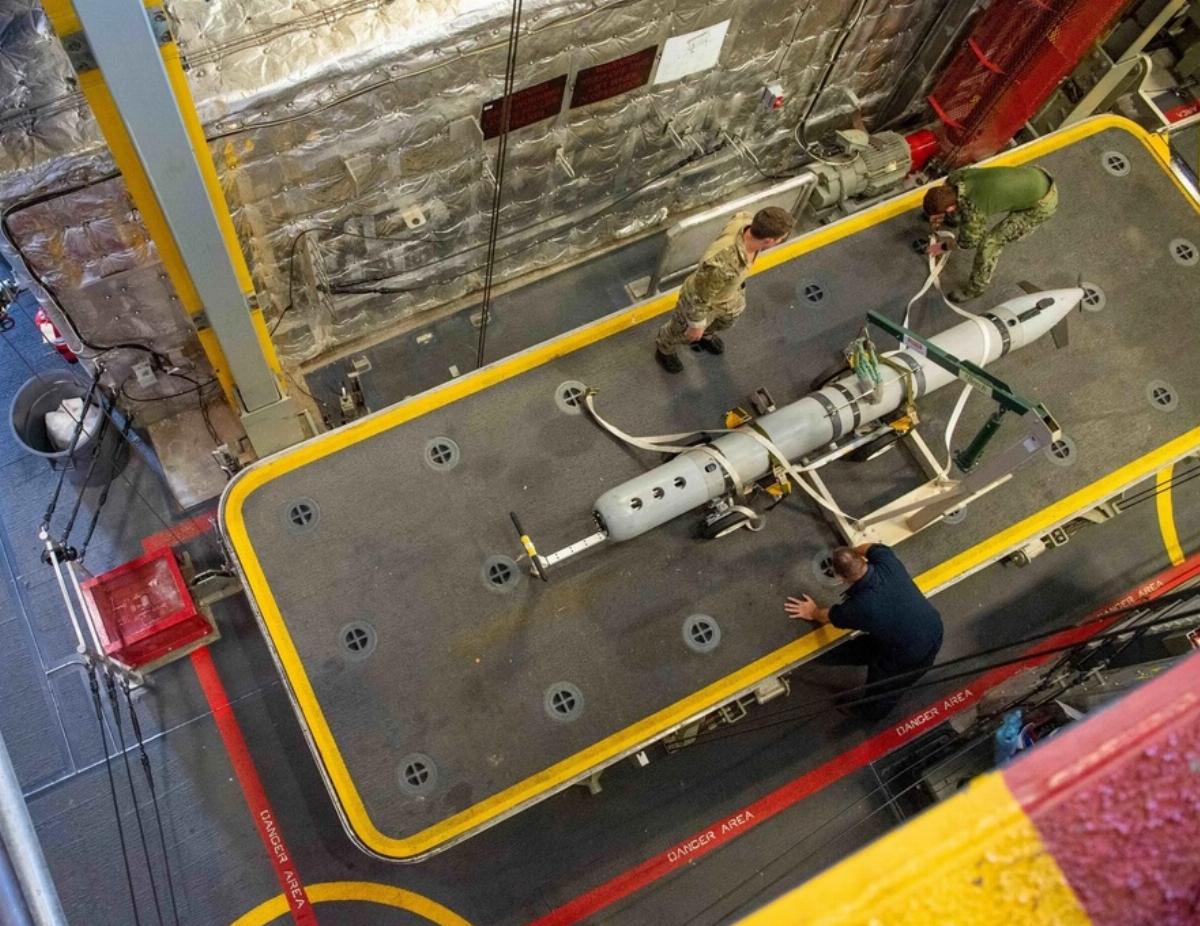
Navy drones operate as coordinated teams, one drone mapping the area using various sensors to detect possible mines while others destroy the mines that are detected. The model generally used in the mapping role is the General Dynamics Mk. 18 Mod 2 Knifefish, a 22-ft., one-ton fully submersible drone. The Knifefish can carry out 16-hour missions with full autonomy. It maps a suspicious area and is capable of detecting all types of mines, including those that are hidden (some modern varieties can be buried in the seabed.)
The Knifefish took a decade to develop and was nearly canceled. At one point, Congress actually cut funding for the program.
One of the systems used to destroy mines is the BSE Archerfish, another submersible unit that uses sonar and low-light TV to identify mines (presumably located by the Knifefish, though the Archerfish can also operate on its own), and then destroy them with a shaped-charge projectile. The Archerfish is considered to be expendable, which suggests that it is extremely cheap — at least by military standards.
Sweeping the strait began in the last week of April. It was estimated at the time that it might take as long as six months to clear the strait. It would appear that the process took three-and-a-half months, a little over half the estimate, which is not at all bad for a military operation using new technology and speaks well for the Navy’s newest weapon systems.
Read more Fauci diary: “Simon Says I’m one amazing guy”
Image: U.S. Navy