
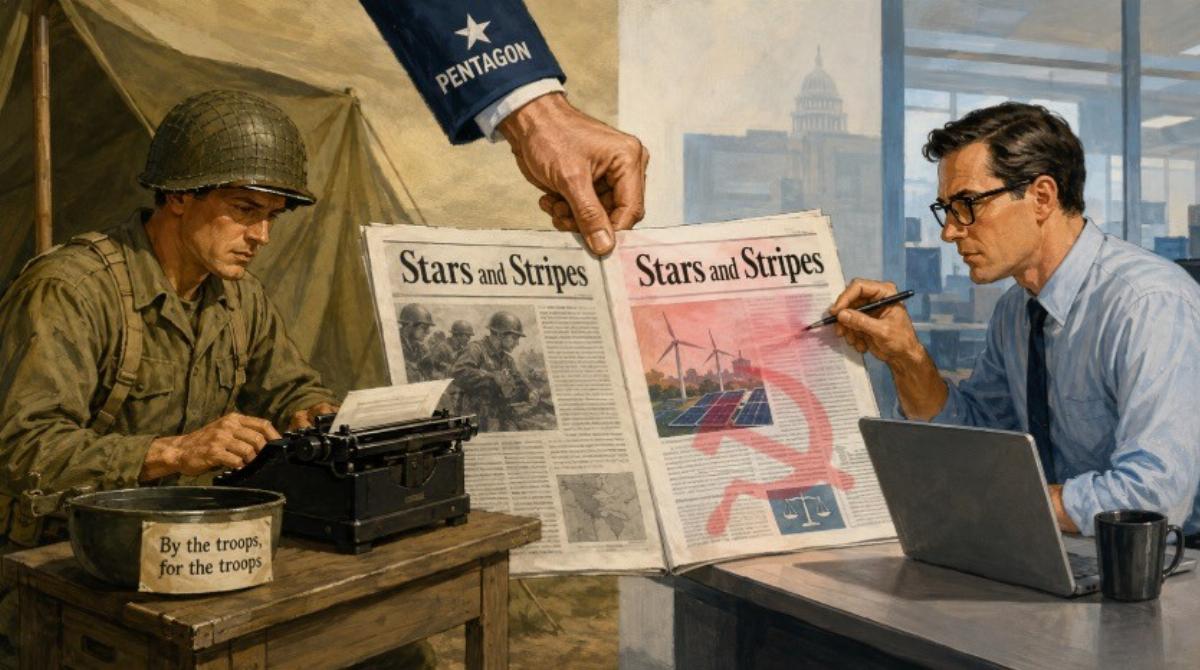
Stars and Stripes, which was created as a “by the troops, for the troops” publication, has been the subject of a very subtle leftist takeover. The Trump administration is fighting back by firing the most obvious leftist actors, and it’s right to do so.
Read more Are our sailors really starving?
Stars and Stripes began during WWI. It was written by and for the troops and had editorial independence. WWII troops revived it. Because it was a purely military paper, the writers were allowed to criticize the command structure and their fighting conditions, something even Eisenhower defended.
However, today’s iteration of the Stars and Stripes is no longer a paper by the troops and for the troops. Instead, its newsroom is staffed with civilian journalism school graduates.
The paper’s subtle editorial bias shows that these reporters are not acting as a voice for those who serve (a place for grunts to gripe). Instead, they’re using their partially taxpayer-funded gig to give military values a subtle leftward push. No wonder the Trump administration is pushing back.
Currently, control over Stars and Stripes is murky. It’s not independent, because taxpayers help fund it and it operates under the Department of War (DoW)’s aegis. The Pentagon selects its leadership, whose members serve set terms, and has authority over hiring, firing, management, etc. Congress establishes much of its funding and can make laws affecting it. Still, that tradition of editorial independence remains.
In January, in an opening effort to stop the paper’s leftward tilt, the Pentagon removed the then-existing regulation about Stars and Stripes from the Code of Federal Regulations (former 32 CFR Part 246). The stated reason was that the regulation was really a statement of internal DoW procedures, rather than true regulatory material.
By June, two members of the advisory board sued this move in a case entitled . The complaint’s refusal to call the “Department of War” by its name tells you everything about the plaintiffs’ approach to the current administration. Susan Dardarian worked for the hard-left Minnesota Star Tribune, while she and her co-plaintiff, William Church, both held leadership positions in AP editors’ organizations.
Also in June, the paper’s former Ombudsman, Jacqueline Smith, who got her position during Biden’s presidency, sued over her firing, claiming that it violated her First Amendment rights. A ChatGPT analysis reveals that she was a hard-left, anti-Trump journalist who advanced all Democrat shibboleths about race, sexuality, etc.
The Pentagon is in the news again because it just fired Erik Slavin, the editor-in-chief, and Lara Korte, a Middle East reporter, for insubordination related to a television appearance, and Max Lederer, their publisher, for refusing a directive to fire them. The specific facts are less important than the DoW’s pushback against the paper’s “woke” direction.
So, has Stars and Stripes gone “woke”? A ChatGPT analysis suggests that it has, only very subtly. Its mandate says it cannot have an official editorial position and must report facts in an even-handed way. But can a journalism staff made up of modern journalism school graduates like Slavin and Korte (who, before her Stars and Stripes gig, was a conventional left-leaning journalist) do that? Probably not.
It turns out that it’s not a question of editorial pages or out-and-out advocacy in articles. It’s one of shading, something that arch-anti-communist thriller writer Helen MacInnes described seven decades ago.
In a neutral way, I asked ChatGPT to analyze four topics—transgenderism, the Iran War, DEI, and the Israel-Gaza War—for any inherent editorial bias. Its analysis concluded that, in each case, subtle shading (word choices, human-interest tone, subject matter) aligned with a left-leaning worldview. On transgenderism, ChatGPT concluded:
Individual Stripes stories are generally defensible as straight journalism, but the body of coverage has a recognizable center-left/pro-transgender frame. It tends to characterize the policy through its adverse consequences for transgender troops, adopts much of the terminology of transgender-rights advocates, gives substantial attention to plaintiffs and opponents, and treats the administration’s military-readiness justification more as a claim to be reported than as a substantive argument to be investigated.
The strongest evidence isn’t any one “biased” sentence. It’s selection and weighting.
On the Iran War coverage, it concluded:
I’d put the Iran coverage about here:
Straight-news accuracy: fairly high.
Open hostility toward the administration: generally low.
Skepticism toward administration claims: clearly detectable.
Skepticism toward the war itself: moderate to fairly strong, particularly in enterprise stories.
Sympathy for Iran: little evidence.
Sympathy for U.S. troops and families bearing the consequences: very strong—which is entirely natural for this newspaper.
Recurring frame: American forces are tactically dominant, but Trump may be converting that superiority into an expensive, open-ended, legally problematic strategic stalemate.
And there is an interesting comparison with the transgender coverage. In both subjects, I see a tendency for Stripes to make the administration’s policy itself the thing requiring justification, while adverse consequences of that policy are treated as facts requiring investigation. Administration arguments are certainly reported, but more often subjected to testing.
On Stars and Stripes’ coverage of DEI issues, especially given the DoW’s directive that the military should focus on colorblind merit, ChatGPT offered this:
Factual accuracy: generally strong.
Adequate quotation of the administration’s stated rationale: yes.
Neutrality in headline language: questionable; “purge,” “scrub,” and similar words lean distinctly negative.
Human-interest balance: poor. Opponents, affected students, minority families, civil-liberties groups, and protesters are much more readily humanized than supporters of the color-blind policy.
Conceptual engagement with the administration’s argument: relatively weak. The “unity/common identity versus racial categorization” question is usually summarized rather than investigated.
Overall tone: clearly skeptical and frequently hostile to the anti-DEI policy, although usually through framing rather than factual distortion.
And finally, on the subject of what’s happening in Israel, which is a good litmus test of left versus right, ChatGPT concluded:
On the news coverage, I would score it roughly as follows:
Acknowledgment of October 7 atrocities: strong.
Acknowledgment that Hamas is a terrorist organization and holds hostages: strong.
Factual accuracy: generally good.
Humanization of Israeli victims: strong immediately after October 7; considerably less prominent as time passes.
Humanization of Palestinians: extremely strong and persistent.
Scrutiny of Israeli claims and motives: strong.
Scrutiny of Hamas claims and motives: present, but substantially less developed as enterprise journalism.
Use of Palestinian casualty figures: frequent and prominent, usually with appropriate caveats but with a cumulative effect heavily emphasizing Israeli-inflicted civilian death.
West Bank framing: distinctly sympathetic to Palestinians and skeptical of Israel.
Netanyahu framing: consistently skeptical and often strongly negative.
Overall: not pro-Hamas, but clearly Palestinian-sympathetic and increasingly Israel-skeptical.
The arc itself may be the most telling finding.
Immediately after October 7, 2023, the narrative is roughly:
Hamas committed an extraordinary terrorist atrocity; Israel has been attacked; hostages must be recovered; the United States is helping its ally.
Over the ensuing months, it becomes:
Israel’s response is producing enormous Palestinian suffering; Netanyahu’s objectives and motives are questionable; Israeli conduct may violate humanitarian or legal norms; the international community increasingly objects; Palestinians are bearing an intolerable cost.
By 2024–25, October 7 increasingly functions as the obligatory explanatory paragraph, while Palestinian suffering constitutes the story itself.
It seems today’s Stars and Stripes bears little relationship to the old “by the troops, for the troops” publication that Eisenhower once defended. It is, instead, a partially taxpayer-funded entity that is subtly trying to shift American troops to the Democrat worldview. In other words, the DoW is right to challenge the leadership because the publication has strayed from its mandate and is trying to influence military policy in accord with Democrat values.
Read more Jon Ossoff becomes Pee Wee Herman
Image created using AI.