
America loves a comeback story. We celebrate the injured athlete who returns to the field, the addict who rebuilds his life, the businessman who survives bankruptcy, and the soldier who refuses to be defined by his wounds.
Read more Trump’s huge deportation success story
But when a disabled American attempts a comeback, the government often responds with a calculator, a deadline, and a warning letter.
I know something about this personally. I have lived with serious chronic illness and permanent disability for years. I also know what it is to still have ideas, ambition, responsibilities, and the desire to contribute. Disability does not automatically remove a person’s intelligence, work ethic, creativity, or sense of purpose. Sometimes it simply makes those things harder to exercise consistently.
The problem with much of America’s disability policy is that it treats the ability to work as an on-and-off switch. Either you are disabled and unable to work, or you are working and therefore no longer disabled. Real life with chronic illness rarely operates that neatly.
A person may work this month and be hospitalized the next. Someone with heart disease, diabetes, neuropathy, mental illness, or an autoimmune condition may be productive for several weeks and nearly incapacitated afterward. Recovery is often uneven.
Social Security Disability Insurance does contain work incentives, which are necessary to cover, for the sake of the essay.
In 2026, an SSDI recipient may use a nine-month trial work period. Any month in which the recipient earns more than $1,210 counts toward that period, although the months need not be consecutive (there are separate qualifications for self-employed individuals). The recipient can continue receiving the full disability payment during those months if the work is properly reported.
Afterward comes a 36-month extended period of eligibility. During that period, a non-blind recipient may generally earn up to $1,690 per month without losing the payment for that month. Earnings above that level can suspend payments. Once the eligibility period ends, working above the substantial-gainful-activity limit can terminate benefits.
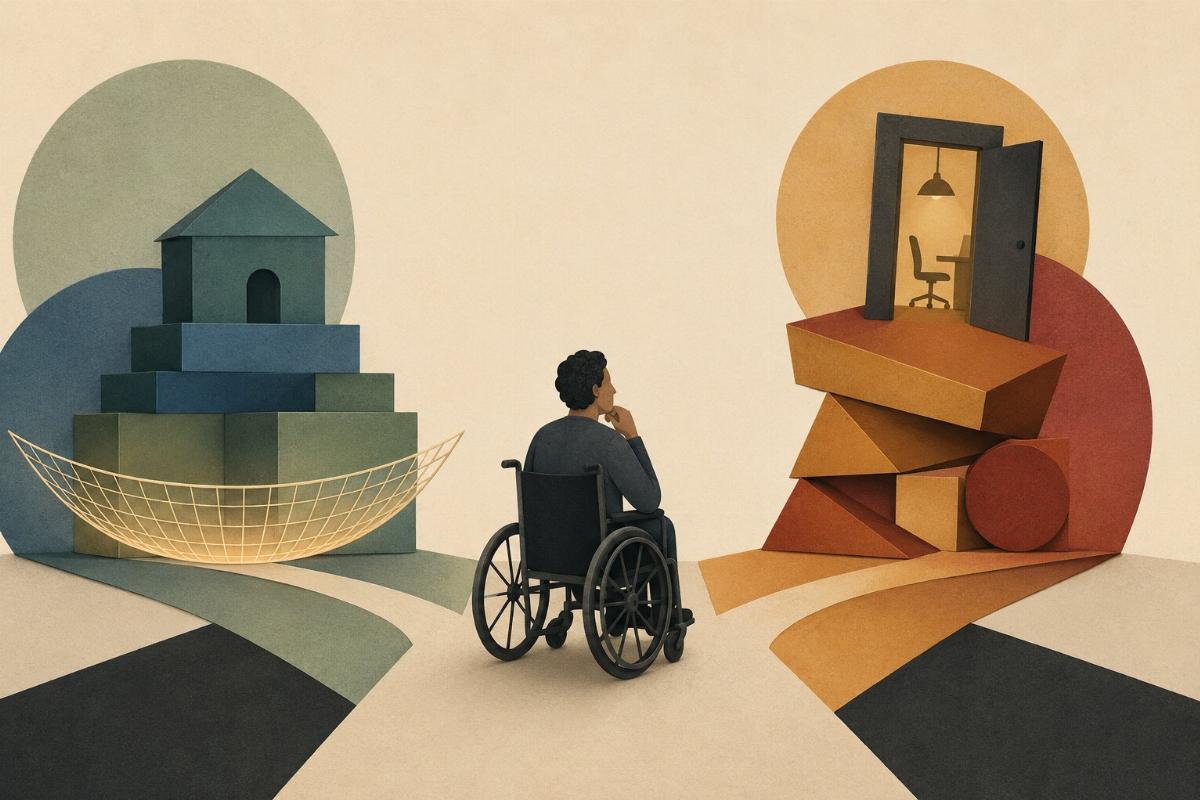
On paper, this looks reasonable. To the person standing on it, however, it can feel like a trapdoor.
The government is asking a medically vulnerable person to trade a stable, though modest, benefit for employment that may not be stable. The job may disappear. The person’s health may deteriorate. An employer may lose patience with absences, or a new supervisor may be less accommodating. The disabled worker is not necessarily afraid of work. He is afraid of what happens if the attempt fails.
People respond not only to incentives but also to risk. A disabled person is not evaluating only a paycheck. He is calculating whether earning a few hundred dollars more could jeopardize the benefits, housing, prescriptions, or medical care that keep him alive.
Read more August 1968 and the history of communism
SSDI is often connected to Medicare, and an entire structure of medical survival. Social Security allows qualifying workers to continue Medicare coverage for at least 93 months after the trial work period, even when cash benefits stop because of earnings. An expedited-reinstatement process may also restore benefits within five years if the person can no longer work because of the same or a related disability.
Those protections are valuable—but complicated. A person should not need to become an amateur Social Security attorney to determine whether taking a part-time job could eventually cost him his medical care.
The rules involve trial periods, earnings thresholds, reporting requirements, impairment-related expenses, extended eligibility, Medicare extensions, and reinstatement procedures. Add processing delays and possible overpayment notices, and many disabled people make the most rational decision available: they do nothing—then society calls them dependent.
A system that claims to encourage work should not make work the most dangerous financial decision a disabled person can make. Policy must recognize the difference between earning some money and achieving durable financial independence.
A better system would gradually reduce SSDI payments as earnings rise. After a protected amount, benefits could decline by one dollar for every two dollars earned, ensuring that additional work always leaves the person better off.
Medical coverage should remain protected during a genuine transition period, with rules explained in one page of ordinary English. It goes without saying, these benefits should only be accessed by American citizens.
Congress should also protect recipients from crushing overpayment demands when they reported wages properly but the government failed to process them. For self-employed people, rules should focus on actual income rather than treating unpaid effort or an unsuccessful business venture as proof that a disability has disappeared.
Most importantly, we should stop treating an attempt to work, though it may be less-than-productive, as evidence of fraud. A person can be disabled and still want purpose. Someone may be unable to maintain traditional full-time employment while remaining capable of writing, consulting, operating a small business, working limited hours, or serving the community.
Conservatives should lead on this issue because it is about work, incentives, dignity, and limited government. The goal should not be to warehouse disabled Americans permanently on public benefits. It should be to create a rational path toward partial—and where possible, complete—independence.
The current system says it wants disabled people to work, contribute, pay taxes, build businesses, and regain control over their lives. Then the system places their stability on the table and asks them to gamble it.
Read more Carbon accounting
That is not a recovery policy, it is a recovery penalty.
Image generated by ChatGPT.