
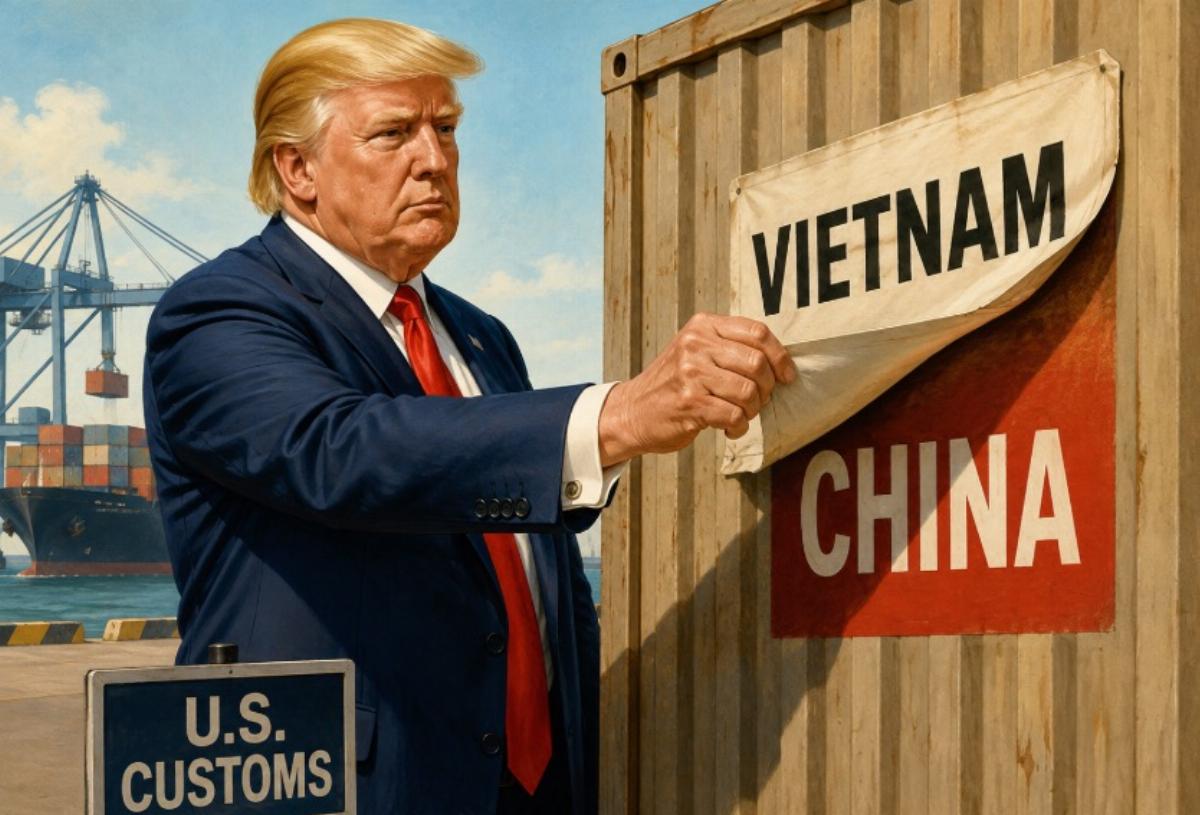
Illegal transshipment claws at your wallet, but most Americans have no clue it exists.
Read more From Cairo to Mamdani: Obama’s Long Game
Foreign exporters facing newly steep American tariffs ship their products to a third country first. There, the goods get a quick relabel, a light touch of assembly, new paperwork, or a fake origin stamp. Then these items sail into the United States under the lower tariff rate that applies to that middleman nation. The true source stays hidden. American workers and factories pay the price.
This scam exploded after President Donald J. Trump’s first tariffs hit China in 2018.
Direct Chinese shipments dropped. Goods that once came straight from Chinese ports suddenly appeared from Vietnam, Mexico, Malaysia, India, and dozens of other places. Some of that shift was honest new investment. Much of it was not. Chinese factories kept making the products. Middlemen simply changed the labels and invoices.
The result is a global shadow network spanning more than 40 countries. Some are big trading partners. Others are smaller spots with cheap labor, weak customs, free-trade zones, or convenient ports.
The numbers are not abstract. Independent estimates put the annual volume of this illegal flow between roughly $40 billion and more than $300 billion.
Goldman Sachs places the narrowest figure near $40 billion. The White House Council of Economic Advisers centers on $60 billion. Exiger arrives at about $75 billion. US Department of Commerce data show a broader $109 billion transshipment crisis. The agency believes that $67 billion moved through just the top hubs in one year alone. Altana’s upper-end exposure reaches $303 billion.
These are different methods, not additive totals. They all point in the same direction: tens of billions of dollars in goods are dodging the duties American law requires.
Assuming transshipment fraud “only” costs $75 billion annually, that means roughly 450,000 American jobs displaced, $113 billion to $150 billion in lower annual economic output, and $19 billion to $26 billion in missing federal tax receipts.
Those losses concentrate in blue-collar communities. Motors and electrical parts that should support factories in Detroit, Grand Rapids, and Indianapolis instead arrive through Mexican corridors. Circuit boards and plastics that belong in Phoenix, Austin, or Akron come via Korean, Vietnamese, or Malaysian routes. Cable assemblies and components that once kept Portland and Dallas busy now move through Dominican or Costa Rican ports.
Every redirected container is a lost order, a quieter plant, and fewer paychecks for working- and middle-class Americans.
Read more Crime is plummeting across the US. Can Trump claim credit?
Trump’s tariffs were designed to stop exactly this kind of predation. They protect American manufacturing from countries that refuse to play fair. Differentiated rates are necessary because trading partners behave differently. Yet those same differences create the opening for the scam. Trump’s administration has not ignored the problem. Reciprocal trade agreements now include explicit rules to stop third countries from capturing the benefits through illegal routing.
Executive Order 14411 tightens importer accountability, bonding, ownership disclosure, and penalties. Customs data already show sharper enforcement. Shipments facing federal scrutiny jumped 245 percent, and revenue assessments rose 169 percent after January 2025. An AI-driven “Detective Border” is taking shape to match routing histories, production capacity, satellite imagery, and shipment records in real time. Legitimate trade will clear. Pass-through fraud will not.
Americans should care because this is not distant paperwork.
It is money taken from Uncle Sam that could rebuild roads, modernize ports, or support the industrial base that underpins national security. It is jobs in the Midwest, the South, and manufacturing towns that never recovered from earlier waves of unfair competition. It is higher costs for families when domestic capacity shrinks, and foreign dependence grows.
This autumn’s midterm elections decide whether that work well and truly continues. If Democrats regain the US House or Senate, they will move immediately to obstruct every tool Trump’s administration is using. Tariff enforcement, customs reforms, and the new detection systems will face funding cuts, oversight harassment, and legislative roadblocks.
The goal will not be better policy. It will be partisan sabotage aimed at weakening President Trump and stacking the deck against 2028 GOP presidential contenders.
The same blue lawmakers who long ignored Chinese mercantilism will suddenly feel an urgent need to dismantle the very measures that finally began to confront it. The result for ordinary Americans will be more lost revenue, more displaced production, and a return to the open door that hollowed out entire communities in the first place.
Republican voters hold the decisive leverage. Showing up this November keeps the enforcement machinery running and the pressure on foreign cheaters, especially China, intact. Staying home hands the keys to those who treat American manufacturing as a partisan bargaining chip rather than a vital national interest.
The choice is clear, and the stakes are measured in real paychecks, real American lives, and the integrity of the rules that protect them.
Image created using AI.
Dr. Joseph Ford Cotto is the creator, host, and producer of News Sight, delivering sharp insights on the key events that shape our lives. He publishes Dr. Cotto’s Digest, sharing how business and the economy really impact us all. During the 2024 presidential race, he developed the Five-Point Forecast, which accurately predicted Donald Trump’s national victory and correctly called every swing state. Cotto holds a doctorate in business administration and is a Lean Six Sigma Certified Black Belt.
Read more The ‘Contrast for America’—a good idea with a rotten rollout