
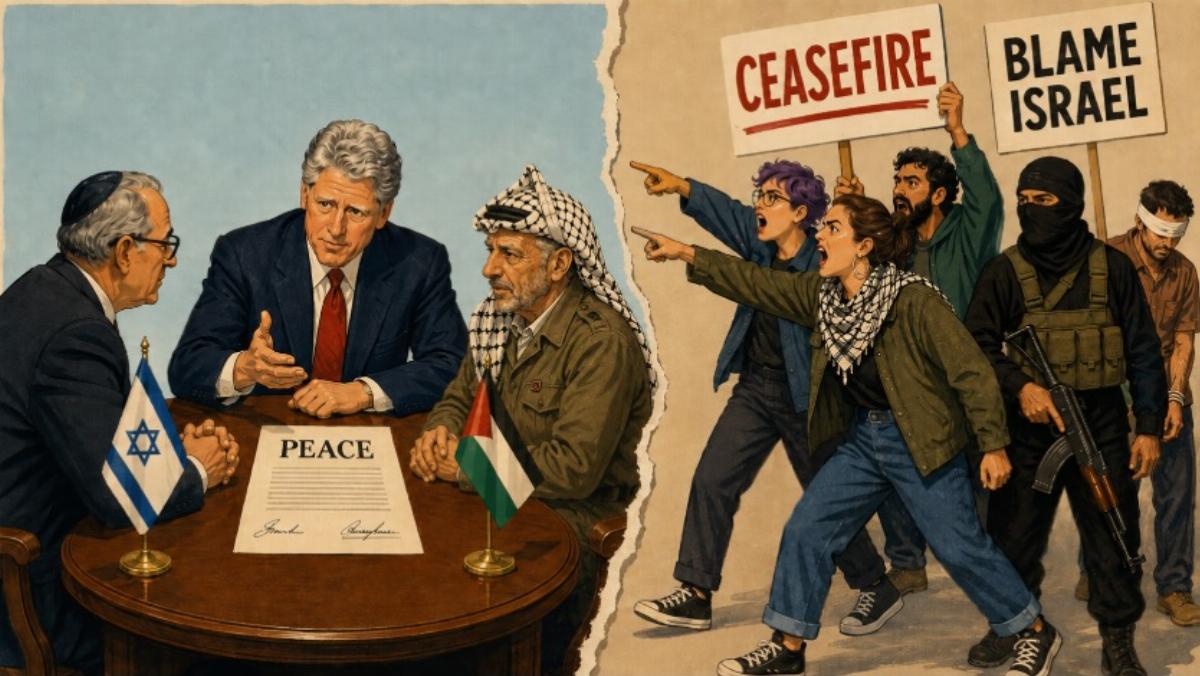
During Bill Clinton’s presidency, Democrats treated peace between Israel and the Palestinians as a serious political objective. Clinton invested years in that effort. He brought Israeli and Palestinian leaders to the negotiating table, pushed both sides toward compromise, and believed a final agreement could end the conflict.
Read more Democratic candidate for Iowa secretary of agriculture once claimed that farming is not that hard
Clinton’s approach reflected an older liberal instinct. Peace required negotiation, accountability, and concessions from leaders on both sides. Israel was expected to take risks for peace. Yasser Arafat was expected to prove that Palestinian recognition of Israel was more than a signature on paper.
Anyone examining Arafat must listen to the Arabic message intended for his own people. The formal letters sent to Western leaders spoke of recognition and peace. On the day of the Oslo signing, an Arabic-language address broadcast on Jordanian television invoked the PLO’s 1974 “phased plan.” That plan called for gaining whatever territory was available and using it to continue the struggle for the full liberation of Palestine. Months later, Arafat compared Oslo to the Treaty of Hudaybiyyah, a truce that preceded Muhammad’s conquest of Mecca.
Arafat’s conduct followed the message. At Camp David in 2000, he rejected the American-backed framework and offered no workable counterproposal. Clinton later held him responsible for losing a historic opportunity. Dennis Ross, Clinton’s Middle East envoy, concluded after years of negotiations that Arafat wouldn’t close the conflict because he still envisioned one Arab state replacing Israel.
Clinton continued pursuing peace and learned that an agreement depends on leaders willing to finish the conflict. A treaty can’t survive when one party treats negotiation as another stage in a longer war.
Much of today’s activist left has abandoned that standard. Its demonstrations call for Israeli restraint while Hamas keeps hostages, retains weapons, and promises more attacks. The demands placed on Israel are immediate and absolute. The demands placed on Hamas are faint, conditional, or missing.
October 7 should have settled the basic question of Hamas’s intentions. Its terrorists murdered civilians, kidnapped families, and attacked communities inside Israel. A senior Hamas official later said the assault would be repeated until Israel was eliminated. Any serious peace movement would begin by confronting that threat.
The loudest activists converted the massacre into another indictment of Israel. Their ideology sorts every conflict by power. The stronger side becomes the oppressor, the weaker side becomes the victim, and moral agency disappears. Hamas benefits from this formula because its brutality is explained away while Israel’s response is treated as the original offense.
Read more American History Is Too Important for Trigger Warnings
The alliance between progressive activists and radical Islam exposes the confusion. Western women who regard dress codes as oppression march beside supporters of movements that impose them. One group reveals nearly everything while covering its eyes. The other covers nearly everything while keeping its eyes fixed on Israel. Their common cause is hostility toward the Jewish state.
I’ve spent decades teaching martial arts and self-defense. That experience teaches a simple lesson about danger: intentions deserve attention, and repeated actions deserve even more. When an enemy says it plans to attack again, keeps the means to do it, and still holds people it kidnapped, vigilance is a duty.
Jewish tradition treats self-defense as an obligation, because protecting life requires action. Israel didn’t choose the war that began on October 7. It faces an armed organization that deliberately brought war into Israeli homes and continues to threaten the country.
Most Democratic voters still view Hamas unfavorably, and many support a two-state solution. The problem lies with an activist faction that increasingly sets the party’s moral language. It has replaced the difficult work of peacemaking with a politics of accusation. Israel supplies the villain, Hamas escapes responsibility, and outrage becomes the objective.
Bill Clinton pursued peace even after Arafat showed how little he was prepared to give in exchange. Today’s activist left rarely asks what Palestinian leaders must do to end the conflict. It asks how much pressure can be applied to Israel while the threat remains in place.
Peace requires the release of every hostage, the disarmament of Hamas, an end to attacks on Israeli civilians, and Palestinian leadership willing to accept Israel’s permanent existence. A movement that avoids those conditions organizes hostility under the banner of justice.
Do something amazing.
Image made using AI.
Tsahi Shemesh is an Israeli-American IDF veteran and the founder of Krav Maga Experts in NYC. A father and educator, he writes about Jewish identity, resilience, moral courage, and the ethics of strength in a time of rising antisemitism.
Read more Dissecting Communism