
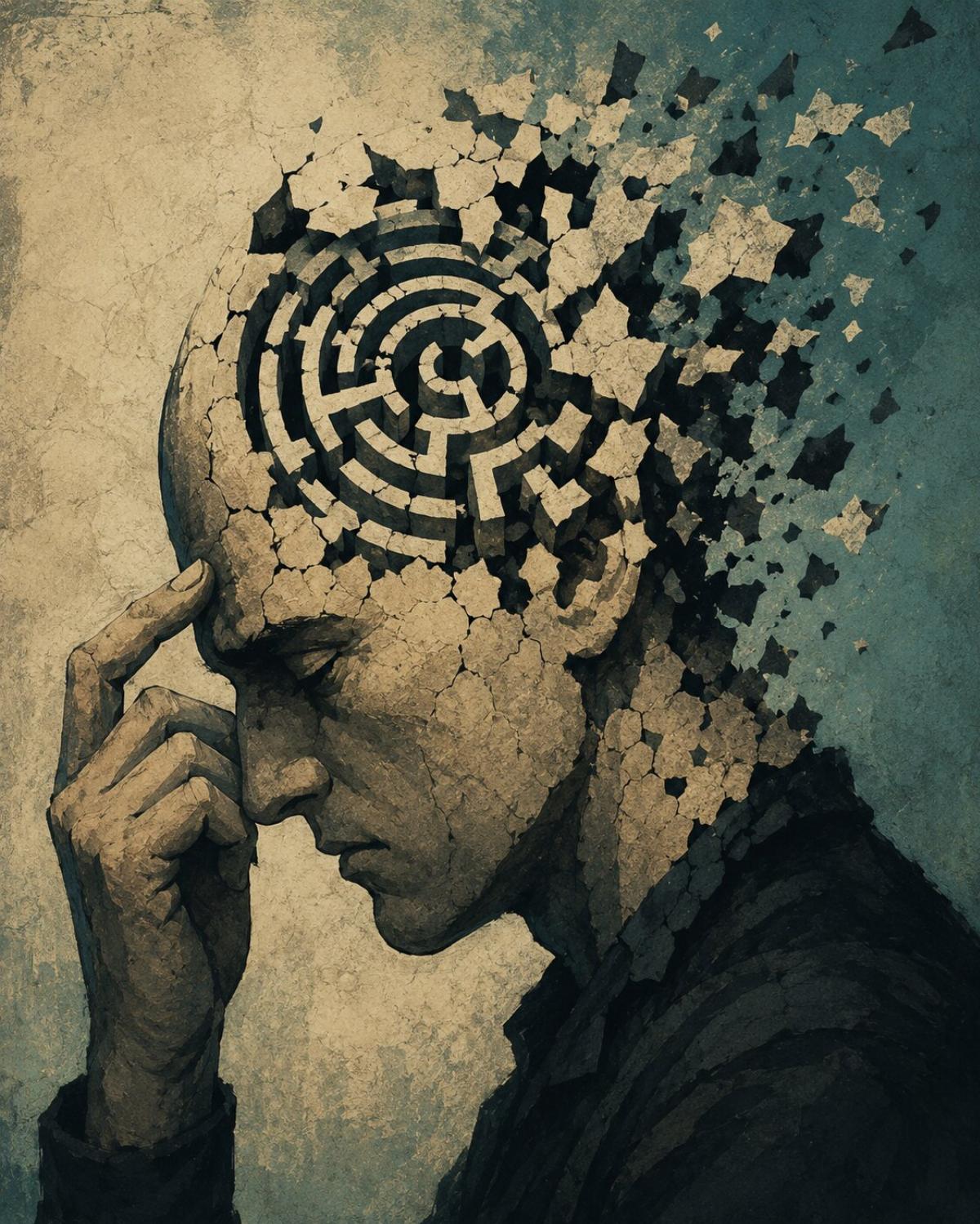
Liberal intellectuals who could help us glean much of what there is to know about the world frequently mar their messages with nonsense, to put it bluntly. It makes me wonder why they more often than not reach into what many of us call La-La Land for their and our enlightenment.
Read more America’s Stranger Problem
Such a tendency recalls the atmosphere of Lewis Carroll’s Alice in Wonderland. Alice’s adventures there proved to be mind-expanding, but they didn’t make her start calling a spade a club. Analysts, journalists, artists, and other professionals who don’t look at things as they are but abstract a “message” that isn’t there, are apt to invent curious substitutions for reality. The corresponding abstractions frequently obscure clear communication. With skill and humor, such exercises can fill the void with engaging nonsense.
But authors of visual and audio communications that have no interest in clarity, let alone truth, commit their stuff anyway to digital media, paper, or art materials. Their erections may be impressive, but some of us sense the hot air that keeps them inflated. Their dependence on symbol and abstraction parallels that of sociology and other subjective “disciplines” that make them candidates for La-La Land. I cite Freud’s The Interpretation of Dreams as an example of digging for what isn’t there to find something serious to deliver.
Angling for what isn’t really there suggests the poem “Antigonish” by Hughes Mearns which, regardless of its original meaning, takes a brazen poke at the real world:
Yesterday, upon the stair,
I met a man who wasn’t there
He wasn’t there again today
I wish, I wish he’d go away….
My irreverence for symbolism and “interpretation” stems from the abuse I have seen with them in communication that should be clear and accurate. Befuddling communication with symbology, “interpretation,” or selling points is likely to lead down a rabbit hole.
The need to be serious about reality eliminates excursions through La-La Land, a sure exit from the world we actually live in. I remind myself, from time to time, that even the symbolic constructs of math, physics and other disciplines designed to explain the world are not the actual reality they stand for. A periodic loosening of the grip of such abstractions on the mind is good exercise, I believe, for keeping us focused on the world we’re actually in.
A return to such a deep level of cognition invites original thought. This is not “thinking outside of the box,” so often a move to another box while remaining outside of reality. A troubling example, pointed out by thinkers who tend to be “conservative,” is the total substitution of the digitized world for the actual world.
Read more Blue-On-Blue Fight Over First Amendment
Although we are born into a world that is infinitely complex, it accommodates all kinds. Most people call a spade a spade unconsciously, “not knowing better,” and live capably within its domain. The philosophically inclined often begin by calling a spade a club and as often realize that calling it a spade is more sensible, benefiting perhaps from the “enlightenment” derived from such exercise. But professionals who need to impress or get paid for their opinions must face the risk of entangling themselves and others in artful webs of nonsense.
How often do we actually use our own eyes and ears to check what is out there and use our own mental capacity to act in accordance with what we see? How many actually think for themselves? Regrettably many are “up to here” in work for such a “luxury” of free time, or are disinclined to think freely for themselves, or are entrenched in demanding ideological activity. But is it not a waste of having a mind as well as a body to quit using the mind to its best potential? And does this not require an uncluttered view of reality? And isn’t this what a good education should provide?
(I can hear the laughter.)
“I don’t like to think,” a young man once told me, when he read something I gave him that I had written. His stunning confession told me that his mind was AWOL. We can thank for this a introduced to the public schools a century ago by John Dewey. Dewey and his allied “progressives” were not interested in teaching kids to grow to their best potential but of grooming them for life in a collective society, run by the state, under the guise of “democracy.”
It is profoundly disturbing to know that among the young in America are many who avoid thinking and need to depend on the “authority and knowledge” of leaders that are blind to the wisdom of great minds, garnered over centuries, regarding the most important things about life. This de facto negligence and drift away from reality has turned many youngsters into virtual zombies, ready to join the “woke” instead of the awake.
It is a tragic irony that in America, cradle of freedom, the most precious freedom of all is being lost: the freedom of the mind. The liberty to think and amble through concrete reality, seeking what is truly best for us and our society is as essential as breathing. In times not long past we got hints of the amazing world we live in from artists and writers and professionals who explored the world beyond its labels and symbols and digitized distractions.
Read more Yes, Jameela, There Was (And Still Is) Slavery
Anthony J. DeBlasi is a veteran and life-long defender of Western Culture.
Image generated by ChatGPT.