
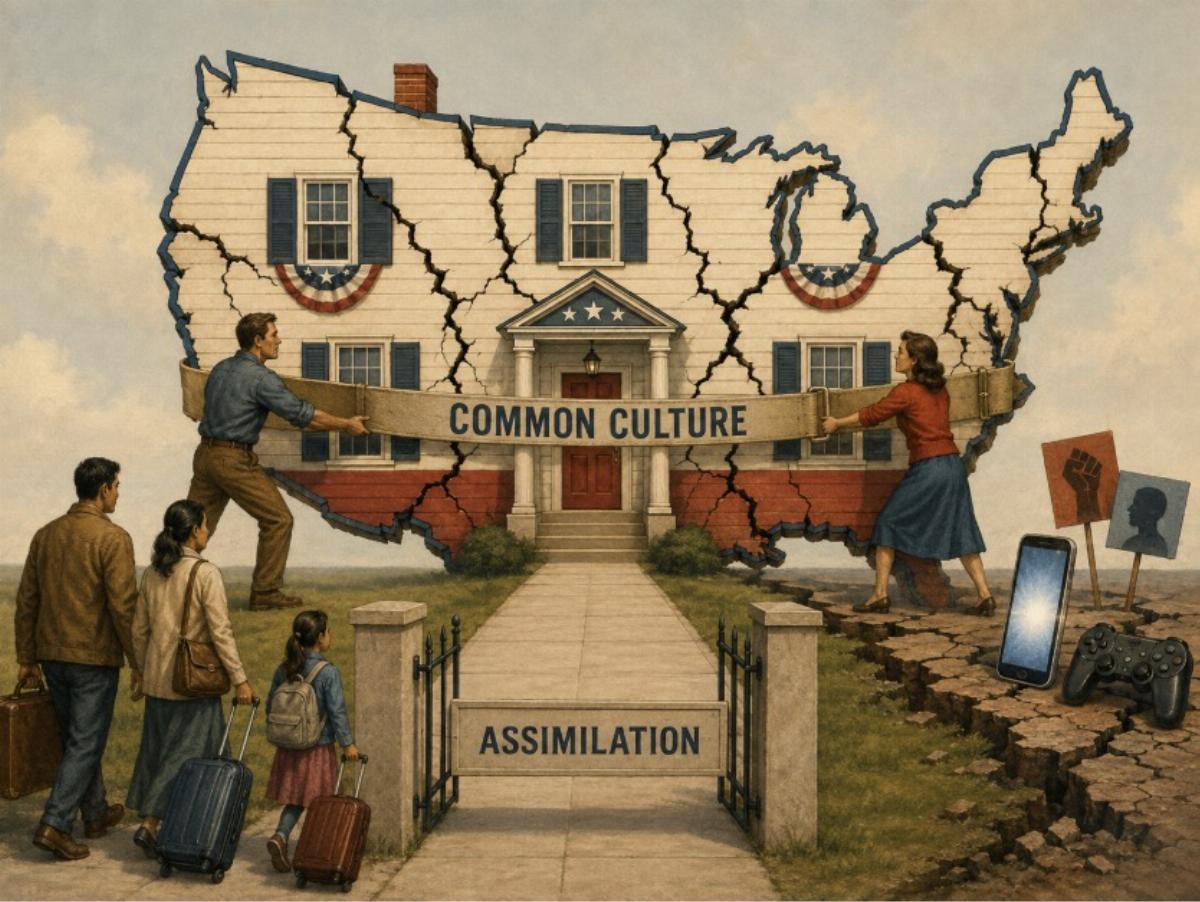
Let’s begin with something most can agree on: high emotion, even rage, and viral imagery increasingly overwhelm logic and reason. Combined with a growing disagreement over what it means to be an American, the result is today’s toxic politics, where fellow citizens increasingly see one another not merely as opponents, but as strangers with fundamentally incompatible values attempting to share a common country. That doesn’t work!
Read more Blue-On-Blue Fight Over First Amendment
Americans have also become increasingly distracted, less engaged in the responsibilities of family, community, work, and citizenship that give freedom its meaning. As a friend of mine wrote in an American Thinker Newsletter:
If you’ve got to watch that new series, old series, or long list of movies, play Call of Duty or Grand Theft Auto, scroll endlessly through TikTok watching stupid people do stupid things, or visit your full-service pot store around the corner, everything else becomes less pressing.
She’s making a larger point about priorities and distractions. When entertainment, instant gratification, and avoidance become more important than responsibility, family, community, work, citizenship, and the obligations that accompany freedom, people gradually lose sight of the things that give life—and a society—purpose. A society insulated from the consequences of its choices drifts ever farther from those essential truths.
Yet these are symptoms, not the fundamental problem.
The deeper problem is that Americans increasingly disagree about the foundational principles upon which the country rests. Persuasion depends upon shared premises, and America’s shared bonds are dissolving. When a society loses a shared national identity, persuasion becomes increasingly difficult because people no longer begin from a common set of values and assumptions. Political disagreement then becomes less about competing solutions to shared problems and more about competing visions of what the country itself should be. That’s a major distinction.
Fifty years ago, Americans certainly disagreed—sometimes bitterly—but political opponents generally shared basic assumptions about the country itself: liberty, constitutional government, equality before the law, patriotism, individual responsibility, and the legitimacy of American institutions. Those assumptions did not eliminate disagreement, but they kept us in the same ballpark. That framework is evaporating.
This, in turn, leads to uncomfortable questions we find difficult to confront publicly and in a nonpartisan manner: Who seriously believes that large-scale immigration without a requirement for assimilation is strengthening us? Traditional immigration has unquestionably brought talented, ambitious, and productive people to our shores, and immigrants have contributed enormously to the country. But immigration without assimilation presents a different question.
America cannot continue absorbing large numbers of people without a corresponding expectation that they will come lawfully and assimilate into our shared culture. The best available global data suggests that hundreds of millions—and plausibly over a billion—people would choose to move to the United States if transportation and legal barriers were removed. In whose view is that feasible?
A national dialogue should have happened decades ago. Instead, claims of Replacement Theory have replaced serious discussion while America has continued to absorb people much faster than it has assimilated them.
Assimilation matters because it is how a society transmits its shared priorities and values. Immigrants do not have to abandon their heritage, religion, or traditions to become Americans. But they do have to adopt a common civic identity and accept the fundamental principles and mores that knit our society together. Without that agreement, immigration weakens our nation. That’s precisely where we are today.
If we wish to save aspirational America, then we must require immigrants to adapt to America, not the other way around.
This is not an argument against immigration; it is an argument that immigration and assimilation cannot be treated as unrelated concepts. A nation can accommodate diversity if its citizens remain united by a sufficiently strong common culture. Without that cultural center, diversity becomes a throwaway phrase.
Read more Yes, Jameela, There Was (And Still Is) Slavery
Most of our most divisive issues involve culture. More specifically, they involve forced cultural changes different from those that predominated in much of postwar America—a framework characterized by a strong emphasis on family, religion, personal responsibility, assimilation, patriotism, and a shared understanding of what constituted normal American life.
Coming to America was never a cakewalk; often it was hard; that’s the nature of assimilation. America’s not perfect, but it provided a cultural foundation upon which people with very different upbringings could still find their place and become members of the American tribe. Can we say that’s true today?
We have lost that common process. The economic engine that once moved millions through a recognizable progression through work, family formation, home ownership, and rising prosperity has weakened, while many of the cultural assumptions that supported it have increasingly been challenged or rejected outright. Many Americans consequently feel abandoned, angry, and receptive to solutions that may ultimately make the disease worse than any supposed cure.
The very idea of the American model is increasingly contested. The institutions and cultural expectations that once moved people toward self-sufficiency, responsibility, and prosperity are now often portrayed as unjust because they distinguish between effort and indifference, responsibility and irresponsibility, achievement and failure—distinctions increasingly rejected by those who place equality of outcome above equality of opportunity.
The rise of socialism highlights this rejection of traditional American assumptions. Many Americans now advocate socialism, yet if you ask them to identify a socialist system that has produced sustained prosperity, individual freedom, and broad opportunity, the response is often emotional rather than analytical.
Ideological commitment increasingly appears to exclude examination of evidence. The same rejection of traditional American assumptions appears across political and cultural boundaries—from the military and American exceptionalism to religion, education, sexuality, and, especially, social identity.
Foremost among those questions of identity is where one comes from and, increasingly, which culture one considers primary. We are witnessing a titanic struggle over cultural mores between the traditional American conception of citizenship and an increasingly fragmented view in which competing cultural identities claim equal or greater authority than the traditional American civic identity.
I would argue that many of the other “isms” running through American politics arise from this conflict.
And here is the uncomfortable part: the Left understands that this is a moment of cultural opportunity. It is organized, energized, and willing to fight for the society it wants. The Right, by contrast, has too often behaved as though preserving the existing order requires little more than being left alone; that’s a profound strategic mistake. A culture that is not defended will eventually be replaced.
The question is whether Americans who still believe in the traditional American conception of liberty, responsibility, citizenship, assimilation, and national identity understand what is happening—and whether they are willing to defend it.
God Bless America.
Image created using AI.
Author, Businessman, Thinker, and Strategist. Read more about Allan, his background, and his ideas to create a better tomorrow at 1plus1equals2.com.
Read more Entrepreneurs Build Prosperity. Freedom Makes It Possible.