
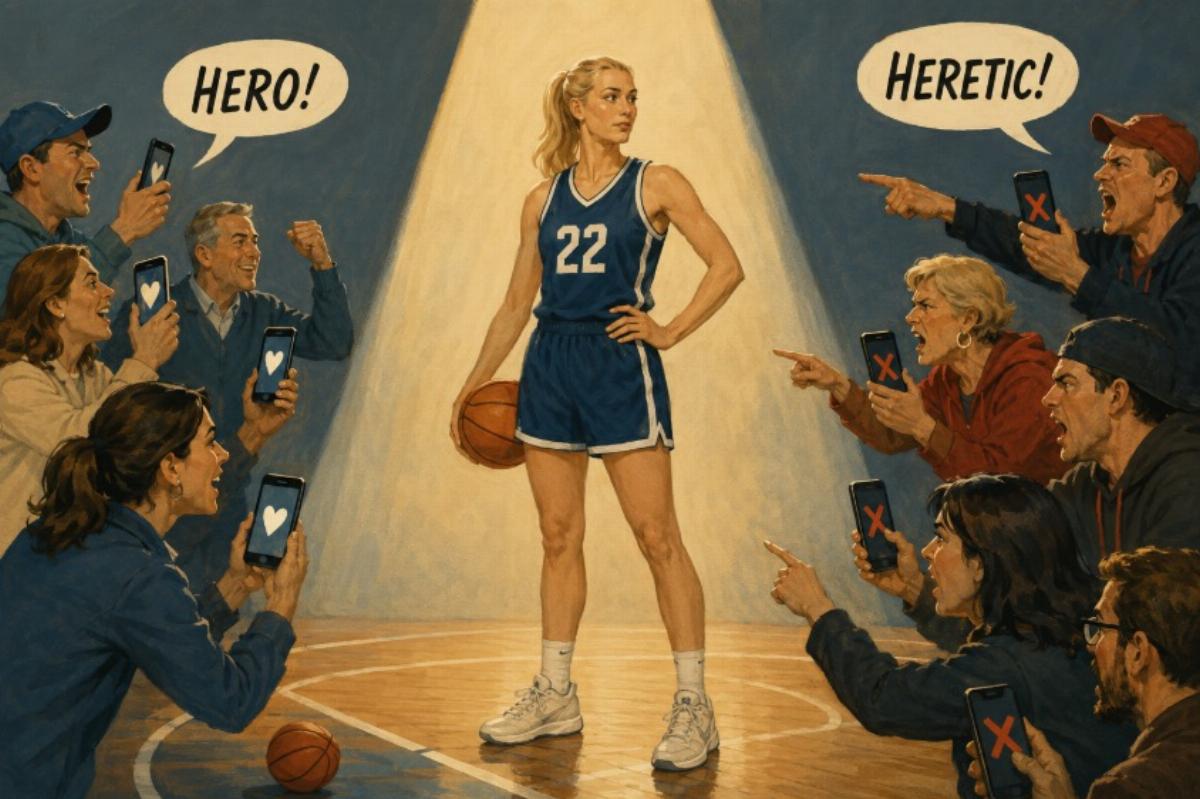
America has invented a new spectator sport, and unlike basketball, it requires no court, no referee, and no athletic ability. All it requires is a smartphone, a social media account, and the confidence to determine within seconds whether another person is defending civilization or destroying it.
Read more The Mohammunist Manifesto—The Promise of ‘Transitional Phase’ Slaughter
The arena changes every week. A university classroom. A corporate boardroom. A school board meeting. Now, apparently, it is a basketball court.
Sophie Cunningham did not become a national talking point because of a jump shot. She became one because she stepped into the most dangerous arena in modern America: a public debate where the correct answer has already been decided, and anyone who questions it risks becoming a character in someone else’s political theater.
That is how MAGA Barbie was born.
The Barbie part required little imagination. The internet saw a blonde professional athlete with the look and confidence associated with the famous doll and did what the internet does best: it created a character. The MAGA part was more complicated. A few assumptions about Cunningham’s politics, some attention to social media activity, and her outspoken views on women’s sports were enough for strangers to assign her an identity.
Cunningham herself has pushed back against being placed neatly into either political camp. She has described herself as somewhere in the middle and criticized the pressure to pick a tribe and accept the entire package that comes with it.
Unfortunately, nuance is terrible for the outrage economy.
The modern culture war has little use for people who say they agree with parts of one side and parts of the other. That does not produce a clean headline or a convenient hero. So, the machine simplifies. The right saw Cunningham as a woman willing to challenge an increasingly rigid cultural script. The left saw the same moment as another example of political conflict entering a league with a strong progressive identity.
The person disappeared. The symbol survived.
And that is where what I call the “Subaru Magoos” enter the arena.
The Subaru Magoo is a fascinating creature of modern cultural life. Like the legendary Mr. Magoo, this character possesses extraordinary confidence while displaying a remarkable inability to recognize what is directly in front of them.
The Subaru connection is not about mocking a car or the people who drive one. Subaru deliberately cultivated LGBTQ customers, particularly lesbians, in the 1990s, helping create the “Lesbaru” association that became part of American marketing lore.
The joke begins where the marketing ends.
The Subaru Magoos are the people who believe owning the symbols of tolerance automatically makes them tolerant. They can identify prejudice everywhere except when it appears wearing their own team colors.
They do not believe in censorship. That sounds too harsh. They believe in accountability. They do not believe in punishment. They believe in consequences. They do not believe in enforcing conformity. They simply believe society works best when everyone reaches the correct conclusions.
The Subaru Magoos have escaped tribal thinking because their tribe has better vocabulary.
The joke is not the vehicle. The joke is the certainty.
The Cunningham controversy ultimately landed on one of the most explosive debates in sports: what are women’s athletic categories designed to protect?
For decades, the answer was considered obvious. Women’s sports exist because biological differences between males and females can affect athletic competition. Separate categories were created because female athletes deserved a fair competitive environment.
Sports have always recognized physical differences. Nobody created weight classes in boxing because they hated larger fighters. Nobody created age divisions because they wanted to insult older athletes. Categories exist because reality exists.
The argument from supporters of sex-based athletic categories is straightforward: if biology matters everywhere else in sports, it cannot simply disappear here because the discussion has become politically uncomfortable.
That argument can be debated. It should be debated.
But modern America has developed a strange habit of treating some questions not as questions, but as violations. The offense is no longer simply having the wrong answer.
The offense is asking whether the official answer deserves examination.
That question turned the WNBA into another front line in America’s endless cultural conflict. The league already occupies a distinct political space, with many players and supporters embracing progressive activism. Cunningham’s position made her a disruption inside that environment.
The response was predictable. A game became a message. A shirt became a message. A sign became a message. A player became a message.
Read more Pete Hegseth cuts the fat out of a bloated, politicized Pentagon
Minnesota Lynx coach Cheryl Reeve wore a “Trans Kids Belong” shirt during a game involving Cunningham, framing it as support for transgender youth and a statement about inclusion. Cunningham continued defending her position that women’s sports should protect biological female athletes while rejecting the idea that her position came from hatred.
And there it was: the great modern American contradiction.
Everyone claimed to be defending humanity. Everyone claimed to be defending fairness. Everyone claimed the other side was the threat.
The basketball almost became an inconvenience.
Crowd reactions, flags, boos, and online battles turned every possession into a symbolic conflict. Nobody was simply watching anymore. Everybody was auditioning.
Then, because apparently the writers of modern America had not yet reached the absurdity limit, former NBA player Enes Kanter Freedom announced his intention to enter the 2027 WNBA Draft.
The announcement was satire, protest, and cultural grenade all at once. It was designed to highlight what critics see as contradictions in modern identity politics and the increasingly complicated arguments surrounding categories, inclusion, and competition.
The reaction was immediate. Some laughed. Some were furious. Some debated whether the joke itself violated the rules of the debate.
Somewhere, a committee probably began drafting a statement explaining that the situation was both incredibly complicated and completely obvious.
And that is where the MAGA Barbie and Subaru Magoo saga reaches its logical conclusion. Everyone wanted a symbol, and everyone got one.
The right got what it wanted: proof that the rules of modern identity politics become remarkably flexible when someone from the other side starts asking uncomfortable questions.
The left got what it wanted: proof that political opponents were willing to turn any controversy into a larger ideological battle.
The internet got what it always wants: another argument.
The media got another headline.
And the basketball sat quietly in the corner, wondering when everyone planned to return to the sport.
That may be the real tragedy of the modern culture war. It takes complicated human beings and turns them into cardboard characters. It takes debates that deserve serious discussion and transforms them into morality plays where everyone already knows who the heroes and villains are supposed to be.
MAGA Barbie was never really about Sophie Cunningham. The Subaru Magoos were never really about a car.
They are characters in a much larger American production where everyone is fighting over the microphone while pretending they are not standing on a stage.
The culture war’s newest sport is not basketball. It is hunting for heretics in sneakers. And judging by the crowds, America has already renewed the season.
P.S. Apparently the show is not over. The WNBA is holding meetings to figure out what the “W” in WNBA stands for, having apparently forgotten why they put the damn thing there in the first place.
Image created using AI.
Luis Gonzalez writes on power, politics, and the systems that quietly shape everyday life. Gonzalez owns and publishes The Last Wire, his online home for news, opinion, and the rabbit holes beneath the headlines. He also continues to publish at Boiling Frogs, the personal blog he launched in 2008.
Read more America’s AI lead depends on unleashing innovation