
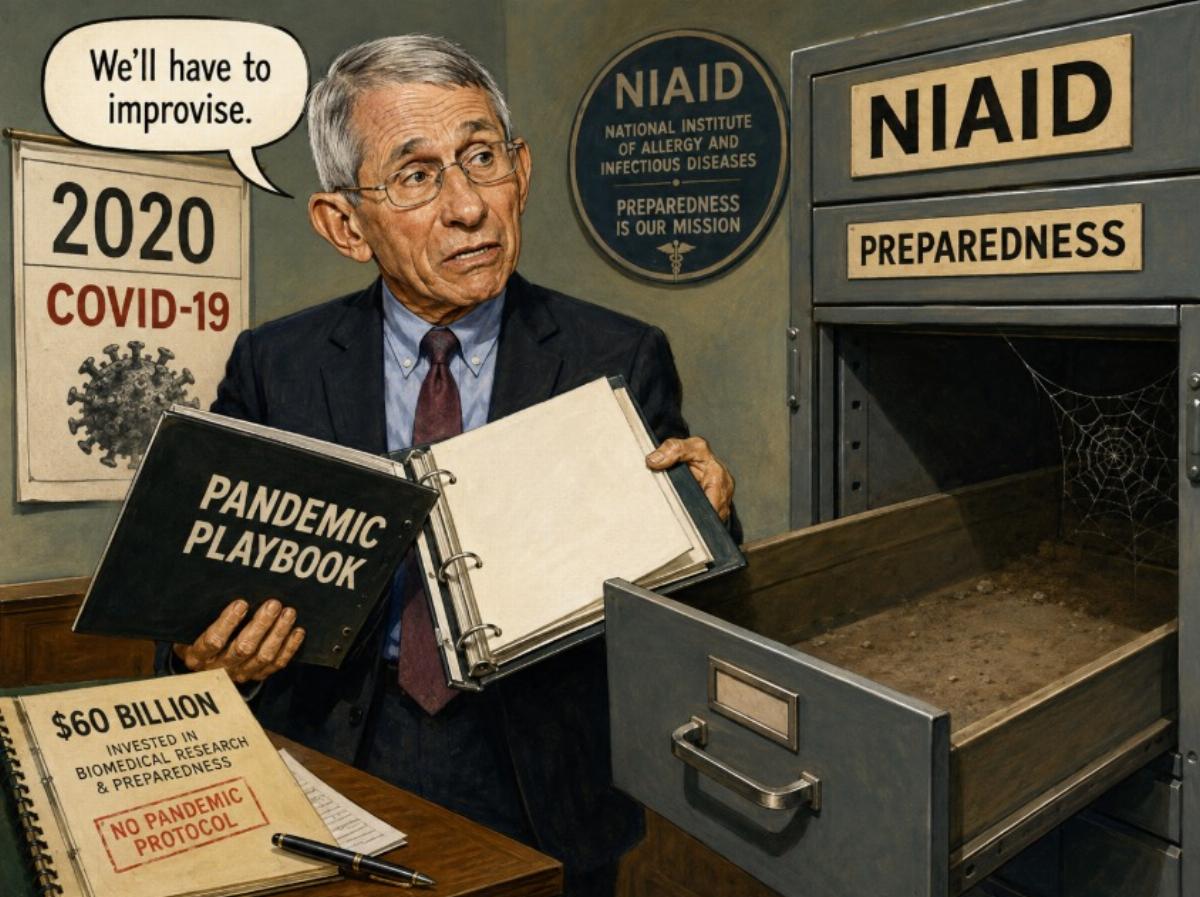
An unanswered first-order question from the COVID-19 pandemic is this: Why was America’s pandemic doctrine in 2020 apparently so lacking after nearly forty years under Dr. Anthony Fauci’s leadership and after spending more than $60 billion preparing for the next inevitable outbreak?
Read more The radical left’s ‘good Jew’ will not be safe
Dr. Fauci served as Director of the National Institute of Allergy and Infectious Diseases (NIAID), one of the nation’s premier public health institutions. His responsibilities extended far beyond supervising laboratory research.
He oversaw billions of taxpayer dollars in infectious disease research as far away as Wuhan, China; advised presidents of both parties; helped shape America’s response to emerging diseases; and was, for all practical purposes, the country’s chief guardian against the next inevitable pandemic.
When COVID-19 arrived, that system should have been primed and ready.
Instead, America discovered that after decades of investment and preparation, the world’s leading public health institutions appeared to be improvising in real time. The virus may have been novel, but the government’s decision-making process should not have been.
That raises a question that has received almost no attention compared to debates over masks, lockdowns, vaccines, mandates, or even the virus’s origins.
Where was our pandemic playbook?
Military commanders hope never to fight a war, yet spend years developing doctrine, conducting exercises, and contingency planning. When conflict begins, commanders don’t start with a blank sheet of paper. They execute established plans, adapting as required.
Pandemics are no different.
COVID-19 was not the first infectious disease to threaten the United States. America had already confronted the influenza pandemics of 1918, 1957, and 1968, along with SARS, MERS, H1N1, Ebola, and Zika. Every outbreak presents unique challenges, but the organizational response remains remarkably consistent: How quickly can the pathogen be identified? How should evidence be gathered and evaluated? How should vulnerable populations be protected, and how should uncertainty be communicated to the public? And pointedly, how should recommendations evolve as new information becomes available?
One example involved age stratification. Evidence quickly accumulated showing that mortality risk was overwhelmingly concentrated among older Americans (93% of the deaths). Nevertheless, public policy continued to treat the risk as uniform.
This is why NIAID exists; its seminal mission is to make those distinctions, but it didn’t. America needed a scientifically grounded doctrine ready to guide decision-makers. Instead, Fauci improvised.
Dr. Fauci deflected by saying that COVID-19 was unlike anything modern medicine had previously encountered. That argument is weak, confusing biological novelty for institutional novelty. While pathogens differ, the fundamental requirements of pandemic response remain very consistent.
SARS-CoV-2 was new. Scientists initially had incomplete information about its infection fatality rate, the extent of asymptomatic transmission, how quickly it would mutate, and which interventions would prove most effective; that’s not unusual. The possibility that SARS-CoV-2 may have resulted from laboratory manipulation—or research-related activity—added a layer of uncertainty that could have been anticipated by an unprecedented 100,000+ researchers working on all aspects of the Pandemic.
A pandemic response plan is not a script, but a scientifically prescribed pathway to truth, even in the face of initial gaps in knowledge. Military doctrine is not discarded because an adversary introduces a new weapon. Fire departments do not abandon established procedures because every fire behaves differently. Likewise, public health should not have been reinventing fundamental decision-making processes amid a crisis.
COVID presented novel scientific questions but familiar organizational ones. Every Pandemic requires officials to determine how evidence will be gathered and evaluated, how uncertainty will be communicated, what standards of proof should justify extraordinary restrictions on daily life, and how vulnerable populations should be protected. Perhaps as many as 100,000 people died from the lockdowns themselves, not COVID!
Those are precisely the issues a vetted preparedness doctrine should have answered long before the first American case even appeared. Instead, Americans watched public policy unfold in daily press conferences frequently contradicting earlier guidance.
Read more Australia’s woke reverence for indigenous people misses a few things
Scientific certainty was frequently proclaimed and then discarded. Americans were repeatedly assured that ‘the science’ required specific actions, only to discover later that many recommendations rested on inaccurate or evolving assumptions, or judgments that were presented with certainty that was not justified.
The larger question is why so much appeared to be invented on the fly after decades of preparation. That institutional failure demands our attention.
Dr. Fauci became the public face of America’s pandemic response. He accepted that role willingly and, over time, became its central player. His public profile grew beyond anything previously associated with a career government scientist. Interviews multiplied, and a cult following acclaimed him “America’s doctor,” while critics increasingly viewed him as a political figure more than an independent scientific adviser.
Rather than remaining America’s chief scientific adviser, Fauci became its chief public spokesman. Scientists are expected to follow evidence wherever it leads, even when it contradicts previous assumptions. Public figures become invested in defending earlier statements, attempting to protect their credibility and image.
With a pandemic raging, growing questions about NIAID’s role in funding coronavirus research later became part of the broader debate over COVID-19’s origins, and gain-of-function research became public. The larger institutional issue is undeniable: Fauci was simultaneously helping direct the nation’s response while facing scrutiny over whether research funded through his institution may have contributed to the origins of the very virus he was tasked with fighting.
The appearance of such a conflict should have demanded extraordinary transparency. Instead, public confidence steadily deteriorated as questions surrounding coronavirus research, gain-of-function experiments, and the origins of SARS-CoV-2 remained unresolved or were reflexively dismissed rather than openly examined. Confidence in Fauci’s leadership plummeted.
Public confidence in scientific institutions suffered enormously, and rebuilding that trust will take decades. The tragedy of COVID-19 was not simply that Americans died. Every serious Pandemic claims lives. The deeper tragedy is that the nation entered its greatest public health crisis in a century without the coherent doctrine that decades of preparation should have produced.
The debates over masks, school closures, lockdowns, nursing home policies, vaccines, mandates, and the origins of the virus will continue for years. They should. Those decisions deserve careful examination.
But before asking whether individual policies succeeded or failed, Americans should ask a more fundamental question. What exactly did decades of preparation buy us?
If the answer is an improvised national response characterized by conflicting guidance, uncertain evidence, economic upheaval, and a profound loss of public trust, then something failed long before COVID-19 ever reached our shores.
History will ultimately judge Anthony Fauci. Fauci’s recent invocation of his Fifth Amendment rights 111 times during a congressional hearing left many questions unresolved. Regardless of the legal significance of that action, the American people deserve a full accounting of what happened and why.
What should not remain in doubt is this: America’s pandemic preparedness system failed us at the worst possible moment. Until that failure is honestly acknowledged and fully understood, the nation risks repeating the same mistakes when the next Pandemic inevitably arrives.
God Bless America.
Image created using AI.
Author, Businessman, Thinker, and Strategist. Read more about Allan, his background, and his ideas to create a better tomorrow at 1plus1equals2.com.
Read more The smiling butchery of it all