
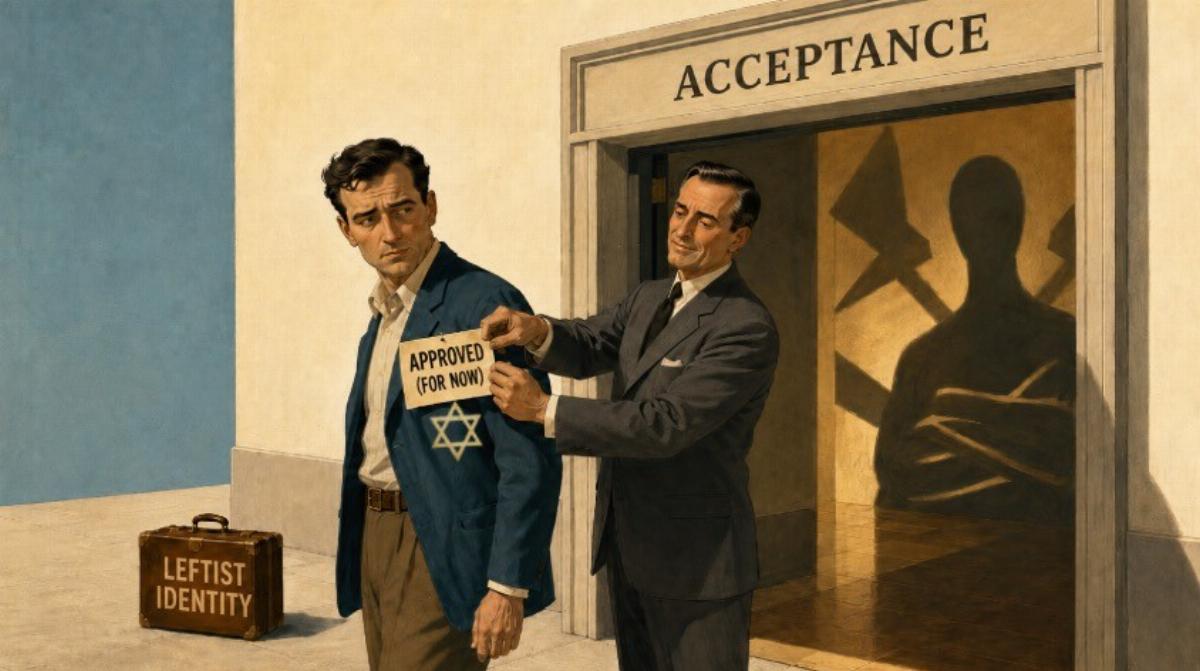
The radical left offers Jews a dangerous bargain. A Jew may remain welcome if he condemns Israel, rejects Zionism, and proves that his loyalty belongs to the movement before his own people.
Read more Australia’s woke reverence for indigenous people misses a few things
This acceptance comes with an ideological loyalty test. The “good Jew” must speak against Israel whenever demanded. He must treat Jewish fear as political manipulation and excuse hostility toward Zionists as a response to Israeli policy.
Some Jews comply because they share the ideology. Others may believe compliance will protect them. Their mistake is that history has already exposed this illusion, more than once.
In self-defense, the first serious failure often happens during threat recognition. A person sees warning signs and explains them away. He focuses on his own behavior while ignoring the intentions of the person approaching him.
Radical-left Jews are making this mistake at the community level. They remain preoccupied with Israel’s imperfections while a growing movement works to make Jewish sovereignty, Jewish strength, and Jewish self-defense morally unacceptable.
The anti-Israel campaign and modern antisemitism operate inside the same political ecosystem. They use familiar accusations about Jewish power, influence, disloyalty, and indifference to non-Jewish suffering. The word “Zionist” provides a socially acceptable way to direct these accusations at Jews.
Once Israel is described as uniquely evil, anyone connected to it becomes morally suspect. The target expands from the Israeli government to Israeli students, Jewish businesses, synagogues, hostage rallies, and American Jews wearing Stars of David.
I learned this personally when I was attacked in New York for being Jewish. My attacker did not ask for my background or beliefs. Whether I was a “good Jew” was irrelevant. As a self-defense instructor, I regularly meet Jews who began training after experiencing similar hostility.
The radical left still insists that anti-Zionism and antisemitism occupy separate political spaces. That separation rarely survives contact with reality. People chant against Zionists, then intimidate Jews. They condemn Israel, then vandalize synagogues. They celebrate attacks against Israelis, then accuse American Jews of supporting genocide.
Jewish participation gives this movement moral cover. A Jewish activist repeats the accusation, and the antisemite responds, “Even Jews agree.” The Jewish voice becomes a shield protecting the accusation from scrutiny.
Alan Dershowitz recently referred to “the 7,000 Jews who voted for Hitler in 1932” while warning Jews against supporting anti-Israel politicians. While that precise number cannot be confirmed through reliable election records, the historical pattern he invoked is documented.
Read more The smiling butchery of it all
The Association of German National Jews had several thousand members. It rejected Zionism, attacked other Jews as disloyal, opposed the international boycott of Nazi Germany, and supported Hitler’s rise. Its members believed their German nationalism would separate them from the Jews targeted by the regime.
The Nazis dissolved the organization in 1935. The Gestapo arrested its founder, Max Naumann. His military service, patriotism, rejection of Zionism, and support for Hitler changed nothing.
The Nazis saw a Jew.
The same political mistake has returned in progressive language. Some Jewish activists believe that condemning Israel will earn them an exemption from the hostility they are helping legitimize. Their approval lasts while their Jewish identity remains useful to the movement.
The exemption ends when the movement no longer needs Jewish permission.
The United States recorded 6,274 antisemitic incidents in 2025, according to the Anti-Defamation League. Physical assaults reached a record high. This increase developed while anti-Israel activism spread through universities, political organizations, professional institutions, and social media.
A broader alliance between radical-left activism and Islamist extremism has helped make hostility toward Israel socially fashionable. The groups involved hold different beliefs, yet Israel gives them a common enemy. Jewish anti-Zionists help present that alliance as principled.
Words shape what people believe is permissible. Describing Israel as a genocidal state makes hostility toward Israelis appear righteous. Describing Zionists as supporters of genocide makes targeting them feel justified. Since most Jews maintain some connection to Israel, the category eventually reaches the wider Jewish community.
A Jew may condemn Israel, reject Zionism, and denounce other Jews every day. The person searching for Jews to attack will still see a Jew.
The radical left’s “good Jew” receives temporary approval. He receives no immunity.
Image created using AI.
Tsahi Shemesh is an Israeli-American IDF veteran and the founder of Krav Maga Experts in NYC. A father and educator, he writes about Jewish identity, resilience, moral courage, and the ethics of strength in a time of rising antisemitism.