
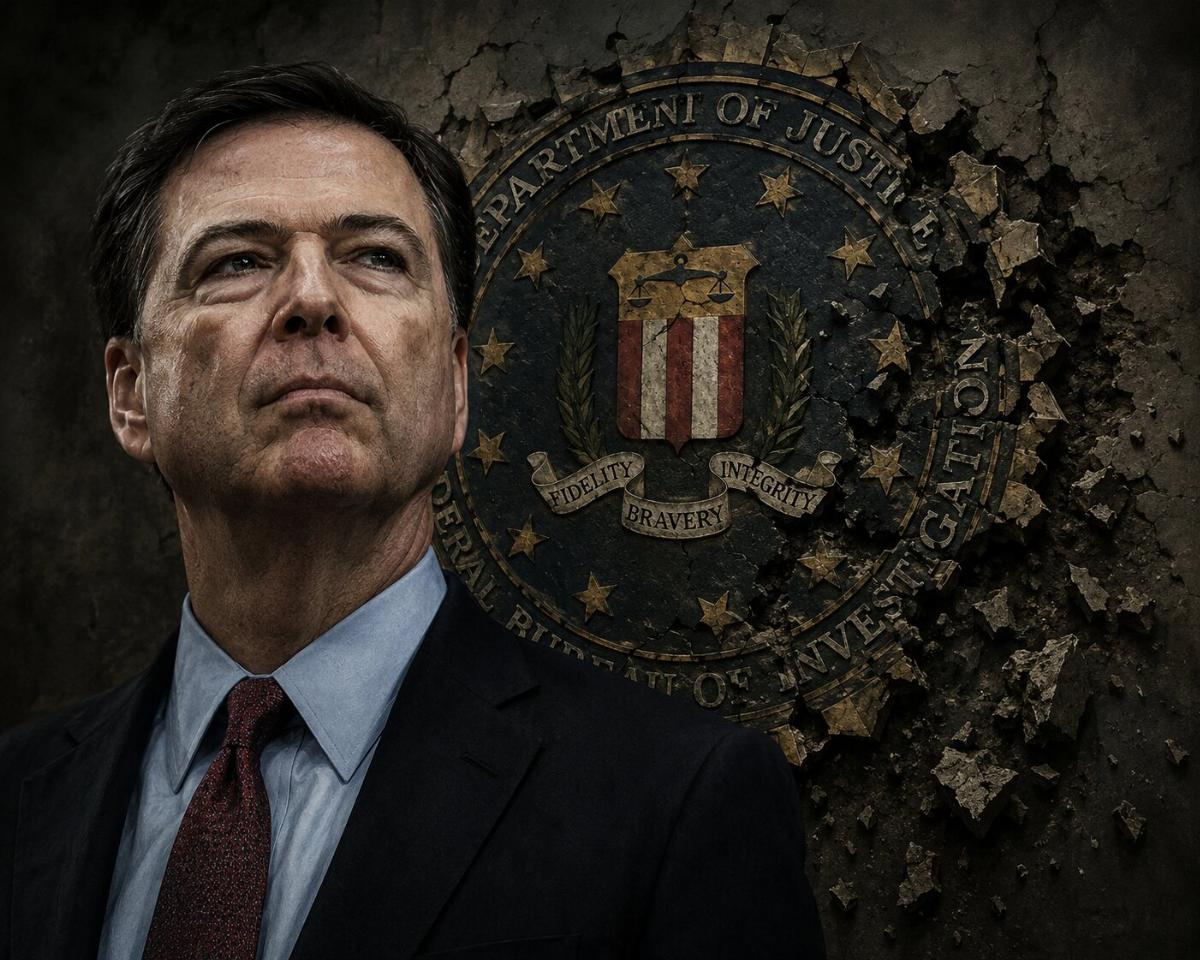
Newly declassified FBI memos confirm what keen observers long suspected.
In May 2017, mere days after President Donald J. Trump removed James Comey as FBI director, the bureau launched a full criminal investigation codenamed “Oxferd Comma.” Agents claimed the new president might have been acting as a Russian asset when he fired Comey.
Read more The State Department shames itself with a disastrous AI-created map
The opening communication declared an “articulable factual basis” that Trump “may be or has been, wittingly or unwittingly, involved in activities for or on behalf of the Government of the Russian Federation.” The stated goal was to determine whether he was directed or controlled by Moscow and whether he had obstructed justice.
This was not some cautious inquiry.
Acting Director Andrew McCabe and Deputy Attorney General Rod Rosenstein were notified at once. The probe was labeled a “sensitive investigative matter,” laughably described as the least intrusive approach available. It triggered the appointment of Special Counsel Robert Mueller and a nearly two-year inquisition that paralyzed Trump’s first term. Mueller’s team found no collusion, just as the FBI itself had failed to find any before him.
Oxferd Comma was quietly closed in April 2019 after Mueller submitted his report with no charges against the president.
The timing alone exposes the rot. Prior to Oxferd Comma’s launch, FBI personnel had spent nearly a year chasing the Trump-Russia fantasy. One of these agents, Peter Strzok, texted a colleague the same week that Oxferd Comma began, admitting his “gut sense” that there was “no big there there.”
Special Agent William Barnett, another participant in the first probe, eventually told investigators that his bureau had largely ruled out collusion involving the Trump campaign. Barnett even joked with colleagues that the whole effort resembled a warped game of Clue in which any connection could be twisted into “evidence.”
Worse, the original allegations had come from Hillary Clinton’s campaign.
The Christopher Steele dossier, paid for by Clinton’s lawyers, was already known to be a collection of unverified gossip and outright falsehoods. FBI analysts had systematically reviewed every claim and found most of them either invalid or impossible to confirm. Steele’s primary subsource, Igor Danchenko, told agents in early 2017 that much of what was attributed to him was mere hearsay. The FBI also knew Danchenko himself had long been suspected of ties to Russian officials.
Intelligence operatives had even warned the highest levels of government about Clinton’s plan months earlier.
In late July 2016, the CIA intercepted information that Clinton’s team intended to “smear” Trump by inventing a Russian conspiracy. CIA Director John Brennan briefed President Barack Obama, Vice President Joe Biden, and FBI Director Comey on that scheme in early August. This was just days after the bureau began investigating Steele’s claims.
Special Counsel John Durham later concluded there had never been a legitimate basis to open the original collusion probe at all.
Read more Julie, Julie, Julie do you love me?
The obstruction theory tied to Comey’s firing rested on equally thin ground. The Justice Department’s own inspector general later found that Comey had violated long-standing department rules in the Hillary Clinton email matter. This was the very reason Trump cited for his removal. Yet the FBI chose to treat the firing as possible proof that Trump answered to Vladimir Putin.
Democrats seized on the fiction and rode it for years.
In 2016, House Democrats demanded an FBI investigation into supposed Trump-Russia ties. In 2017, U.S. Senate and House leaders pressed for independent counsels and accused Republicans of stonewalling. In 2018, congressional Democrats vowed to keep the investigation alive after Republicans closed theirs. The blue team released its own report filled with recycled allegations.
Even after Mueller found no conspiracy in 2019, Democrat leaders dismissed the clear result and demanded more investigations.
The cost was enormous. For 674 days, most of Trump’s first term, the president governed under the constant threat of a special counsel digging through every aspect of his life and those of his aides. Policy stalled. Immigration law enforcement, healthcare reform, judicial confirmations, and a realistic approach to Russia as a counterweight to China all suffered. Careers were ruined. Public trust was shattered.
The Trump-Russia collusion hoax waged monumental public relations damage. It lasted for years, into the 2018 midterms and even the 2020 presidential election. In both cases, the relentless false narrative of a compromised president helped swing key results against Republicans.
That history is the clearest possible warning for the months ahead.
Democrats may regain the U.S. House or Senate, perhaps even both, this November. If restored to power, they will have every incentive to invent fresh crises, launch new witch hunts, and attempt once again to cripple Donald Trump’s presidency. They would also try sabotaging the broader Republican agenda heading into 2028.
The Oxferd Comma files prove the pattern. Only a decisive Republican turnout can break it. Do GOP supporters care enough to vote?
Dr. Joseph Ford Cotto is the creator, host, and producer of News Sight, delivering sharp insights on the key events that shape our lives. He publishes Dr. Cotto’s Digest, sharing how business and the economy really impact us all. During the 2024 presidential race, he developed the Five-Point Forecast, which accurately predicted Donald Trump’s national victory and correctly called every swing state. Cotto holds a doctorate in business administration and is a Lean Six Sigma Certified Black Belt.
Read more How professional baseball is killing itself
Image generated by ChatGPT.