
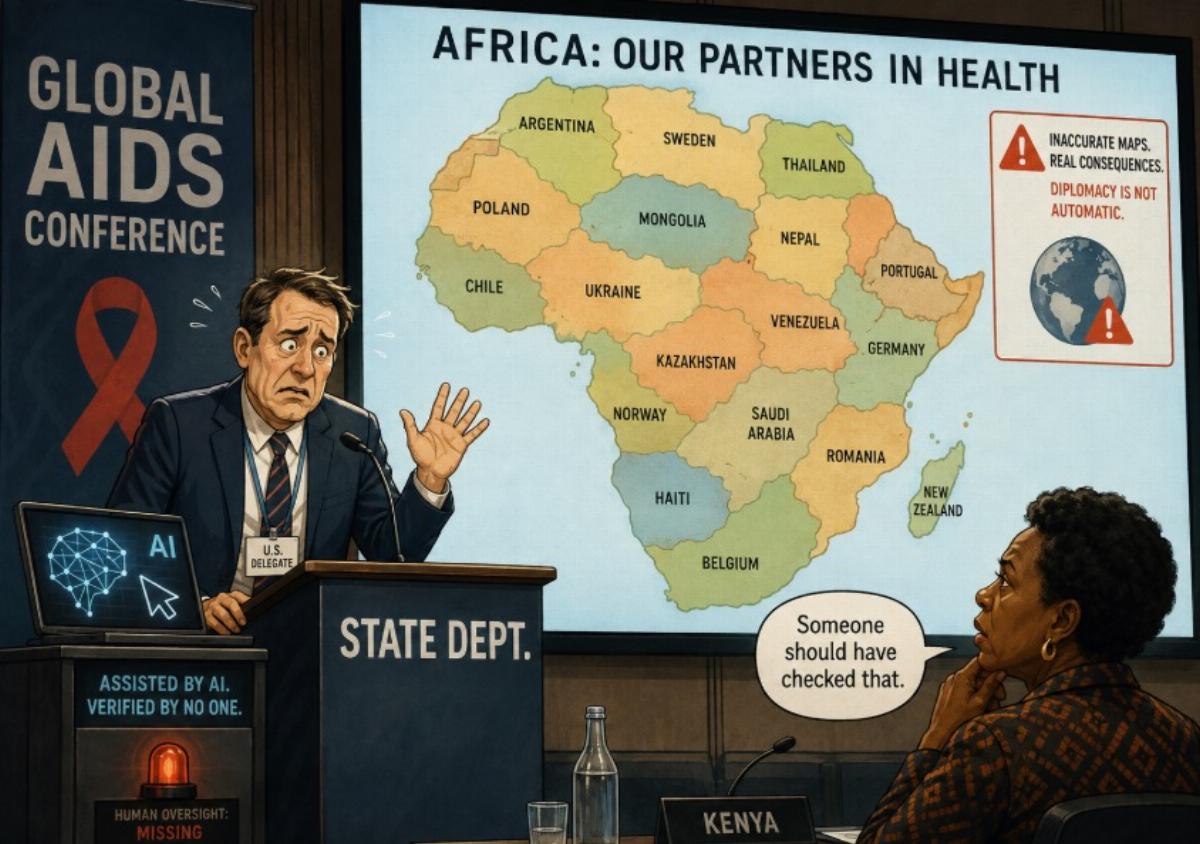
In an embarrassment for the U.S. Department of State, many news organizations reported on its map mistake, which was so significant that the story went global—as well it should have!
Read more Julie, Julie, Julie do you love me?
As Reuters reported,
A U.S. government map of Africa mislabeled every country during a State Department presentation at a global conference (on AIDS-editorial add) taking place in Brazil this week, causing a stir among attendees who took screenshots and posted them online.
The Times of Israel even picked up the story, focusing on the fact that the Department of State immediately took responsibility: “State Department takes full responsibility and apologizes for map that appears to have /been made with AI tools.” Of course! What choice did they have?
To use a cliché more often employed by the left than the right, this is a teachable moment because the map mislabeling was done in haste and was also significantly AI-empowered.
One would think that, with HIV being such a vicious, pernicious disease in Africa, much more care and quality assurance would have been devoted to labeling the map. Sub-Saharan Africa has about 15% of the world’s population, yet it also has the majority of people living with AIDS worldwide (an estimated 65%).
The fact that so many are living with AIDS, rather than dying from it, shows that, in this era of pandemic testing and modern medicine, AIDS is moving from a fatal disease to a more manageable chronic condition. This is the demonstrated value of such important conferences.
Whoever made such a globally visible fumble must be greatly embarrassed. Let us all hope it was made in haste because everyone reading this has had his or her own “Oh, s**t!” moment—just not on a global scale.
More concerning would be if this wasn’t a mere accident but was, instead, made out of ignorance because the staffer did not know the locations of Africa’s countries. If that were the case, then the Department of State has awful employment-screening protocols.
Read more How professional baseball is killing itself
At bottom, though, in today’s brave new AI world, the key component of the mistake was the use of AI tools. Just as the Department of War’s targeting cells rely on AI to assist in striking enemy targets, another Cabinet department has now learned a valuable lesson about AI’s strengths and weaknesses.
When the Department of War makes a mistake in battle, people die. When the Department of State makes a mistake on a global map, America could be drawn into a war.
This is why such a human-AI goof has tremendous teaching value: We must ensure that it never, ever happens again. Context in the great game of nations is everything. An AIDS conference is one thing, but making a smaller-scale mistake—mislabeling a borderline or a nation’s name, for example—can become a very dangerous signal about U.S. resolve. Such a human-empowered mistake has happened twice before. The first was a mistake that led to the Korean War:
What you don’t say can sometimes matter as much as what you do say. Secretary of State Dean Acheson learned that lesson when he spoke before the National Press Club on January 12, 1950. His failure to include South Korea within his description of the U.S. defensive perimeter in Asia came back to haunt him. Critics later charged that his failure to explicitly commit the United States to defending South Korea’s territorial integrity had invited North Korea’s June 1950 invasion that plunged the United States into the three-year long Korean War.
Decades later, another war was triggered by stupid words. It was widely reported at the time that our U.S. ambassador met with Saddam Hussein. U.S. Ambassador to Iraq April Glaspie met with Saddam Hussein on July 25, 1990, a week before Iraq invaded Kuwait. Her statement—noted in an Iraqi-released transcript—included the phrase: “We have no opinion on the Arab-Arab conflicts, like your border disagreement with Kuwait.” (Some contend, though, that the fault lay, not with Glaspie, but with protocols.)
So, if something good can come out of such a recent mistake, perhaps two things will occur. The human element will be addressed and corrected, and the use of AI will be subjected to mature, vetted, and validated oversight before it can create huge, unanticipated diplomatic signals.
Image created using AI.
While serving as a professional staff member for the House Committee on Rules, Ed Timperlake also served as staff secretary to the North Atlantic Assembly, the political arm of NATO.
Read more Don’t Confuse Urban Drug Addiction With Homelessness